



By the numbers, Milano Cortina 2026 was the biggest Winter Paralympics yet.
More than 600 athletes from 55 different national Paralympic committees competed in 79 medal events, spread across six different sports. More women than ever before competed at the Games.
And perhaps most importantly, more people than ever watched those athletes compete.
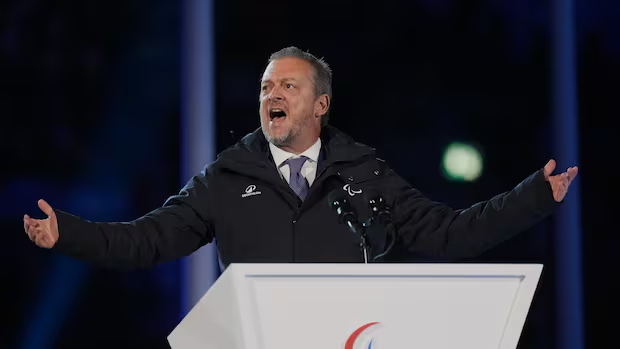
“We had an impressive number of 650 million video views of those Games in 14 days,” International Paralympic Committee (IPC) president Andrew Parsons said in an interview with CBC Sports’s Anastasia Bucsis. “This is more than the whole year of 2024 together, including the Paris [Summer Paralympic] Games period. It’s mind blowing.”
It comes on the heels of a record-breaking 2024 Summer Paralympics in Paris that shattered every metric the IPC tracks, including spectators, the number people watching at home, and the number people interacting with Paralympic content on social media.
But Parsons still sees a lot of room for growth, especially when it comes to elevating the profile of the Winter Paralympics and its athletes.
“Where we see this movement going is that in 10 years time, first of all, people will be excited for the Paralympics as a sport event,” Parsons said. “People will say, I want to go online, I want to see that final of wheelchair basketball or rugby, I want to see that track athlete. They will know these athletes by their names. They will be household names in their own countries.”
Adding more sports
Parsons would like to see more sports on the winter programme in 2030 and 2034.
There were 22 sports in the Paris Summer Paralympics in 2024, but only six sports in the Winter Games in Milano Cortina: Para alpine skiing, Para biathlon, Para cross-country skiing, Para ice hockey, Para snowboard and wheelchair curling.


The biggest gap comes on the ice. Parsons would like to see skating sports added by 2034, when the Games will be held in Salt Lake City.
“We are in early discussions with [the International Skating Union], with some of our friends in some of the future host cities to [see] how we can develop those sports in time to maybe have them at the Paralympics,” he said.
Another area Parsons would like to grow is the number of women competing at the Paralympics. While a record number of women competed in Milano Cortina (160), that only represented a little more than 26 per cent of the total competitors.
It’s another area where the Winter Paralympics lag behind — about 45 per cent of the athletes at the Summer Paralympics in Paris were women, according to the IPC’s figures.
Adding women’s Para hockey
Parsons would like to see women’s Para ice hockey added to the Paralympic programme as early as 2030, which would help push the Games closer to gender balance.
Women can compete in the Para hockey category now, but it’s dominated by men. Canada has never had a woman on its Paralympic hockey team.
To get there, Parsons said the sport needs more countries participating. There were six teams in the sport’s first world championship, which was held last year. That included a world team with athletes from several different countries.
“Obviously hockey is a sport that everyone knows Canada, U.S., you guys are very strong,” Parsons said. “So people will be looking for maybe the bronze medal in the first competition or something like that. But I think it’s more about creating more opportunities for females in winter sports.”

The president of the International Paralympic Committee shares his perspective on the next steps to add women’s para ice hockey to the Paralympic Games.
Last fall, Parsons called on more countries to fund women Para hockey, with the assurance that the sport will soon be on the Paralympic stage.
Hockey Canada doesn’t fund women’s Para hockey as a high-performance program. The national sport organization says it has a mandate from the federal government to operate national teams that compete in the Olympics and Paralympics, and women’s Para hockey doesn’t meet that criteria yet.
“We continue to work intently with World Para Ice Hockey and the International Paralympic Committee as they navigate the path towards inclusion of women’s Para hockey in the Paralympic Games programme,” Hockey Canada spokesperson Jeremy Knight wrote in a statement to CBC Sports.
“However, while this advocacy is ongoing, we continue to provide support for [women’s Para Hockey of Canada, WPHC] in a number of ways, which includes the Hockey Canada Foundation granting the organization $150,000 this season and Hockey Canada providing WPHC with over $25,000 in equipment and team gear in advance of the most recent Women’s World Para Ice Hockey Championship.”
The 23-year old joins Paralympic studio host Allison Lang for a powerful conversation where she shares her experience competing for Canada at the world championships for para women’s ice hockey. Plus, her thoughts on the fact that women’s para ice hockey not yet being included in the Paralympics.
Climate change and war among challenges
While this year’s Paralympics broke records, it didn’t come without challenges and controversy.
Calls mounted for the Paralympics, which typically follow the Olympics, to happen earlier in the season to avoid the warm, slushy conditions that are becoming increasingly common with a warming planet.
Global warming is a reality the organization needs to face, Parsons acknowledged.
“There are internal discussions in the [International Olympic Committee],” Parsons said. “We are part of those discussions.”
Several countries also boycotted the Milano Cortina 2026 opening and closing ceremonies, after athletes from Russia and Belarus were allowed to compete at the Paralympics under their flags in several alpine sports.
The decision was made by the IPC’s general assembly last fall, and drew condemnation from the Canadian Paralympic Committee.
“I would say it’s probably one of the most impassioned, emotional issues that has been on the floor in the general assembly for the last several years,” CPC CEO Karen O’Neill told CBC Sports earlier this year.
‘All In’, follows 3-time Paralympic medallist Tyler Turner as he connects with elite athletes to try their sport and prove that any sport can be for any body. Tune in to AMI-tv and AMI+, Thursdays at 8 p.m. Eastern, for All In!
Throughout the backlash, Parsons has stressed the need to separate the Paralympics from conflict and politics.
“What we tried was to keep the focus on the athletes and what they do in the field of play,” he said. “This was a little bit challenging in the buildup because the media and the governments of some countries are making some political statements, which again is in their right to do. What we tried to do is protect the athlete experience.”
It’s a tension that’s likely to arise again ahead of Los Angeles in 2028, in a Paralympic Games under the shadow of the Trump administration.
But Parsons hopes LA28 can be a vehicle for change in the way people with disabilities are perceived.
“We understand that there is a concern in terms of the current administration in the country, that diversity is not high on their agenda,” he said. “But we see that as an opportunity. We see exactly that the Paralympics could be a turning point in how diversity in that country is viewed, understood and even encouraged.”





