



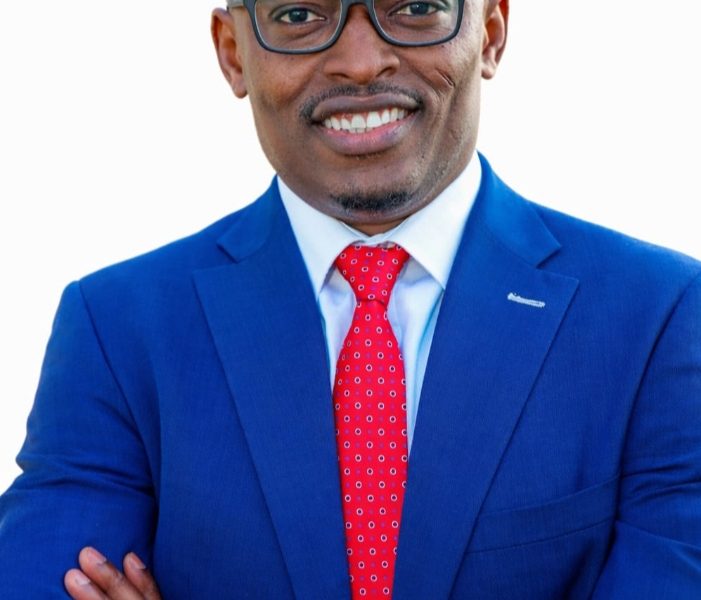
Delta ADC candidate, Dr. Emmanuel Unuafe
- Share
- Tweet
The governorship candidate of the African Democratic Congress (ADC) in Delta State, Dr. Emmanuel Usiwoghene Unuafe, a Project Management professor at Arden University, Coventry, UK, has unveiled an ambitious 14-point development agenda aimed at transforming the state into what he described as Africa’s leading sub-national economy between 2027 and 2035
Unuafe, whose campaign slogan is “For A New Delta,” said his administration would deploy the state’s oil wealth to drive investments in agriculture, industrialisation, infrastructure, digital technology, housing and human capital development rather than relying solely on federal revenue
According to a campaign document released by the candidate, his vision is “to transform Delta State into Africa’s leading sub-national economy – a globally competitive, technology-driven, industrialised and prosperous state where every citizen has the opportunity to thrive, every community is connected, and every family enjoys security, dignity and a better quality of life.”
The campaign document, which features Unuafe alongside his running mate, Kenneth Gbandi, states that “oil money must build farms, factories, skills, roads, ports, power, housing and digital jobs,” underscoring the campaign’s emphasis on economic diversification and job creation
Unuafe said his administration would prioritise the complete digitisation of government operations to improve transparency, efficiency and accountability. He pledged to establish a unified digital platform for revenue collection, budgeting, procurement, licensing, taxation and land administration while engaging digitally-savvy young professionals to build and manage the systems
On agriculture, the ADC candidate promised to reduce Delta’s dependence on oil by investing heavily in mechanised farming, agro-processing and agribusiness. He said the goal would be to improve food security, lower food prices, create rural employment and boost agricultural exports
The health sector, according to the blueprint, would receive significant investment through the establishment of functional primary healthcare centres in every ward, the upgrade of hospitals with modern equipment, digitise health records and the recruitment of more healthcare professionals
Unuafe also pledged major investments in infrastructure, including rural farm-to-market roads, improved urban road networks, modern traffic management systems and the development of rail networks linking the state’s three senatorial districts through partnerships with private investors
On security, he proposed the deployment of community-based CCTV surveillance systems, technology-driven crime prevention measures and faster emergency response mechanisms, while stressing that “no individual, regardless of status, will be above the law.”
The development plan also outlines a diversified energy strategy based on gas, solar, wind and waste-to-energy projects, alongside the transition of public institutions to alternative energy
To boost industrialisation, Unuafe said his administration would work with the Federal Government and private investors to revive key industrial assets, including Delta Steel Company, Delta Glass Company, Asaba Textile Mill, Koko Port, rubber manufacturing facilities and agro-processing hubs
The ADC candidate further promised reforms in education by equipping schools with internet connectivity, digital learning tools, modern laboratories and well-trained teachers, while integrating coding, artificial intelligence, robotics and digital entrepreneurship into secondary school curricula
His vision also includes expanding broadband infrastructure, establishing ICT innovation centres and revitalising technical colleges to equip young people with globally competitive digital skills
The blueprint outlines programmes to support women through grants, business development services, vocational training and access to finance, while proposing urban renewal projects, improved waste management, environmental sanitation, tree planting and modern drainage systems to create cleaner and more liveable communities
In the areas of culture and tourism, Unuafe promised to restore historical landmarks, develop riverine tourism, improve tourism infrastructure and promote cultural festivals and recreational facilities
He also pledged to establish sports academies across the state’s three senatorial districts, organise annual sporting competitions and create pathways for youth development through sports
For vulnerable groups, the plan proposes monthly stipends and free healthcare for senior citizens, free public transport for the elderly, legislation to establish care homes and maternity support initiatives for first-time mothers
Describing the blueprint as more than a political manifesto, Unuafe said it represents “a vision for building a Delta State where innovation drives government, agriculture feeds the nation, industries create jobs, infrastructure connects communities, technology empowers young people, and prosperity is shared by all
“Our mission is clear: to transform Delta State from a rey competitive economic powerhouse where every citizen has the opportunity to succeed. The Delta Renaissance begins now.”
Don’t Miss
Tinubu Unveils Honours’ List In 2026 Democracy Day Address


Politics
Tinubu Unveils Honours’ List In 2026 Democracy Day Address
3 weeks ago
on
June 12, 2026
By
NewTimes
President Bola Tinubu
Full Text Of President Bola Tinubu’s 2026 Democracy Day Address
Fellow Nigerians
Today, we celebrate democracy and the enduring Nigerian spirit. For 27 unbroken years, since May 29, 1999, Nigerians have chosen their leaders through the ballot, witnessed peaceful transitions of power, and resolved disagreements in courtrooms and legislative chambers—not through violence. We have experienced the longest stretch of civilian rule in our history. Our democracy is not perfect, but it is ours, and we must continue to defend and strengthen it
In the coming days, Ekiti and Osun States will hold elections. I urge INEC, security agencies, and all parties to ensure these polls are peaceful and credible
Democracy fails when citizens doubt the process. To our National Assembly, Judiciary, the Press, and Civil Society: you are the guardrails of our republic. Criticise me, disagree with me, but never stop believing in Nigeria
To our young people: Nigeria is your home and your future. Build here, code here, work here, and vote here. Every great nation was built by those who stayed to solve problems, not by those who abandoned ship
To our armed forces, police, and intelligence services: Nigeria salutes your sacrifice. To our traditional rulers, faith leaders, and community heads: thank you for your support of peace and reconciliation. The government cannot do it alone
Today, we honour the resilience of Nigerians who refused to surrender their faith in freedom, and the courage of those who stood firm against intimidation. We pay tribute to patriots who endured persecution, imprisonment, exile, and even death so that future generations could enjoy democracy. I salute labour leaders, journalists, activists, students, women, professionals, political leaders, and soldiers—both those who have passed and those still with us—for their patriotic contributions
Though this year’s mood is dampened by the abduction of our children in Oyo and Borno, we remain hopeful for their safe return. Democracy without security is not solid enough. That is why this administration declared a security emergency and approved the recruitment of more than 50,000 new police officers and thousands of military recruits. Our 2026 budget commits N5.41 trillion—our largest ever—to defence and security. Our administration is ever ready to do much more to secure our people.
We have moved from training with our allies, the United States, France and other European countries, to precision targeting. In Arege, Borno State, we degraded ISWAP’s command centre. Terror-related deaths are down by 81% since 2015. Over 13,000 terrorists have been neutralised in the past year. But we also keep the door of surrender open. Over 124,000 fighters and dependents have laid down their arms since 2023 through Operation Safe Corridor
To bandits, kidnappers, and sponsors of terror: Surrender or face the full force of the Nigerian State. These windows of surrender will not remain open forever. No mercy will be shown to those who trade in the blood of Nigerians
At a time like this, let us not assign blame or point fingers. Crime has no ethnicity. We must stand united and be assured that the enemies of our nation shall soon be history. We will triumph over terror and continue to build a more prosperous nation
June 12 occupies a sacred place in our national memory. It represents more than an election; it is a defining chapter in our story. We remember Chief M.K.O. Abiola, who won a pan-Nigerian mandate transcending ethnicity and religion. We remember Alhaja Kudirat Abiola
We also remember Chief Gani Fawehinmi, Chief Bola Ige, Chief Alfred Rewane, Pa Abraham Adesanya, Chief Anthony Enahoro, Alhaji Balarabe Musa, Commodore Dan Suleiman, Dr Beko Ransome-Kuti, Frank Kokori, Arthur Nwankwo, Chima Ubani, Shehu Musa Yar’Adua, and the many other heroes and heroines of democracy whose sacrifices helped secure the freedoms we enjoy today
As beneficiaries of their struggle, we have a duty to strengthen and deepen the democratic institutions for which they fought. The greatest tribute we can pay is to build a Nigeria where freedom is protected, justice is upheld, opportunity is expanded, and government is accountable
June 12, 1993, revealed the possibility of a true Nigerian nation. The heroes of June 12 secured political freedom. Our challenge is to secure economic freedom. Democracy must be felt in the quality of people’s lives—in opportunities for youth, in prosperous farmers, successful entrepreneurs, and the dignity of our workers
The reforms we are undertaking were not chosen for ease, but for necessity. Three years ago, our public finances were under severe strain, investment was discouraged, and economic uncertainty threatened our future. We chose to act, embracing reforms to advance Nigeria’s economic freedom
Since 2023, our reforms have restored stability and credibility to economic management. Federation revenues have risen, providing states and local governments with more resources for infrastructure, education, healthcare, and security. Fiscal transparency has improved, leakage has been reduced, and public funds are better directed to national priorities. Investor confidence has returned, with investments in agriculture, energy, manufacturing, technology, mining, transportation, and the creative industries growing.
Domestic refining capacity has increased, strengthening energy security and reducing our reliance on imported petroleum products
By 2023, when we came on board, the electricity sector was characterised by chronic generation shortfalls, an unreliable gas supply, and transmission infrastructure so fragile that it could not evacuate available power. Distribution companies were burdened by massive losses and a metering deficit of over four million. Worst of all, the value chain was drowning in legacy debt. The result was a sector that generated less than the 13,500 Megawatts installed capacity, a sector that transmitted less than it generated, distributed less than it transmitted and collected revenue far below what it needed to sustain itself.
To address the problems besetting the sector, I signed the Electricity Act, which grants states authority to generate, transmit, and distribute power. The Presidential Power Sector Task Force is working hard to reduce the metering deficit. It has also been authorised to raise N4 trillion bond to settle verified legacy debts. The Rural Electrification Agency, supported by the World Bank and the African Development Bank, has deployed off-grid and mini-grid power to underserved communities, universities, markets, and hospitals. Electricity is a democratic dividend we owe every Nigerian. We intend to deliver it.
Across the country, infrastructure projects are connecting producers to markets and creating opportunities for enterprise and employment. The National Agricultural Development Fund is deploying 10,000 tractors over five years. Over 1,000 SMEs have been certified for export. Non-oil exports grew by 21% last year
Yet, many Nigerians still face economic hardship. We remain focused on reducing inflation, expanding food production, creating jobs, improving living standards, rebuilding confidence in our economy, and creating conditions for sustainable prosperity
We are moving from uncertainty to stability. The next phase is about accelerating growth and ensuring the benefits are felt in every home, every community, and every region. We believe that Democracy must be felt in the pocket
Recognising that democracy is undermined when people do not feel its impact, my administration has sought financial autonomy for our 774 local councils. A fundamental challenge to our nation’s advancement has been ineffective local government administration. The insecurity we are addressing is partly due to the collapse of grassroots governance. The Renewed Hope Agenda is about ensuring that all Nigerians benefit from governance
Every generation has a defining responsibility. The generation of our founding fathers secured independence—the generation of June 12 secured democracy. Our generation must secure prosperity
Let us move forward together—rejecting division, cynicism, and despair; embracing unity, hope, and confidence. Let us build a Nigeria united by a common purpose, strengthened by diversity, where justice is accessible, liberty is secure, and opportunity is abundant
Among the architects of modern democratic Nigeria, we honour General Shehu Musa Yar’Adua for his vision of national partnership. In recognition of his contributions, the Federal Government has approved the revitalisation and renaming of the completed Institute of Petroleum Studies, Kaduna, as the General Shehu Musa Yar’Adua University of Geological Sciences and Engineering Technology
I am also pleased to announce national awards to the following Nigerians, who suffered persecution, endured indignities, exile, incarceration, and, at times, solitary confinement, so that we have democracy today
Barrister Ayoka Lawani
Tunde Fagbenle
Oladele Alake
Olatunji Bello
Louis Odion
Segun Babatope
Sam Omatseye
Sir Ademola Osinubi
Bola Bolawole
Lade Bonuola
Femi Kusa
Debo Adeniran
Chief Ayo Opadokun
Chief Ralph Obiora
Ose Osayande
Barrister Osa Director
Prof. Sylvester Odion-Akhaine
Dr Arthur Nwankwo (Posthumous)
Dr Osagie Obayuwana
Dr Joe Okei-Odumakin
Barrister Titus Mann
Joe Igbokwe
Richard Akinnola
Ben Charles-Obi (Posthumous)
George Mbah
Dr Niran Malaolu
Major-General Ishola Williams (rtd)
Femi Aborisade
Jenkins Alumona
Gbemiga Ogunleye
Muyiwa Adekeye
Babajide Kolade-Otitoju
Ike Okonta
We also recognise the soldier-democrats of the June 12 struggle:
Major General MA Garba
Brigadier General Lawal Jaafaru Isa
Col Umar Farouk Ahmed;
Col Sambo Dasuki;
Col Lawan Gwadabe;
Brigadier Jonathan Ndam Temlong
Col Musa Shehu;
Major General Chris Eze;
Major General Harris Dzarma;
Col Isa Jibrin;
Maj. General Joseph Oshanupin;
Col Olusegun Oloruntoba, Olugbede of Gbede Kingdom)
Lieutenant Colonel Happy Kefas Bulus
Col J Okai;
Col Emmanuel Ndubueze;
Lt Col Yakubu Muazu
Brigadier Yahaya Abubakar, the Current Etsu Nupe, who is already the holder of the CFR title.
The honours list will be released in the next few days
Fellow Nigerians, 27 years ago, many doubted democracy would survive here because of our diversity. Today, our diversity sustains our democracy. The road ahead is steep. But June 12 reminds us: Nigerians do not break. We bend, we bleed, but we do not break
Let us renew our covenant: That the labours of our heroes past shall never be in vain, and that government of the people, by the people, for the people, shall not perish from this land
May God bless the heroes of our democracy. May God bless the Federal Republic of Nigeria. May God continue to bless us all
Happy Democracy Day
BOLA AHMED TINUBU, GCFR
President and Commander-in-Chief of the Armed Forces
Federal Republic of Nigeria
Continue Reading
Politics
ADC And New Framework Of Electoral Campaign
Published
2 months ago
on
May 15, 2026
By
NewTimes
Dr Salihu Moh. Lukman
By Salihu Moh. Lukman
Since the beginning of initiatives to form a coalition of opposition political leaders, there have been legitimate public demands about what is the ideological orientation of those forming the coalition. Many have argued that leaders of the opposition are not different from APC leaders. The reality that most of them were at some point also members of APC was further used to contest the legitimacy of the assertion that the coalition initiative will rescue Nigeria from the current downward slide, which has eroded living conditions of citizens to a level far below what anyone could have ever imagined.
Many leaders and apologists of the APC tried desperately to dismiss the coalition initiative. Many wanted to push the initiative into making some policy declarative statements. Issues of subsidy removal, exchange rate management, rising unemployment, inflationary pressure, etc. were certainly challenges requiring clear responses. Notwithstanding, coalition leaders remained focused and choose to facilitate negotiations to produce agreements among leaders. This is the main reason why on July 29, 2025, Sen. David Mark, while assuming office as the new ADC National Chairman announced the plan to set up a 50-member policy committee.
Eventually, the committee was constituted and inaugurated on February 2, 2026, with Chief John Odigie-Oyegun and Prof. Pat Utomi as Chairman and Deputy Chairman respectively. A month later, on March 2, 2026, the committee submitted its report with two documents attached – Manifesto and Policy Principles. The ADC National Convention of April 14, 2026 considered and adopted both the ADC Manifesto and the Policy Principles. The thrusts of both the ADC Manifesto and Policy Principles were founded on three pillars – First, ‘that every policy, from economic reform to security to social protection, must be measured by its impact on citizens.’ Second, ‘that Nigeria’s challenges are structural and require coordinated, institutional solutions, not ad hoc interventions.’ And third, ‘that reform is necessary, but it must be sequenced, supported, and humane, ensuring that Nigerians are not pushed further into hardship in the process.’
With focus on twelve sections, the ADC Manifesto is founded on the principles that ‘the Nigerian state must be reconstructed to serve the Nigerian citizen.’ The twelve sections are (i) agriculture; (ii) economy;(iii) energy; (iv) environment; (v) mineral re foreign policy; (vii) governance and rule of law; (viii) health; (ix) human capital and social protection; (x) productivity and industrialisation; (xi) infrastructure and transport; and (xii) security
While the Manifesto is specific in terms of outlining what ADC governments at all levels will do, the Policy Principles is more detailed containing diagnosis of where we are in each section and prescribing key policy initiatives of ADC governments to tackle challenges. For instance, a major diagnostic of the agricultural sector is that it is ‘operating under severe structural stress: rising production costs, falling farm-gate prices, insecurity in food producing areas, weak technology adoption, and climate pressure. A key consequence is growing reliance on imports to fill domestic gaps.’ To address the challenges identified, the Manifesto commits ADC to ‘make food security a national security priority’ based on which the Policy Principles outlined thirty-four recommendations covering smallholder-centred food security and price stability, all-season agriculture through irrigation and water asset optimisation, agricultural mechanisation and productivity benchmarking, zero-based and performance based budgeting, agricultural transformation for food security and growth, etc.
On governance, the Manifesto commits ADC to ‘put citizens at the centre of governance’ based on which the policy principles outlined twenty-eight recommendations to address challenges covering rule of law and a zero-impunity state, independent electoral management free from executive control, performance audits and value-for-money governance, subsidiarity and fiscal responsibility, living wage, tripartite labour governance and productivity alignment, etc
In the area of education, the Manifesto commits ADC to ‘declare state of emergency on education’, based on which the Policy Principles outlined sixteen recommendations to address challenges covering people-centred development, universal access to quality education, system-wide education reform, national workforce development strategy, a right-based social protection, disability inclusion, integrated poverty reduction strategy, decentralised social protection delivery, etc
Similarly, the Manifesto commits the ADC to ‘prioritise preventive healthcare’ based on which the policy principles outlined twenty-one recommendations to address challenges covering health as national productivity and security policy, primary healthcare centre (PHC) as the foundation of universal health coverage, universal coverage through insurance expansion and risk pooling, PHC under one roof with clear accountability, workforce retention as a national emergency priority, national disease surveillance and emergency response readiness, health equity for vulnerable population, etc.
To address the security challenges facing the country, the Manifesto commits ADC to ‘operate a security framework across four coordinated levels’ – local-level intelligence, state-level prevention and deterrence, national-level coordination and enforcement, and regional-level collaboration. To achieve that the Policy Principles outlines nine recommendations covering statutory intelligence coordination as the backbone of national security, federal subsidiary and decentralised policing under national standards, police professionalisation, demilitarisation, and rights-based enforcement, independent oversight and internal accountability across security agencies, adequate manpower, modern training, and professional renewal, technology-enabled border governance and territorial control, etc.
On the economy, the policy thrust is ‘to achieve sustained economic growth with high job creation, moving Nigeria away from an economic model dominated by consumption fuelled by rent extraction from a challenged oil-dependent structure, towards a production-driven economy built on the factor endowments of the country’s geopolitical zones.’ With a focus on ‘unlocking regional productive capacity through structured value chains linked to each zone’s comparative advantages’ the commitment of the ADC is to ‘prioritise development of regional value chains that integrate agriculture, manufacturing, logistics, technology, and services, ensuring that raw materials produced in each region are processed and transformed domestically before export.’
Acknowledging that ‘Nigeria’s economy faces deep structural pressures that threaten long-term stability and prosperity’, the manifesto made nine policy commitments aimed at ensuring that‘macroeconomic stability must protect people, not just markets; gradual and sequenced reforms with social cushioning; coordinated fiscal and monetary policy for full employment; exchange rate stability through managed flexibility; debt sustainability as a social and economic imperative; social protection as a core component of economic reforms; survival income must not be taxed; progressive taxation and fair contribution; and tax simplification and harmonisation.’
Specifically, the ADC manifesto commits its elected representatives to ensure that ‘economic stabilisation must protect purchasing power, support job creation, reduce hardship and expand opportunity.’ In clear terms, ADC ‘rejects shock-therapy reform with commitment to implement economic reforms gradually, with clear sequencing, social impact assessment, and robust protection for vulnerable populations.’ In the are of social protection, ADC commits itself to ‘integrate social protection directly into macroeconomic reform. Cash transfers, targeted subsidies, and stabilisation mechanisms will be treated as essential parts of economic policy during periods of adjustments.’
In all the twelve areas, the new ADC Manifesto adopted on April 14, 2026 made clear commitments based on which the Policy Principles outlined detailed implementation recommendations. Part of the consideration towards popularising both the Manifesto and the Policy Principle is to unveil the two documents – Manifesto and Policy Principles –to members of the party and the general public. This is being delayed because the party leadership has to prioritise sorting out legal challenges. If not for those legal challenges, aspiring ADC candidates for 2027 elections would have received copies of both the ADC Manifesto and Policy Principles together with their nomination forms. And perhaps, the screening process would have largely been centred around testing the capacity of aspirants to develop corresponding initiatives to handle the responsibilities attached to offices to which they are aspiring.
Be that as it may, the leadership of the party will unveil both the Manifesto and the Policy Principles and will take necessary steps to organise induction or orientation programmes for candidates of the party to ensure that they are committed to implement promises being made based on outlined recommendations. Given that manifestos of political parties in Nigeria are reduced to archival materials, the need for ADC to undertake induction or orientation of its candidates for 2027 to ensure that they are committed to implement promises based on outlined recommendations is necessary. To a large extent, such induction or orientation programme would be a critical determinant towards building the confidence of Nigerians in the party and its candidates.
Noting that one of the big disappointments of Nigerians with the APC is how after winning the 2015 elections, the party abandoned its manifesto and almost all the electoral promises made in 2015, it is important that the ADC demonstrates strong commitment to implement promises being made. One of the shortcomings of the APC was that the tasks of running governments returned to business-as-usual at all levels since the emergence of APC as the ruling party in 2015, with most elected and appointed APC leaders left to exercise discretionary initiatives with hardly any bearing on commitment made in the APC manifesto. The Renewed Hope initiative of President Bola Tinubu is one of those discretionary initiatives. The majority of elected and appointed APC leaders since 2015 never study provisions of the APC manifesto. The few that may have gone through the manifesto hardly use the commitments and recommendations contained in the APC manifesto as a guide towards managing the responsibilities of the offices they are elected or appointed to.
Therefore, notwithstanding all the legal and political distractions, ADC leadership is committed to introducing a new framework of political campaigns for 2027. The new framework as a matter of necessity is about developing stronger commitment by elected and appointed ADC leaders to manage responsibilities based on commitments enshrined in the ADC Manifesto and Policy Principles. This new framework is about putting in place measurable initiatives based on which ADC governments at all levels can be assessed, which should be led by the party’s presidential candidate. Given that there is enough time between the emergence of candidates and the 2027 general elections, the party leadership will put in place an engagement framework for all its candidates to produce corresponding commitment towards implementing recommendations to deliver on campaign promises. Invariably, both the national leadership and the presidential candidate of the party will drive the process of producing the new initiative.
If ADC is to succeed in producing the new framework of collective leadership, how the party is able to develop this new framework based on strategic initiative to undertake induction and orientation of ADC candidates for 2027 elections is important. The overarching objective of the ADC induction or orientation programme should prepare ADC candidates at all levels to produce the envisioned strategic shifts from politics as rhetoric to governance as delivery, from state capture to citizen- centred institutions, from centralised dysfunction to structured decentralisation, from consumption vulnerability to productive capability, from reactive crisis management to prevention and resilience, and from elite-only policy making to grounded consultations and legitimacy.
One of the commitments outlined in the ADC Policy Principles is entrenchment of ‘manifesto compliance as a governance norm.’ This is an issue that requires the leadership of the party such that all ADC-elected and -appointed officials must be subordinated to the party. Party leaders must have the requisite capacity to oversight elected and appointed ADC officials.This cannot be achieved by mere declarations. Painstaking initiatives would be required to enable party leaders develop the needed capacity to oversight both elected and appointed officials. At the same time, party candidates must develop the right orientation and culture to use the manifesto as governance norm.
Nigerians are anxiously looking forward to a situation whereby politicians can be held accountable to electoral promises they made ahead of elections. This is an area that should distinguish the ADC from the APC and other parties in the country. The decisions of Nigerians to vote for the ADC in the 2027 elections would be earned based on the emergence of the new framework that commits candidates of the party to deliver on electoral promises made. This point was emphatically made by the ADC National Chairman, Sen. David Mark when he emphatically stated at the National Summit of Opposition Political Parties in Ibadan on April 25, 2025 that ‘the very survival and restoration of our country, is greater than every single one of us. It involves sacrifice by every member in the opposition.’
The new framework to guide the delivery of promises being made must prepare ADC leaders and candidates ahead of the 2027 elections to be ready to make needed sacrifices to achieve envisioned objectives outlined in both the ADC manifesto and the Policy Principles. It is the emergence of transparent initiatives to commit ADC leaders and candidates to implement recommendations that will make Nigerians to develop strong belief in the capacity of the party to deliver on its promises
The new framework for electoral campaign will produce a qualitative shift that ensures that ADC candidates for the 2027 elections at all levels are committed to implement provisions of the party manifesto and the Policy Principles. Integral to the new framework is the corresponding development of institutional capacity by the party to oversight elected and appointed ADC representatives in government at all levels. The ability of the party to oversight elected and appointed representatives is what is required to ensure party supremacy and hold governments produced accountable to the party.
This is what ADC and the coalition of opposition political leaders represent. This is what the commitment to rescue Nigeria represents and is what will be fully unfolded once candidates of the party for the 2027 elections emerge. Invariably, this is what will endear the ADC and its candidates to Nigerians and is what will produce the electoral victory for the party. With elected and appointed representatives committed to implementing the ADC manifesto, Nigeria shall rise and shine!
Continue Reading
Politics
You Can’t Run Away From Yourself – Open Letter to Dr. Rabiu Musa Kwankwaso
Published
2 months ago
on
May 3, 2026
By
NewTimes
Dr Salihu Moh. Lukman
By Salihu Moh. Lukman
Your Excellency, I read a statement credited to you being clarification of your position on your considered defection, which you described as ‘realignment within the African Democratic Congress (ADC) due to the current challenges facing the party.’
Although you call it ‘misleading narratives in the public domain’, the statement basically confirmed that you ‘have commenced wide-ranging consultations – including with leaders from the NDC, PRP and others to explore the best options for protecting our democratic interests.’
Sir, I decided to write this open letter to you to address this issue because it would appear that, perhaps on account of a combination of overconfidence and also assuming that leaders can take any hasty decision and get away with it, the destiny of the country and innocent citizens is being sacrificed. I am pained to have to raise this issue at such a time when we thought that what we have spent more than two years negotiating has been achieved
Noting that you are not the only leader considering this option, being the one that is closer to me in every respect, I want to use you as a point of contact with all those leaders. Recognising that Mr. Peter Obi is one of those leaders and in the last few months, I have had more contacts with him, without sounding disrespectful, politically, ideologically and even in terms of lineage, if I can use that loosely, you are closer to me
Coming from Kaduna State, North-West, many of us look up to you for leadership. Somehow, unfortunately, the signals we get is that our expectations don’t matter, what matters is your personal political ambition, whether narrowly defined in terms of becoming President of Nigeria or broadly considered based on claimed commitment to work for the improvement of the welfare of citizens. Having spent all my adult life campaigning for a better society, I am quite troubled that leaders easily become self-absorbed in pursuing their narrow interests. Quite worrisome is the fact that leaders who claimed to be the torchbearers of campaign for better society end up becoming worse. This is at least the case with both the late President Muhammadu Buhari and now President Bola Tinubu.
Being a founding member of APC and one fortunate to have served the party and witnessed the betrayal of its founding vision by its leaders, I am traumatised to see leaders with potential of providing selfless services to Nigerians becoming self-absorbed in their personal ambitions. As a person who is in his 60s, and therefore at the closing period of my life, my ambition and hope are limited to the expectation of witnessing a positive turning point in Nigeria
Many of you who are entrusted with leadership positions almost throughout your lives are very senior to me in age. Few are younger. The hopeless reality is that most of you with ambitions, both those older and younger relate with us condescendingly and highly disrespectful almost as if we are all foolish. If you want any evidence of condescension and disrespect, your considered defection out of ADC or realignment is it. How can you, in less six weeks of joining ADC, be considering defecting to another party or some realignment? What has changed that wasn’t there before you joined?
I am asking these questions, almost as an academic exercise, knowing full well you have already made up your mind. But for the purpose of clarity, I will highlight that there is nothing in ADC today that is unique to ADC. Having been privileged to be at the centre of the negotiations that produced the coalition, it is important to highlight some of the factors that were considered leading to what we have today. The first issue is that the unity of all opposition leaders under one political platform (party) is a critical success factor for electoral victory. APC won the 2023 election marginally because opposition was divided.
The second point was the recognition that the main opposition parties during 2023 elections were destabilised, and they are still destabilised. PDP, LP and NNPP were all factionalised by APC sponsored agents. Our assessment indicated the need to work towards producing an alternative platform. It was based on these assessments that we commenced consultations among opposition leaders in the country as far back as 2024. I will recall that around June 2024, on your initiative, I had the honour of meeting you and discussing this challenge with you. I recall that during our meeting you fully agree with the assessment of the danger facing opposition political parties. I can also recall that although you agree that opposition political leaders must unite, you expressed the need to slow down and wait till 2026, which may have influenced your decision on the timing when you eventually joined the coalition and ADC.
Shortly after meeting you, I had a similar honour of meeting Mr. Peter Obi who also agreed that opposition leaders must unite ahead of 2027. In the case of Mr. Obi, he was emphatic on the role of Alh. Atiku Abubakar in achieving such unity. On his insistence, I contacted Alh. Atiku Abubakar and travelled to Morocco to meet him in July 2024. Like Mr. Obi and yourself, Alh. Atiku Abubakar also agreed that opposition political leaders must unite ahead of 2027. Although he (Alh. Atiku) complained of how he was betrayed by many of the opposition political leaders, he affirmed his commitment to be part of such a coalition and requested a roadmap.
Two options were considered to be central to the roadmap – register a new party or adopt any of the registered parties. Further assessment also indicated the weak potential of succeeding to get a new party registered
Notwithstanding, however, we agreed to explore the option of registering a new party, which by May 2025, with more than 100 applications before INEC and not much progress was being made to get them registered, it was becoming clear that the option of adopting an existing party may be the only option for opposition leaders
Shortly after meeting you, Mr. Obi, Alh. Atiku Abubakar, without mentioning names, other leaders were similarly consulted, and a core of drivers emerged and began to hold weekly meetings. Those weekly meetings developed the framework for negotiating the coalition and implementing decisions. A major outcome of those weekly meetings was the establishment of a committee to undertake due diligence on existing parties under the leadership of Sen. Liyel Imoke. The objective is to identify potential parties among the existing registered parties to be adopted.
Part of the terms of reference of the committee is that parties considered for adoption should not be in danger of deregistration by INEC. In other words, they must have won an election conducted by INEC in compliance with Section 78(7) of the Electoral Act 2022. In addition, such a party should not have an internal crisis or intractable litigation. In addition, the leadership of the party should subscribe to complete rebranding, which may include change of name, change of constitution, change of flag, logo, slogan and change of leadership. By August 2024, the committee was able to identify Accord, Action Alliance, African Democratic Congress, Action Democratic Party and Youth Party as candidates for negotiation. Social Democratic Party, although without an internal crisis or intractable litigation, preliminary discussions with their leaders showed resistance to complete rebranding on account of which it was not considered.
To activate negotiation with the candidate parties, a small technical subcommittee was set up under the leadership of Chief John Odigie-Oyegun. The subcommittee engaged leaders of the candidate parties. Supported by the work of another legal subcommittee, which reviewed the constitution of the parties, negotiation commenced. Eventually, the negotiations were narrowed to Accord and African Democratic Congress. Two issues guided the negotiations, which were the need to resolve subsisting leadership problems, including court cases and what to do to achieve complete rebranding.
We were able to make progress with ADC largely because the parties in the leadership dispute agreed to go through an alternative dispute resolution facilitated by INEC. INEC undertook to facilitate the ADR on account of the fact that one of the reasons given by the State Chairmen of the party (about 10 of them) who went to court challenging the leadership of Chief Ralph Nwosu argued that INEC did not attend the October 2022 Convention which returned Chief Nwosu as the National Chairman. INEC acknowledged that they were duly invited by the party to the Convention but for some reasons they were unable to attend.
We monitored the ADR facilitated by INEC, which took about two months to reach an agreement. Eventually, after signing an agreement, the state chairmen who had a case in Supreme Court requested their lawyer, Chief Mike Ozokhome, to present the agreement to the court. Interestingly, Chief Ozokhome declined to do so on account that Chief Dumebi Kachikwu who gave him the brief had not approved it. All efforts to win the support of Chief Kachikwu was not achieved. In the end, the state chairmen who went to court had to disengage Chief Ozokhome and hire a new lawyer before the terms of agreement were filed in the Supreme Court, which ended the leadership dispute in ADC.
Once that is done, we proceeded to the next level of negotiating leadership change. The legal subcommittee was able to do a thorough evaluation of the party’s constitution. Some of the restrictive provisions were identified. One of them is that for anybody to assume leadership position in the party, the person should be at least a member of the party for two years. The second restrictive provision is that in the event of vacancy in leadership position, the person to fill the vacant position should come from the same state. The National Executive Committee (NEC) under the constitution was given the power to waive these provisions. At least two NEC meetings, which were observed by INEC held and passed resolutions that waived these provisions.
By the third week of May 2025, an agreement was reached with ADC. However, at the point of adopting the ADC as the coalition party, Mal. Nasir El-Rufai, who was the last person among political opposition leaders to fully subscribe to the coalition, argued that SDP was not given the same consideration with ADC and that he believed SDP would be a better party for the coalition. An extension was given to the Sen. Liyel Imoke Committee to engage the SDP and report back. Three meetings were held with SDP, and the terms of the coalition were presented to them. They requested a short adjournment to go back and consult their organs. About two days after, a major leadership crisis that swept away the National Chairman of the party, Alh. Shehu Gaban erupted. That ended our negotiation with SDP.
The rest, as is often said, is history. ADC was adopted and unveiled on July 2, 2025 as the coalition party. Processes of leadership change at national level in line with the agreement reached with the Chief Ralph Nwosu leadership was consummated. Chief Kachiku who wanted to block the ADC from being adopted by the coalition continued to explore other means of triggering another leadership crisis. He was able to find allies in people like Hon. Leke Abejide, Nafiu Bala Gombe and subsequently some of the state chairmen who want to remain in office beyond their tenure. What has so far played out is that decisions of organs of the party can be undermined by individual ambitions. With respect to all the cases in court, whether by Nafiu Bala or some of the state chairmen, the issues in disputes are decisions of organs of the party.
Once they are disputed in the way the courts are being invited to reverse, it simply means a complete erosion of internal democracy within parties. Being the democrat you are, and you don’t need to remind us, appreciating the need to protect this basic democratic sanctity of political parties should be given. To argue that ‘ADC has now been forced into’ ‘externally influenced legal problems that made our stay perilous’ is to attempt to run away from the problem. Yes, there are ‘externally influenced legal problems’, which can follow you wherever you go. You mentioned NDC and PRP. Those ‘externally influenced legal problems’ are already rearing their heads or to put it more correctly, these parties are also highly vulnerable.
By the way, NDC is registered by INEC as a result of court order. Someone has already threatened legal action against INEC regarding this. In the case of PRP, prior to adopting ADC, we have had a series of meetings with leaders of the party. A major threat is that the party has not met the electoral threshold, on account of which it risks being deregistered. Already, following a courtesy visit by the new PRP leadership, led by its National Chairman, Dr. Hakeem Baba Ahmed, to the ADC National Chairman, Sen. David Mark, a so-called faction has emerged threatening to go to court. It is very predictable what will follow.
Perhaps, it is important at this point to raise the worrisome issue of political leaders aspiring to hold elective positions without going through the rudiment of elections. What is the value of democracy if people can hold elective positions without going through elections? I will return to this question shortly. The point must be emphasised that the major obstacle to Nigeria’s democracy is the corresponding absence of strong electoral framework within political parties. This reality is progressively getting worse. From a situation of imposition in PDP to a new alarmingly inelastically repressive conditions in the name of consensus within parties, especially APC. The situation is worsened by the fact that the Electoral Act 2026 is limiting the powers of political parties to determine and set their internal rules to guide the process of producing candidates for elections.
As a Nigerian who was actively involved in advocacy for the merger negotiations that produced the APC and the coalition that negotiated the adoption of ADC, I am highly frustrated by the fact that all that matters to political leaders is their personal ambition. I am quite agitated that almost all the promises made to Nigerians during the merger negotiations and the 2015 campaigns have been betrayed
Somehow, here we are in the coalition with ADC being presented as the potential party to rescue Nigerian democracy, but the same leaders who are being looked upon to build the ADC into a modelled democratic party are already undermining it from within
I am one of those who was excited when you joined the coalition and ADC. I was hoping that your coming would enable and capacitate us to redress some of the leadership challenges in the ADC, especially in North-West. Problems of leadership have slowed the process of party building so much that some of our state leaders in some states in North-West are behaving almost as if they were working for APC. For instance, in some cases, conscious efforts are made to block all-inclusive meetings of coalition leaders. In my own Kaduna State, we are being subjected to a paralysing situation of no leadership with the arrest of Mallam Nasir El-Rufai and Mal. Bashir Saidu. Prior to the arrest of Mal. Bashir Saidu, party congresses were manipulated to produce leaders who are dominantly skewed in favour of only a section of the coalition leadership in the state. And with some of the leaders loyal to Mal. El-Rufai being forced to go underground, ADC in Kaduna State is practically leaderless. Sadly, supporters of Mal. Bashir Saidu are bent on controlling the structures of the party and through that exercise monopoly in producing candidates for 2027 elections to the exclusion of others.
Given your leadership role, many of us were expecting that you will help us resolve the challenges of leadership in the states such that we can be enabled to produce popular candidates for the 2027 elections.The unity of opposition leaders in Kaduna State is a fundamental requirement for electoral victory. Out of all the states in the North-West, with the exception of Sokoto, the unity of opposition leaders is in jeopardy, and the expectation of party members is that you will help us to achieve unity. When therefore what you call ‘misleading narratives’ or defecting to another party began to filter out, it was quite shocking. Many of us believe that you are by far more politically sophisticated.
At a time, when a new constitution and manifesto were just adopted by the April 14 National Convention of the ADC, one would have expected that coalition leaders like you would be more concerned about giving life to both the new constitution and manifesto of the ADC. Many of us believe that the distractions of the last few weeks are responsible for why both the new constitution and the manifesto of the party are yet to be unveiled to the public. In addition to the constitution and manifesto, the party also now has Governance Principles and Code of Ethics, otherwise known as the The Orange Book.
All these need to be mainstreamed within the party and appropriate steps taken to ensure that they guide the conduct of members, leaders and elected representatives. Having witnessed how excellently well negotiated documents were reduced to archival materials in APC, I am quite nervous and strongly believe that we must do everything possible to compel political leaders to implement agreed positions contained in all adopted documents. A situation where leaders relate to agreed positions with contempt as was the case with the APC manifesto and the report of APC True Federalism Committee must not be allowed to find roots in ADC.
Just about a week ago, while appearing on Arise Television Morning Show, I talked confidently about the new model of Collegiate Leadership, which I advocated that ADC leaders would use to consummate negotiation to produce the 2027 presidential candidate. Least did I know that you and Mr. Peter Obi were already considering leaving the party. Somehow the issue of ‘externally influenced legal problems’ is only being used as a smokescreen. The real issue would appear to be a determination to emerge as either a presidential candidate or running mate. Already, there are speculations that you believe you must be on the ballot in order to win back Kano State. My attitude is pushing to dismiss this as more of blackmail against you. Your ambition at this stage is not limited to Kano State.
As someone who is eminently qualified and has what it takes to emerge as a presidential candidate, why will you have to go outside ADC to emerge as a presidential candidate? The same question applies to Mr. Obi. The argument that is more associated with Mr. Obi is that in the event of a primary election in ADC it will be impossible to defeat Alh. Atiku Abubakar. Some of the assumptions, which are more associated with indirect primary is that Alh. Atiku Abubakar will bribe his way to win the primary, which is quite unfair. It is on record that twice Alh. Atiku Abubakar has contested primary in 2011 in PDP and in 2015 in APC and lost. In 2015 he came third and, in that primary, you came second ahead of him.
The idea that you are defecting is almost a confirmation that political leaders at the highest level want to hold elective positions without going through the rudiment of election. Although difficult to associate it with you, it cannot be dismissed. The big question is if those of you aspiring to become presidential candidates don’t want to go through elections, having emerged as presidential candidates, wouldn’t you face the general election? In the specific cases of Mr. Obi and yourself, may be your defeat in 2023 could have been the result of poor preparations on account of not going through internal electoral process before emerging as candidates. Perhaps, poor preparations might have been responsible for the week relationship between you and leaders of your old parties, which could have weakened your capacity to manage ‘externally influenced legal problems’.
Since July 2025, following the adoption of ADC as the coalition party, it is distraction after distraction. Many of us and most Nigerians have remained very hopeful that the party will overcome its challenges and at the minimum present a united front of opposition political leaders. As expected, one of the identified obstacles to the unity of opposition political leaders is individual ambitions. A major demand made by some of the aspiring presidential candidates is the issue of zoning the presidency to the Southern parts of the country. Partly to ensure inclusivity and more to facilitate internal unity within the coalition, discussion on this matter has been suspended.
With the Supreme Court judgement of last Thursday, April 30, the expectation of many party members is that the process of internal negotiations leading to the emergence of candidates will be accelerated. Coming shortly after the Ibadan declaration of April 25, no one expected the shocking news of ‘wide-ranging consultations … to explore the best options for protecting our democratic interests.’ Without sounding disrespectful and dismissive, the ‘best options’ you may be considering may only demonstrate how absorbed you may have been to achieve your personal political ambition. Ordinarily, there should be no problem with that. The big question will be at what expense?
Given that you are 69 years and by October, you will be 70, one will expect that your preoccupation at this point is to ensure that you leave a positive political legacy beyond achieving your personal ambition to rule Nigeria. One of such legacies will be how those of you with leadership responsibility can facilitate a new political orientation of collective leadership in the country. When I had the privilege of meeting Alh. Atiku Abubakar in July 2024, I had cause to pose the question to him, does he want to be counted as one of those who ruled Nigeria, or will he want to be among those who history will record as one of those who rescued the country? The tragedy is that in our recent political history as a nation, we have produced more leaders who only add to the statistics of those who ruled the country. The last two – the late President Buhari of blessed memory and President Tinubu, although they have achieved their ambitions, the problems of the country have defied them.
At this point therefore, rather than ‘exploring best options’, Nigerians will be more excited to see political leaders like you demonstrating the kind of selfless disposition to ensure unity and producing the needed collective leadership that will give all leaders and all parts of the country a sense of belonging. Without attempting to claim any credit, as someone who was at the centre of the advocacy leading to the emergence of the coalition and the adoption of ADC as the political party for 2027, I must caution that the approach of defecting to another party, which you are about to take together with Mr. Obi will simply diminish you as someone who is self-centred and to that extent inconsiderate of the stark harsh realities facing citizens in the country. At your late age, I will appeal for moderation. Both of you have good records and you will not want to be on the wrong side of history.
I am confident that good conscience driven by the desire to produce a better, prosperous and truly democratic Nigeria will prevail. I also have faith that eventually Allah (SWT) will direct the political affairs of Nigeria and ensure that we conduct ourselves properly in a way that enable us to earn the confidence of Nigerians to win the 2027 elections. Beyond winning the 2027 elections, it is our prayer that ADC governments at all levels will produce a new governance reality based on which the expectations, wishes and aspirations of citizens will be met. May 2027 be a watershed in the democratic life of Nigeria such that the era of unaccountable leaders driven by crudely raw personal ambitions will be consigned to the dustbin of history. Amin!
Continue Reading
Opinion4 days agoKano State And Mass Weddings
Opinion4 days agoVeronica Ngalasi Igwe: Loving, Giving And Forgiving Unto Death
Opinion2 days agoInsecurity On The Move: Politics As A Powering Fuel
Latest News2 days agoOlaopa Tasks NIPR On Development Communication
Latest News3 days agoBREAKING: Terrorists Invade Borno School, Abduct Students





