A central pillar of Europe’s strategic doctrine in the context of rearmament in the face of the Russian threat is the achievement of air superiority through a combination of powerful air defence systems and top-notch fighter jets1. The NATO Integrated Air and Missile Defence framework includes the NATO Ballistic Missile Defence component as a central aspect of strategic dominance in the air, with the Supreme Allied Commander Europe responsible for the conduct of NATO Air Defence2.
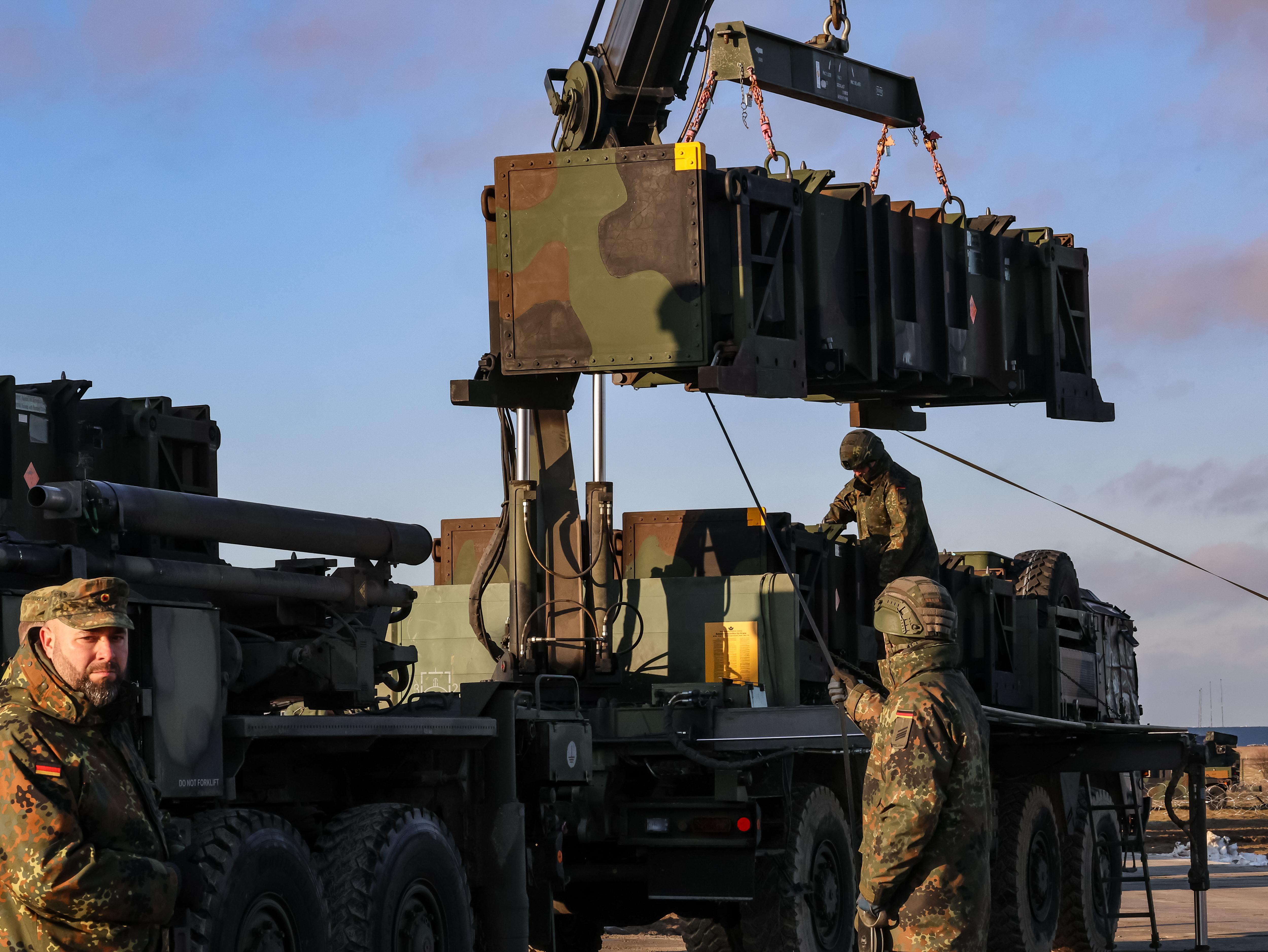
Many European countries, in particular Germany, have prioritised United States-made technology for air superiority: the F-35 strike fighter aircraft and Patriot theatre-level air and missile defence systems. Alongside the less widely available French SAMP/T, Patriot is the only system available to Europe able to intercept ballistic and hypersonic missiles.
A core argument for buying in US technology was that F-35s and Patriots, for example, are both highly effective and readily available. Moreover, a widespread view was that buying US technology would keep the US committed to the defence of the European continent politically, and that to be militarily interoperable with the US, European countries should purchase much of their military equipment from it3. Meanwhile, comparable European fighter jets face long development times, while European air defence systems have been put aside. These procurement decisions have proved highly consequential because they have generated path dependency in technology, increasing Europe’s long-term reliance on the US.
However, political developments over the last 10 years show that the US commitment to Europe cannot be taken for granted. Even putting aside politics, competing US priorities and the limited resources of the US defence industrial base put hard constraints on the degree to which European security can rest on the US. The US-Israel-Iran conflict has sapped US air defence and precision-guided munitions. The ability of Europe alone to defend itself should therefore be the critical benchmark for European rearmament.
But in the meantime, Patriots remain integral to European integrated air and missile defence (IAMD)4. The purpose of IAMD would not be to shoot down enemy missiles and drones indefinitely (the conflicts in Ukraine and the Middle East show this is very difficult), but to protect major European military and civilian assets long enough for European forces to gain the initiative and degrade the sources of drone and missile attacks. In any conflict, the F-35 would be vital in enabling quantitatively and qualitatively superior European air forces to gain air superiority, thereby enabling European tactical aviation to neutralise the quantitative advantage nominally enjoyed by Russian ground forces.
Potential IAMD shortages are thus very significant. Given its experiences in Ukraine, especially the mixed results of the opening stages of the war in 2022, Russia is likely to only engage in a future full-scale attack once it is satisfied that stockpiles are well-filled and capable of executing devastating saturation attacks in the opening stages of the conflict5. European aviation and air bases would be particular targets. Given currently high Russian production rates, even a relatively short ceasefire in Ukraine, or a holding back of the frequency of Russian attacks, could rapidly lead to considerable replenishment of Russian stocks of attack drones and cruise, ballistic and hypersonic missiles6. High Russian production rates – similarly to Iran – would enable the country to sustain attacks for long periods, without severe disruption to production of attack missiles and launch platforms.
In case of a massive Russian attack, European air defence would therefore need to protect multiple civilian and military targets. European airbases, combat aircraft, logistics, and command facilities would be heavily targeted by Russia. The Patriot, the SAMP/T and the Israeli Arrow 3 in Germany are the only systems available to Europe that can intercept ballistic missiles, which Russia continues to produce and refine based on lessons from Ukraine. Powerful air defence capabilities against jet-powered drones would be equally critical.
Alongside IAMD, Europe needs to invest in dispersing aircraft, reinforcement of facilities and redundancy, all of which would reduce pressure on interceptor stocks (Bronk, 2023; NATO, 2025). But these are imperfect substitutes for IAMD. Patriot supply bottlenecks would thus severely constrain European defensive planning. In this analysis, we therefore assess US production of Patriot missiles, the predominance of Patriot launch platforms in air defence and the geographical distribution of launch platforms across European countries. We focus on Patriots as they can be used against ballistic, hypersonic and, potentially, subsonic cruise missiles.
The production of Patriot missiles is not keeping up with demand
Between Russia’s full-scale invasion of Ukraine and the end of 2025, European countries ordered 1519 Patriot missiles, compared to 1026 in the preceding seven years, after Russia occupied Crimea (Figure 1). From 2022 to 2025, 84 percent of Patriots ordered globally were for Europe, compared to just 36 percent in the period before.
However, high consumption rates in ongoing conflicts and production constraints led to long delays in fulfilling European orders. Switzerland was notified that it would receive missiles it agreed to purchase in 2022 with at least four to five years delay, and would have to pay a substantially higher cost7.
Patriot Advanced Capability-3 (PAC-3) missiles, particularly their upgraded Missile Segment Enhancement (MSE) variant, are critical for air defence, especially against ballistic and hypersonic missiles. Russia produces significant quantities of sophisticated ballistic missiles, which are hard to intercept because of their high speed and mid-flight manoeuvrability. Their large warheads mean that impacts are comparatively more damaging than cruise missiles, and significantly more so than current-generation drones and loitering munitions. It also means that ballistic missiles are highly relevant for attacking reinforced targets.
Interceptor shortages have left Ukraine highly exposed to ballistic missiles. To secure a more reliable supply, Ukraine has sought an agreement with the US to produce PAC-3 missiles domestically, but negotiations have at time of writing not led to any production arrangements8.
Figure 1:Numbers of Patriots ordered by European and Middle East countries
Deliveries of advanced PAC-3 MSE interceptors rose from 385 in 2023 to more than 500 in 2024 and 620 in 20259. A January 2026 framework agreement would raise the delivery capacity to 2000 per year by 203010. However, achieving this target will require bottlenecks in the supply chain to be overcome. One constraint in expanding production has been attributed to the PAC-3 seeker (or guidance system), a critical component that is manufactured by a single Boeing facility11. Shortages of these seekers have delayed plans to expand production in the past12.
Current production capacities cannot keep pace with heightened consumption. The first sixteen days of Operation Epic Fury – the initial US strikes on Iran – used 402 interceptor missiles, equivalent to 65 percent of annual production of PAC-3 MSEs13. Meanwhile, Ukraine has reportedly run out of stocks and is requesting 300 Patriot missiles from its allies (see footnote 6). The US has cleared the sale of an additional 500 PAC-3 MSEs to Ukraine, but fulfilment could take years14. Costly interceptor missiles are also being used against inexpensive attack drones in the Middle East, not only against ballistic missiles15. While drones can be deployed in large numbers, Patriot missiles are scarce. Using Patriots against mass drone attacks adds to demand pressures and risks exhausting both stocks and budgets. Defensive shortages could worsen as Russia continues to innovate and deploy new precision missiles, including low-cost systems such as the Filin16.
Production constraints, coupled with high demand, have led to a large backlog of unfulfilled deliveries, reaching 4300 units in May 2026, at least 35 percent of which are destined for Europe17. At the last reported delivery capacities of the PAC-3 MSE interceptors, it would take close to seven years to deliver these 4300 Patriot missiles. Europe may face even longer delays. Because of the war in Iran and withdrawal from US stocks, the US in early 2026 informed Europeans of further delays18. Meanwhile, in the first months of 2026, orders from US allies in the Middle East have ramped up (Figure 1). Saudi Arabia and Qatar agreed in the first months of 2026 to purchase 730 and 300 missiles respectively (Bruegel, 2025).
Alternative systems exist, but lock-in effects prevent rapid switching
Europeans have alternatives in long-range air-defence systems, but previous procurement choices have locked them into dependence on the US defence industrial base. As 67 percent of the long-range air-defence launchers in stock are Patriots, Europe’s air defence relies heavily on the supply of US-produced Patriot missiles (Figure 2). France and Italy are exceptions: they operate the SAMP/T system, which uses Aster 30 missiles produced by Eurosam, and thus have no reported orders of Patriot missiles (Table 1).
In July 2026, ten countries and a dozen manufacturers, including those behind SAMP/T, announced the development of Freyja, a new European air defence system19. The initiative could help address Europe’s structural dependence on US missile production and strengthen its defence industrial base in the longer term20. However, with only a prototype potentially available by mid-2027, Freyja offers no immediate substitute for the Patriot system, leaving Europe reliant on US deliveries in the near term.
Figure 2: Number of long-range air defence launchers in Europe by model
Table 1: Stocks of long-range air-defence systems in Europe by model
| Country | Patriot | SAMP/T | S-300 | S-400 | Other | Total |
| Bulgaria | 8 | 12 (S-200) | 20 | |||
| France | 40 | 40 | ||||
| Germany | 70 | 70 | ||||
| Greece | 36 | 12 | 48 | |||
| Italy | 12 | 12 | ||||
| Netherlands | 18 | 18 | ||||
| Poland | 16 | 16 | ||||
| Romania | 12 | 12 | ||||
| Serbia | 4 (FK-3) | 4 | ||||
| Spain | 18 | 18 | ||||
| Sweden | 12 | 12 | ||||
| Türkiye | 32 | 2 (Siper; MIM-14) | 34 | |||
| Total | 182 | 52 | 20 | 32 | 18 | 304 |
The strategic bet on US systems for air defence has left Europe highly dependent on US deliveries from a defence industrial base that cannot meet global demand. This dependence has significant and worrying consequences for European security. A major Russian attack on Europe’s eastern flank might rapidly weaken European air superiority by hitting major assets, including fighter jets and airports equipped to service them.
It is, of course, difficult to establish how different the situation would look if Europe had invested early on in home-grown systems. There is a European alternative to the Patriot, but because of a lack of major orders, neither launchers nor missiles are available in sufficiently high numbers. The rapid progress with new air defence systems such as Freyja suggests that, had a determined investment effort in homegrown European alternatives been made in 2022, it would have made a major difference already by now. But calls to Europeanise the funding and ordering of air defence systems (Steinbach and Wolff, 2024) were ignored and the strategic gap is now all too visible.
Europe should thus find major resources to scale up the production of the domestic air defence systems SAMP/T and Freyja, which do not depend on the US defence industrial base. Major long-term order books will enable the respective companies to increase production capacities. Contracts should be designed to incentivise rapid production increases and early deliveries. Meanwhile, European policymakers need to work with US policymakers, including the Congress elected in November 2026, to lobby for the timely delivery of ordered Patriot missiles to fill immediate gaps. In strategy terms, Europe needs to move from blindly buying from the US to a realistic strengthening of domestic alternatives that will ultimately be in the interest of overall transatlantic security.
AOTD and VAS (2026)2026 National Threat Assessment, Defence Intelligence and Security Service and State Security Department of Lithuania, available athttps://www.vsd.lt/en/reports/national-threat-assessment-2026/
Bronk, J. (2023)Regenerating warfighting credibility for European NATO air forces, Whitehall Report 1-23, Royal United Services Institute, available athttps://www.rusi.org/explore-our-research/publications/whitehall-reports/regenerating-warfighting-credibility-european-nato-air-forces
Bruegel (2025) ‘US Foreign Military Sales (FMS)’,Bruegel Dataset, version of 5 October, available athttps://doi.org/10.64153/KBPT2220
IISS (2025)The Military Balance 2025, International Institute for Strategic Studies, Routledge
Mejino-López, J., J. Ospital and G.B. Wolff (2025) ‘Understanding US foreign military sales globally since 2008: an analysis of a new dataset’,Working Paper27/2025, Bruegel, available athttps://doi.org/10.64153/QOZC5551
NATO (2025) ‘NATO Integrated Air and Missile Defence Policy’, available athttps://www.nato.int/en/about-us/official-texts-and-redefence-policy
Steinbach, A. and G. Wolff (2024) ‘Financing European air defence through European Union debt’,Policy Brief21/2024, Bruegel, available athttps://www.bruegel.org/policy-brief/financing-european-air-defence-through-european-union-debt
Authors
Alexandr Burilkov
Researcher, Leuphana University Lüneburg
Javier Ospital
Guntram B. Wolff
Theme
Macroeconomic policy and governance
Keyword
defencesecuritytechnologytransatlantic relationsinvestment
Country
United States
Language
English
Endnotes
- 1
See NATO, ‘NATO Air Defence’, updated 8 October 2026, https://www.nato.int/en/what-we-do/deterrence-and-defence/nato-air-defence.
- 2
See NATO, ‘NATO Integrated Air and Missile Defence’, updated 29 October 2026, https://www.nato.int/en/what-we-do/deterrence-and-defence/nato-integrated-air-and-missile-defence.
- 3
See for example Katarina Djokic, ‘Are the European NATO states moving towards self-reliance in arms procurement?’ SIPRI, 19 March 2025, https://www.sipri.org/commentary/topical-backgrounder/2025/are-european-nato-states-moving-towards-self-reliance-arms-procurement-qa-katarina-djokic, and Chris Lunday and Stefanie Bolzen, ‘Germany fears breaking dependence on US arms risks straining transatlantic ties’, Politico, 5 November 2026, https://www.politico.eu/article/germany-fears-breaking-dependence-on-us-weapons-could-strain-transatlantic-ties/.
- 4
A Patriot battery is a complete system consisting of radar, command unit, and interceptor missile batteries. It uses radar as the primary detection method (both its own and other friendly radars and sensors) to detect, track, and destroy incoming missiles and aircraft.
- 5
Fabrizio Minniti and Giangiuseppe Pili, ‘Wartime Zapad 2025 Exercise: Russia’s Strategic Adaptation and NATO’, Commentary, 22 September 2025, RUSI, https://www.rusi.org/explore-our-research/publications/commentary/wartime-zapad-2025-exercise-russias-strategic-adaptation-and-nato.
- 6
See AOTD and VSD (2026) and Defence Intelligence of Ukraine, ‘Арсенал терору — скільки крилатих та балістичних ракет накопичила та виробляє росія’ [Arsenal of Terror: How Many Cruise and Ballistic Missiles Russia Has Accumulated and Produces], 4 November 2026, https://gur.gov.ua/content/arsenal-teroru-skilky-krylatykh-ta-balistychnykh-raket-nakopychyla-ta-vyrobliaie-rosiia.html
- 7
Reuters, ‘United States informs Switzerland of delays, price hike in Patriot delivery’, 13 May 2026, https://www.reuters.com/world/united-states-informs-switzerland-delays-price-hike-patriot-delivery-2026-05-13/.
- 8
Victoria Butenko and Lauren Kent, ‘Exclusive: Ukraine runs out of Patriot interceptor missiles as Zelensky and Trump clash over war’, CNN, 16 October 2026, https://edition.cnn.com/2026/10/15/europe/ukraine-us-patriot-interceptor-missiles-run-out-intl.
- 9
See Lockheed Martin news of 24 March 2025, ‘Lockheed Martin’s PAC-3 MSE Achieves Record Production Year’, https://www.lockheedmartin.com/en-us/news/features/2025/lockheed-martins-pac-3mse-achieves-record-production-year.html.
- 10
See Lockheed Martin news of 8 January 2026, ‘Lockheed Martin and U.S. Government Reach Historic Deal to Turbo-Charge PAC-3 MSE Production for U.S. and Allies’, https://www.lockheedmartin.com/en-us/news/features/2026/Lockheed-Martin-and-U-S-Government-Reach-Historic-Deal-to-Turbo-Charge-PAC-3-Missile-Segment-Enhancement-MSE-Production-for-U-S-and-Allies.html.
- 11
Macdonald Amoah, Morgan D. Bazilian and Jahara Matisek, ‘Scaling Patriot Production: The Industrial Base Crisis Explained’, Analysis, 18 May 2026, Foreign Policy Research Institute, https://www.fpri.org/article/2026/05/scaling-patriot-production-the-industrial-base-crisis-explained/.
- 12
Nobuhiro Kubo and Tim Kelly, ‘US-Japan Patriot missile production plan hits Boeing component roadblock’, Reuters, 20 July 2024, https://www.reuters.com/business/aerospace-defense/us-japan-patriot-missile-production-plan-hits-boeing-component-roadblock-2024-07-20/; Clement Charpentreau, ‘Lockheed Martin outlines integrated firepower vision and production ramp-up’, AeroTime, 19 June 2025, https://www.aerotime.aero/articles/lockheed-missile-paris-2025.
- 13
George Headley, ‘Magazine depth: Rapid depletion of missile stockpiles in Iran raises concerns about US readiness’, Small Wars Journal, 27 March 2026, https://smallwarsjournal.com/2026/03/27/magazine-depth-iran-missiles-stockpile-readiness/.
- 14
Tamara Nowakowsky, ‘US approves $2.1 billion Patriot missile sale to Ukraine as Zelensky warns of years-long wait for deliveries’, The Kyiv Independent, 30 October 2026, https://kyivindependent.com/us-approves-2-1-billion-patriot-missile-sale-to-ukraine-as-nato-commander-dismisses-delivery-concerns/.
- 15
On the use of Patriot interceptors against cheaper Iranian Shahed drones by Gulf States, see Samya Kullab and Hanna Arhirova, ‘Ukraine’s low-cost Shahed killers draw US and Gulf interest, but a wartime ban blocks sales’, Associated Press, 7 March 2026, https://apnews.com/article/iran-ukraine-shahed-russia-drone-defenses-war-76c91cad24bb98dd201f8f37a93c3464.
- 16
Dylan Malyasov, ‘Russia’s new Filin cruise missile caught on camera’, Defence Blog, 2 November 2026, https://defence-blog.com/russias-new-filin-cruise-missile-caught-on-camera/.
- 17
- 18
Gram Slattery and Humeyra Pamuk, ‘US officials tell European countries to expect weapons delivery delays,d/middle-east/us-officials-tell-european-countries-expect-weapons-delivery-delays-
- 19
John Irish and Dominique Vidalon, ‘Ukraine and allies set up coalition to tackle Russia ballistic missile threat’, Reuters, 12 July 2026, https://www.reuters.com/business/aerospace-defense/allies-muster-more-air-defence-aid-ukraine-battlefield-momentum-shifts-2026-07-13/.
- 20
Elina Ribakova, Nataliia Shapoval and Guntram B. Wolff, ‘Freyja and the making of a European defence industry’, First Glance, 1 October 2026, Bruegel, https://www.bruegel.org/first-glance/freyja-and-making-european-defence-industry.