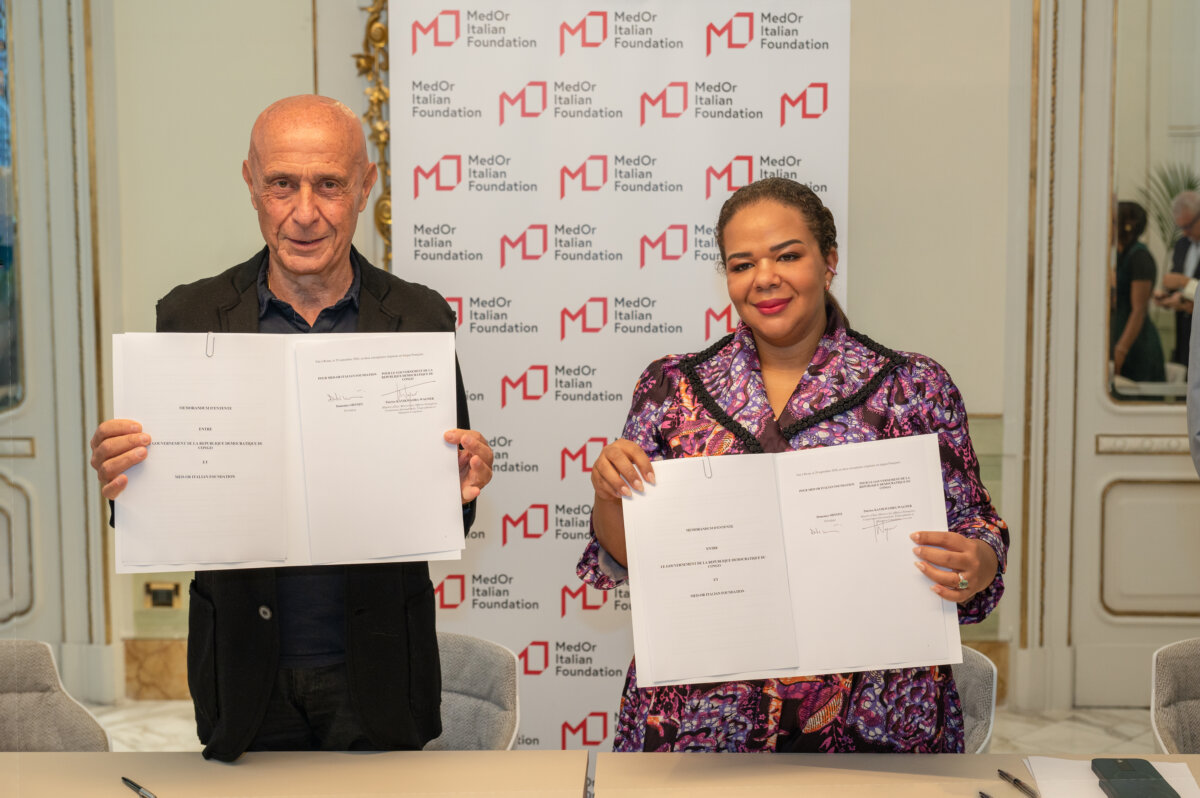
Med-Or and the Democratic Republic of Congo signed a Memorandum of Understanding to establish a framework for cooperation. The agreement focuses on strategic dialogue, joint initiatives, and projects in training and capacity building. This partnership is part of Italy’s broader strategy to strengthen relationships with African countries, particularly in the context of the Mattei Plan and the DRC’s strategic importance in global supply chains
At the Foundation’s Rome headquarters, Med-Or President Marco Minniti and the Democratic Republic of Congo’s Foreign Minister, Thérèse Kayikwamba Wagner, signed a Memorandum of Understanding on Monday aimed at establishing a stable framework for cooperation between Med-Or and the government in Kinshasa.
What’s in the agreement. The MoU provides for strategic dialogue, joint seminars and initiatives, as well as projects focused on training, capacity building and strengthening sector-specific expertise.
The wider context. The agreement comes at a particularly significant moment in relations between Rome and Kinshasa. In March, the Democratic Republic of Congo joined Gabon, Rwanda and Zambia among the countries covered by Italy’s Mattei Plan, which now includes 18 partner countries and more than 70 projects.
- The expansion into Central Africa also points to the evolution of an Italian strategy initially concentrated largely on the Mediterranean and the Horn of Africa.
Why the DRC matters. In Congo, the economic dimension is difficult to separate from the strategic one. With a population of more than 100 million and extraordinary mineral wealth, the DRC occupies a central position in global critical raw-material supply chains — and therefore in the competition to secure the inputs needed for the energy transition, digitalisation and emerging technologies.
- The country also has vast, largely untapped agricultural potential, making areas such as training, infrastructure and the development of local value chains particularly relevant to any long-term partnership.
The bigger picture. This is where the agreement with Med-Or takes on a significance that goes beyond the individual memorandum. In recent years, the Foundation has progressively built a network of relationships with African governments and institutions in which political dialogue is accompanied by training programmes and the development of local expertise.
- In February, for example, the opening of Med-Or’s first overseas office in Nairobi was accompanied by a memorandum with Kenya’s Ministry of Mining, Blue Economy and Maritime Affairs.
- The agreement focuses on the blue economy and fisheries and explicitly aims to foster innovation, capacity building and joint operational initiatives. The Kenya office was conceived by the Foundation as a hub from which to coordinate activities and partnerships across the continent.
The Djibouti case. A few months later, in July, Med-Or signed an agreement with Djibouti’s Ministry of Economy and Finance focused on critical infrastructure, digital connectivity, energy systems and strategic dialogue.
- The agreement is particularly significant given Djibouti’s position on the Bab el-Mandeb and its role in global connectivity. The cooperation has already translated into a project aimed at strengthening the ability of Djiboutian authorities to protect critical infrastructure, as Decode39 reported.
The Somalia precedent. Relations with Somalia are even more established. A memorandum signed in 2023 expanded cooperation from higher education and the promotion of the Italian language to health security, justice and public administration, building on the broader relationship developed between Med-Or and Mogadishu.
- That relationship subsequently produced, together with UNITAR and with the support of the Italian Foreign Ministry, a training programme for Somali diplomats and officials linked to Mogadishu’s 2025–2026 term on the United Nations Security Council. In June, Med-Or held a new intensive session in Mogadishu for senior officials from the Foreign Ministry.
The common thread. This trajectory also helps put the agreement with Kinshasa into perspective. The common denominator is not so much the export of a single model of cooperation as the use of training, expertise and institutional dialogue as tools to consolidate strategic relationships with countries that are becoming increasingly relevant to Italian and European interests.
Zoom in: Critical minerals. The raw-material dimension makes the DRC a particularly important case. Med-Or has already incorporated critical raw materials into its African activities: in 2025, it signed a memorandum with Italy’s Ministry of Enterprises and Made in Italy to support the coordination of Italian initiatives in the sector and has developed engagement with countries including Zambia, a key player in copper, nickel, cobalt and manganese and in the broader development of the Lobito Corridor.
The bottom line. The Democratic Republic of Congo’s entry into the Mattei Plan and the new agreement with Med-Or therefore place Kinshasa within this same emerging geography.
- For Italy, the issue is not simply access to resources. It is also about building relationships deep enough to support investment, human-capital development, institutional strengthening and the local development of value chains.
- It is on this terrain that the Mattei Plan’s ability to move from a political framework to durable partnerships will also be tested. The memorandum signed in Rome is a relatively small step. But it is part of an African network that, agreement by agreement, is becoming increasingly structured.
Will it be Europe first?