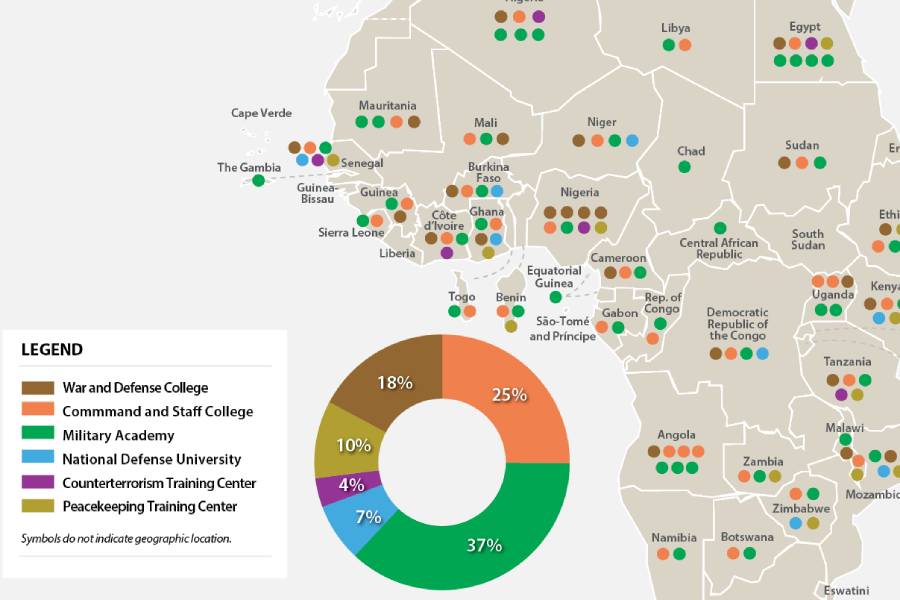
African countries have increasingly invested in building out their professional military education institutions as a means to foster capable and apolitical militaries.

Highlights
- Strengthening professional military education (PME) institutions is a linchpin for improving military professionalism in Africa. Effective PME schools can instill a commitment to democratic civil-military relations and citizen security, shape a strategic vision, advance understanding of national and regional security strategy development, foster the upholding of the rule of law, and enhance a service ethos within the officer corps.
PME opportunities are one of the most formative experiences in the careers of African security sector professionals.
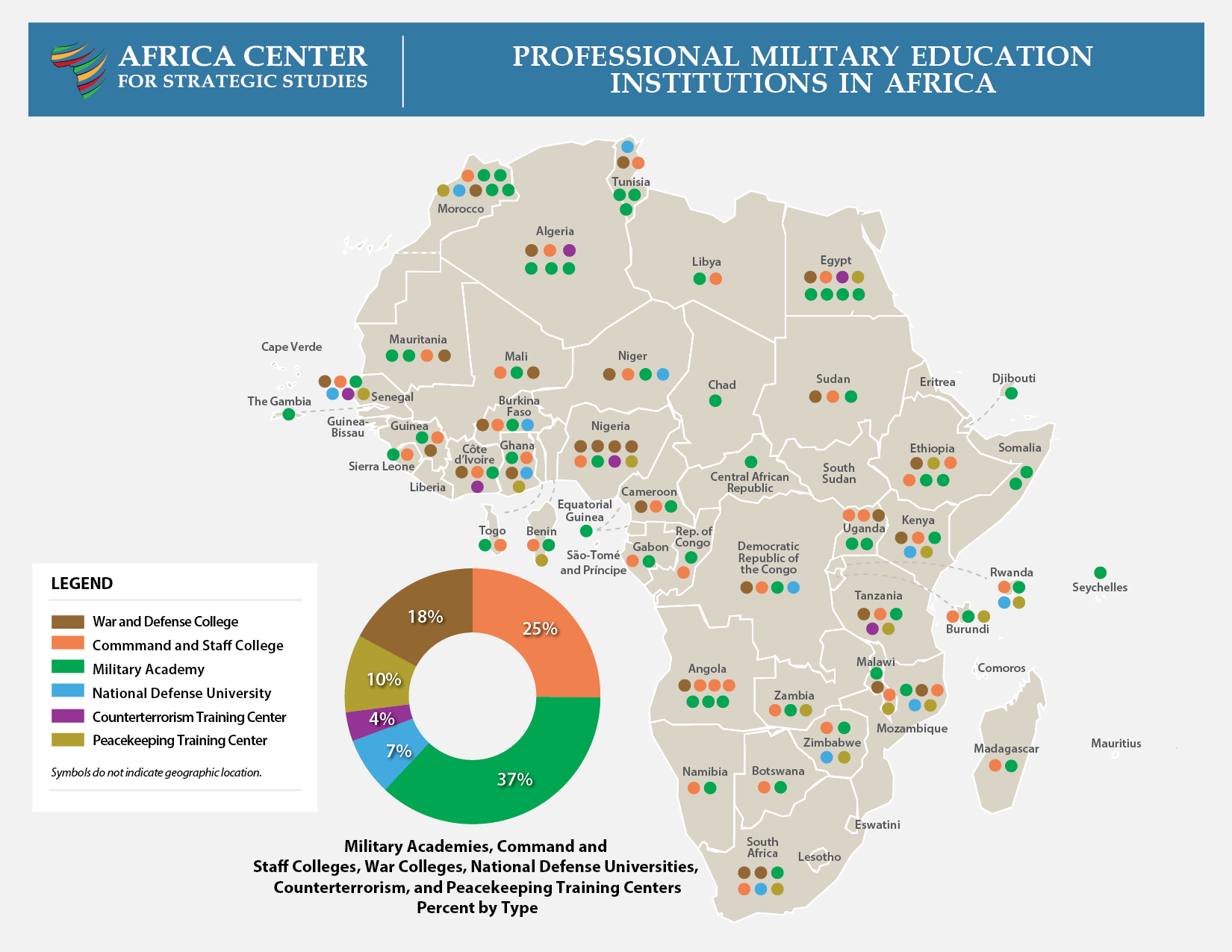
- With over 150 military colleges on the continent, Africa has a solid base of PME institutions. This includes 29 War Colleges, 41 Command and Staff Colleges, and 60 military academies.
- Several countries have established National Defense Universities (or their equivalent) that house multiple levels of PME institutions and support career progression for officers and senior civilian civil servants in the national security architecture.
- There are six regional counterterrorism (CT) training centers on the continent: Algeria, Côte d’Ivoire, Egypt, Nigeria, Rwanda, and Senegal.
- 16 regional training centers that prepare military and police contingents for peacekeeping missions. Participating in UN-mandated peace operations has long been considered a marker for professionalism since contingents must meet international standards.
| Type of School* | Educational Objectives |
|---|---|
| National Defense University | House several levels of PME schools, typically War Colleges and Command and Staff Colleges, and support career progression for officers and senior civilian civil servants in the national security architecture. |
| War and Defense College | Develop senior leaders (typically colonels and generals) to serve in high-level national security assignments. War and Defense Colleges aim to provide graduates with a strategic perspective of national and regional security challenges, enabling them to provide well-conceived, strategic guidance to civilian and military decision-makers. War and Defense Colleges develop a cohort of civilian and military professionals to develop and implement a national security strategy. |
| Command and Staff College | Provide mid-career educational opportunities to captains, majors, and lieutenant colonels to strengthen their leadership, ethical understanding, analytical and communication skills, and understanding of operational issues. Command and Staff College graduates will assume command staff duties in service, joint, interagency, international, and multinational organizations. Civilian counterparts sometimes attend as well. |
| Military Academy | Provide cadets an undergraduate education that prepares them for careers as senior officers. Military academies provide an advanced educational foundation as well as instill values of civil-military relations, military professionalism, discipline, and leadership skills. Graduates become commissioned officers, typically as second lieutenants or equivalent. |
*Does not include other technical or functional PME schools
- PME institutions are relatively evenly distributed across Africa’s subregions considering population size and numbers of countries.
- The presence of a PME school is not in itself evidence of stronger military professionalism. Rather, greater attention is needed to strengthen the curricula and culture within PME programs to reinforce the values of democratic civil-military relations and an apolitical military. In so doing, the prestige of PME institutions can be enhanced, and graduates will earn the enormous responsibility to bear arms to protect citizens.
- Depending on their size, not all countries need Command and Staff Colleges, War and Defense Colleges, or National Defense Universities. In such cases, there are regional hubs where officers can attend PME institutions and gain this knowledge, skill, and strategic perspective.
- A survey of African military professionals shows that PME opportunities are one of the most formative experiences in the careers of African security sector professionals. Moreover, young officers have especially high ideals of public service—a value that PME institutions can help reinforce.
Additional Resources
- Africa Center for Strategic Studies, “Translating Botswana’s Concept of Botho into a Culture of Military Professionalism,”Spotlight,March 1, 2026.
- Africa Center for Strategic Studies, “Reflections on 60 Years of Strengthening Military Professionalism in Kenya,”Spotlight,February 10, 2025.
- Africa Center for Strategic Studies, “Creating a Culture of Military Professionalism in Senegal,”Spotlight,December 6, 2023.
- Dan Kuwali, “Oversight and Accountability to Improve Security Sector Governance in Africa,”Africa Security Brief No. 42, Africa Center for Strategic Studies, September 11, 2023.
- Africa Center for Strategic Studies, “The Role of Parliamentary Committees in Building Accountable, Sustainable, and Professional Security Sectors,”Spotlight,April 3, 2023.
- Africa Center for Strategic Studies, “Deepening a Culture of Military Professionalism in Africa,”Spotlight, December 20, 2022.
- Catherine Lena Kelly, “Justice and Rule of Law Key to African Security,”Spotlight,Africa Center for Strategic Studies, May 25, 2021.
- Kwesi Aning and Joseph Siegle, “Assessing Attitudes of the Next Generation of African Security Sector Professionals,”Africa Center Research Paper No. 7, Africa Center for Strategic Studies, May 2019.
- Emile Ouédraogo, “Advancing Military Professionalism in Africa,” Africa Center Research Paper No.6, Africa Center for Strategic Studies, July 2014.
- Mathurin C. Houngnikpo, “Africa’s Militaries: A Missing Link in Democratic Transitions,”Africa Security Brief No. 17, Africa Center for Strategic Studies, January 2012.
More on: Military Professionalism