





Listen to this article
Estimated 4 minutes
The audio version of this article is generated by AI-based technology. Mispronunciations can occur. We are working with our partners to continually review and improve the results.
Iran and the United States said they had carried out strikes on military targets, and each accused the other of acting aggressively as diplomatic efforts to end three months of war drag on.
The U.S. military said that on the weekend it struck Iranian air defences, a ground control station and two drones that were threatening ships after “aggressive Iranian actions,” including shooting down a U.S. drone over international waters.
Iran’s Islamic Revolutionary Guard Corps said Monday it had targeted an airbase used by the U.S. in response to the attack on southern Iran, without identifying which base.
It didn’t identify the base, but Kuwait activated air defences on Monday, and denounced Iranian missile and drone attacks, which it said were undermining efforts to reduce tensions in the region.

CBC’s David Common, sitting in for chief political correspondent Rosemary Barton, speaks with retired vice-admiral Mark Norman about the proposed framework for a deal to end hostilities between the U.S. and Iran.
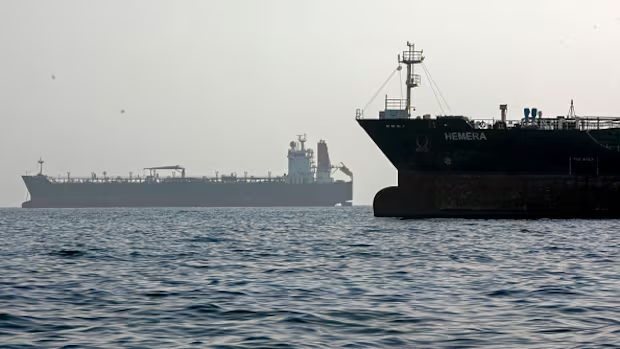
The war launched by the U.S. and Israel on Feb. 28 has killed thousands of people, mainly in Iran and Lebanon, and caused global economic pain by pushing up energy prices due to Iran’s effective closure of the Strait of Hormuz.
Trump confident ‘it will all work out’
In a late-night social media post, U.S. President Donald Trump did not mention the exchange of hostilities, repeating his as yet unproven claim that Iran “really wants to make a deal.”
He berated critics, including what he described as “seemingly unpatriotic Republicans,” for negative “chirping” about negotiations to end the conflict.
“Just sit back and relax, it will all work out well in the end — It always does!” he said.
Despite Trump’s remarks, Iranian Foreign Ministry spokesperson Esmaeil Baghaei accused Washington on Monday of constantly shifting its negotiating stance and condemned what he called U.S. aggressive action.
He said sending contradictory messages wouldn’t work as a negotiating tactic, and urged Washington to reach a clear and definitive position as soon as possible.
“Negotiations have started amid severe suspicion and mistrust, and the exchange of messages is taking place in this atmosphere,” Baghaei said.
“The other party is constantly changing its views and putting forward new or contradictory demands … it is natural that this situation will prolong negotiations,” he said, adding that Tehran viewed Israeli actions in the region, including in Lebanon, as inseparable from those of the U.S.

Trump is under pressure to reopen the Strait of Hormuz and get U.S. gasoline prices down ahead of the November congressional elections, as voters show increasing frustration over rising prices. At the same time, he faces a potential backlash from Iran hawks in his own party over any concessions to Tehran.
Trump has said his key aim in the war is to prevent Iran from developing a nuclear weapon with its highly enriched uranium. Tehran has consistently denied it has plans to do that.
The two sides remain at odds on several other issues, such as Tehran’s demands for the lifting of sanctions and the release of tens of billions of dollars of Iranian oil revenues frozen in foreign banks.
Day 610:11How we can bring down the high price of gasoline in Canada
The price of gas across Canada remained high this week. Although prices at the pumps have dipped slightly here and there since the start of the war in Iran, these high prices are expected to continue for some time. The mantra from government, industry and financial analysts is that high prices are inevitable because of geopolitical instability. Canadian economist Jim Stanford disagrees. Earlier this month, he authored the report, A Sequel We Don’t Want: What the 2026 Oil Price Shock Will Cost Canadians. Jim Stanford joins Day 6 host Brent Bambury to talk about how high gas prices in Canada have little to do with war, supply and demand, or market forces — and what can be done to bring those prices down.
Israeli troops to move deeper into Lebanon
Israel’s war in Lebanon with the Iranian-backed Hezbollah militia is another major impediment.
Israeli Prime Minister Benjamin Netanyahu said Sunday he had ordered troops to move farther into Lebanon in the battle against the Iranian-backed Hezbollah militant group.
On Monday, he ordered the military to attack targets in Beirut’s southern suburbs, a Hezbollah stronghold. His office accused Hezbollah of repeated violations of a ceasefire agreed in late April.
U.S. Secretary of State Marco Rubio spoke with both Lebanese President Joseph Aoun and Netanyahu on the diplomatic negotiations between Israel and Lebanon, and has proposed a plan to allow for “gradual de-escalation,” a U.S. official said.





