



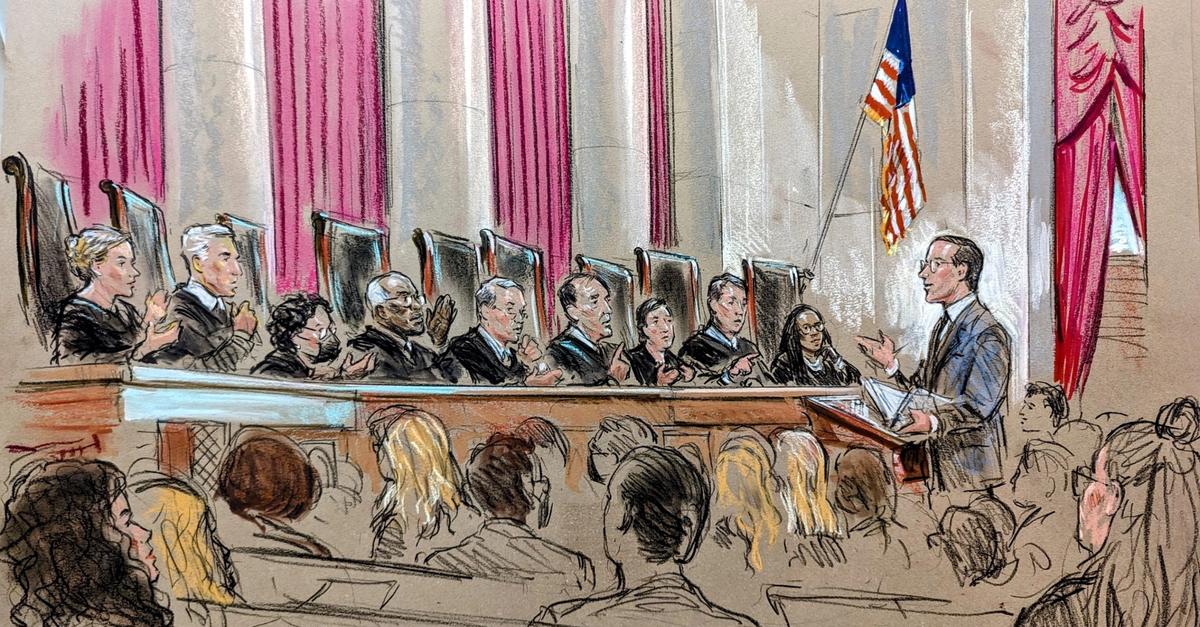
Empirical SCOTUS is a recurring series by Adam Feldman that looks at Supreme Court data, primarily in the form of opinions and oral arguments, to provide insights into the justices’ decision making and what we can expect from the court in the future.
Oral argument at the Supreme Court is often treated as theater – a ritual of pointed questions directed at nervous advocates that rarely changes a case’s outcome. But a careful look at how justices behave during argument offers something more: a window into whether a case is headed toward consensus or conflict, and often, who is writing what.
This article examines data from six recent Supreme Court cases – three decided unanimously and three decided by contested votes – and asks a straightforward question: Does the nature of oral argument appear to differ in ways that predict, or at least are consistent with, the eventual division of the court?
The answer is yes – and the differences can be striking.
The six cases
The cases span the October 2025 Term, the final argument of which took place on Wednesday, Apr.29. The three unanimous decisions studied (Barrett v. United States, Berk v. Choy, and Ellingburg v. United States) were each resolved 9-0. The three contested decisions (United States Postal Service v. Konan, Bowe v. United States, and Hencely v. Fluor Corp.) divided 5-4, 5-4, and 6-3, respectively.
The cases cover a range of doctrinal terrain: statutory interpretation in the mail-liability context (Konan), federal habeas corpus procedure (Bowe), military-contractor preemption and wartime tort liability (Hencely), criminal sentencing (Barrett), federal civil procedure (Berk), and the Mandatory Victims Restitution Act (Ellingburg). Their variety makes the behavioral patterns across the two groups especially revealing.
Volume: contested cases generate more argument


This one might seem obvious, but the most immediate difference between the two groups are the lengths of argument. The three contested cases averaged 93.7 transcript pages per argument, compared to 73 pages for the unanimous cases. Justices’ turns to ask questions followed the same pattern: an average of 200.3 turns in the contested cases versus 136.7 in the unanimous ones. Transitions between justices – moments when the bench turns to address a new voice – averaged 60.3 per contested argument and 36 per unanimous one.
In other words, the contested cases generated substantially more oral argument activity than the unanimous ones, even though both groups involved nine justices working through a comparable range of issues.
So what does this tell us? In contested cases, the justices are not merely eliciting clarification or confirming what they already believe (as is the common narrative about oral argument). Instead, they are, in a meaningful sense, working through disagreement with both the advocates and perhaps more importantly, one another, in real time – pressing advocates harder, returning to problems that resist easy resolution, and engaging each other’s implied positions from across the room.
Tone: the questions asked
The nature of judicial questioning also shifts between the two groups. Skeptical and challenging turns – questions that push back on an advocate’s position, expose tensions in the argument, or directly contest a premise – averaged 35.0 per contested argument, compared to 24.0 for unanimous cases. And probing the underlying logical foundations of a legal position averaged 26.3 in contested cases and 18.7 in unanimous ones.

These patterns are consistent across the six cases and suggest that skepticism at oral argument is very real – not merely a justice playing devil’s advocate or testing out certain ideas. When multiple justices are pressing an advocate hard on the foundations of their argument, it often reflects that the court itself is genuinely divided about those foundations. When the bench is more quiescent, more focused on breaking down a doctrine and seeking clarification of a legal point, it is usually because the justices have already found – or are converging on – common ground.
Justice-level behavior
The justice-by-justice data makes the relationship between oral argument behavior and eventual case outcomes even sharper.
The future majority author does not necessarily ask the most questions. Rather, the dissenters tend to ask more questions and (predictably) often express their skepticism at the party which turns out to have the winning hand. For example, in Konan, Justice Ketanji Brown Jackson, who joined the dissent, had the highest turn count of any justice.
And then there is the outlier: Justice Clarence Thomas. Unsurprisingly given his reputation, in every case in the sample, Thomas asked the fewest or near-fewest turns. His questioning style was overwhelmingly exploratory or doctrinal – which is consistent with a well-documented pattern of seeking clarification or information rather than pressing advocates with adversarial challenges. Despite his relative silence, however, Thomas was the majority author in both Konan and Hencely.

In contrast, the three unanimous cases share a recognizable pattern. The questioning is substantive – justices ask plenty of doctrinal and expository questions – but the level of sustained pressure on the advocates is much lower. Skeptical and challenging questions are fewer, contesting the advocates’ entire premise is reduced, and there is less of the justice-to-justice tension that characterizes divided cases.
In Ellingburg, for example, the questioning was largely oriented toward clarifying the doctrinal framework (what exactly makes a sanction “penal” for ex post facto purposes, and how does the MVRA fit within that framework?) rather than challenging the legal conclusions of either side. Several of the justices who would join the majority asked questions that functioned more as road-mapping exercises – helping the advocate organize their argument to help the court write its opinion.
In Berk, the clearest signal of eventual unanimity was the nature of Justice Amy Coney Barrett’s questions. As is common with Barrett, her queries were consistently oriented toward identifying the narrowest adequate ground for decision. This entailed asking which rule, exactly, was being violated; whether the holding needed to say anything about analogous state procedures; and what the limits of existing precedent were. Such questioning – which asks for the most defensible version of the disposition rather than challenging whether to reach any disposition at all – is a recognizable pattern in justices who are heading toward authorship of a unanimous opinion.
What this all tells us – and what it does not
The data from these six cases supports several tentative conclusions (while fully recognizing the limitations of such a small sample size).
First, the total volume of oral argument activity – measured in pages, justice turns, and transitions – was higher in contested cases. This is not simply a function of case complexity; it reflects the justices’ greater uncertainty and genuine division about the eventual outcome.
Second, the justices’ skepticism, especially towards one another’s positions, may be a strong indication of a divided opinion. High skepticism predicts contested outcomes; lower skepticism, combined with more doctrinal questioning, predicts consensus.
Third, individual justice behavior at oral argument tends to be consistent with their eventual opinion roles. Future majority authors often exhibit an organizing or synthesizing posture – fewer turns of questions overall or turns oriented toward clarifying and confirming the winning argument. Future dissenters tend to ask more and probe more insistently on the points that the majority’s eventual reasoning may not fully resolve.
Finally, genuinely fragmented cases – those with multiple separate opinions rather than a clean majority – look different at oral argument from more ordinary 5-4 or 6-3 splits. Of course, this is not an ironclad rule. There are cases where a justice asks many questions and joins the majority. There are cases where a quiet justice ends up writing separately. But as a lens for understanding what is happening inside a court that almost never explains itself in advance, the structure of oral argument behavior is a more reliable guide than the conventional wisdom – that argument is theater and questions are noise – typically concedes.
Conclusion
The six cases examined here suggest that oral argument is a more telling event than it is often treated as being. The amount of argument, the level of skepticism across different justices, and the nature of individual questions all carry information about what the court is doing and where it is headed. Contested cases are louder, more adversarial, and more focused on the foundations than unanimous ones. And the justices who will eventually write the most significant opinions often reveal their likely roles, not through dramatic moments, but through the quieter structural work of their questioning – confirming, narrowing, synthesizing, or resisting the advocates’ positions in ways that are visible, in retrospect, well before the opinions themselves come down.





