

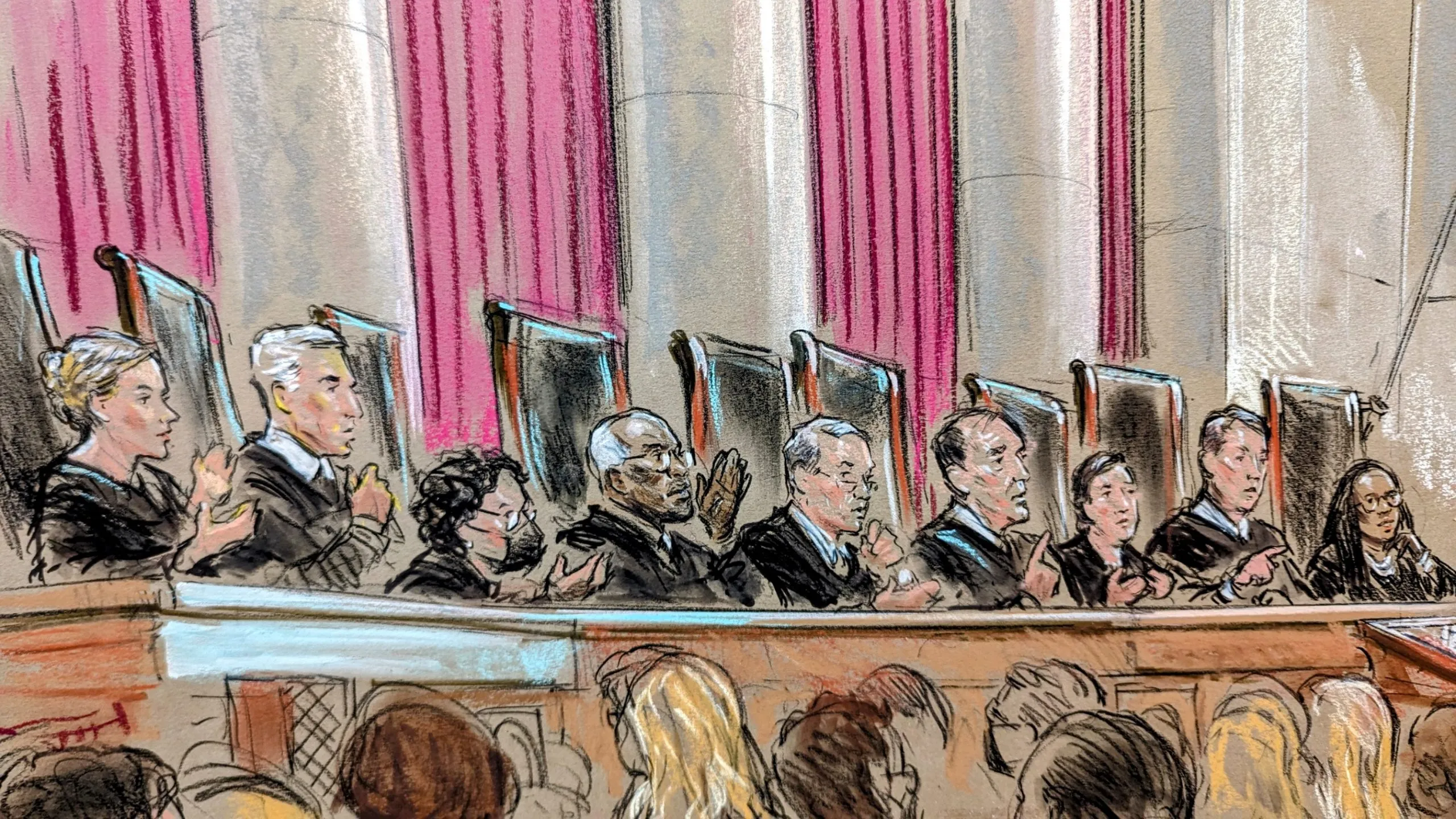
Courtly Observations is a recurring series by Erwin Chemerinsky that focuses on what the Supreme Court’s decisions will mean for the law, for lawyers and lower courts, and for people’s lives.
As someone who grew up (and continues to be) obsessed with baseball statistics, I think that a great deal can be learned from looking at the numbers concerning the Supreme Court (and SCOTUSblog does as well, as reflected in its 2024-25 Stat Pack). And now that the court has completed issuing decisions other than emergency matters, it is possible to study the statistics for October Term 2024.
Size of the merits docket. The court decided 56 cases with signed opinions after briefing and oral argument. This seems to be the new normal for the court. Last year, the court decided 59 merits cases. In each of the two years prior to that, the court decided 58 cases. The term before that it was 54, and the year before that it was 52, which was the smallest number since 1862.
To put this in perspective, in the 1980s, the court was deciding over 160 cases a year. The smaller docket began when William Rehnquist was chief justice. In his last year, October Term 2004, the court decided 85 cases. When John Roberts went before the Senate Judiciary Committee in the summer of 2005 for his confirmation hearing, he was asked about the smaller docket. He lamented it. He had been a Supreme Court litigator and said that the court should decide at least 100 cases a year. Never in his 20 years as chief justice has the court come close to the 85 merits cases of Rehnquist’s last term. On the other hand, as discussed below, the size of the emergency docket has increased enormously.
One interesting consequence of the smaller docket is that the justices generally write one majority opinion for each month the court hears oral arguments. This year, each justice wrote no fewer than five opinions and no more than seven opinions.
Lack of interest in reviewing state court decisions. Of the 56 decisions, only three were reviewing state court rulings. This is not a one-year phenomena. A year ago, only four decisions were reviewing state court decisions, and the year before that it was five. It certainly means that state court judges can rule knowing that the odds of the Supreme Court granting review in one of their cases is very tiny.
It is not clear why the court has little interest in reviewing the state courts. It may be that the justices care much more about splits among the federal circuits than they do about disagreements among the state courts. Perhaps they see their role as ensuring uniformity of law applied in the federal courts, with less concern about that when state courts are deciding federal law issues.
Perhaps, too, it may be about the issues that are of most interest to the justices. It is striking that again this year, there were no decisions about the scope of searches under the Fourth Amendment or the privilege against self-incrimination or eyewitness identifications or the confrontation clause. Maybe also this reflects the relative lack of interest in criminal procedure among the justices. The paucity of criminal procedure cases may be a product, in part, of not reviewing state court decisions, because the vast majority of criminal prosecutions in the United States occur in state courts.
It is the Roberts Court. After Justice Amy Coney Barrett was confirmed and there were five conservative justices in addition to Roberts, many questioned whether it would still be the John Roberts Court. This was vocalized even more after the court’s decision in 2022’s Dobbs v. Jackson Women’s Health Organization, in which the five other conservative justices overruled Roe v. Wade without Roberts joining them in that result.
But in the years since, it’s been clear that in every way it really is the Roberts Court. Again this term, Roberts was in the majority more than any other justice: 95% of the time. He dissented only twice in cases on the merits docket, and wrote no concurring or dissenting opinions. He was in the majority in all of what can be regarded as the most important decisions of the term.
The United States Court of Appeals for the 5th Circuit. Of the 56 decisions, 12 or about 20%, were reviewing the United States Court of Appeals for the 5th Circuit. By comparison, the next most frequent were eight decisions reviewing the U.S. Court of Appeals for the 4th Circuit, seven decisions reviewing the U.S. Court of Appeals for the 9th Circuit, and five reviewing the U.S. Court of Appeals for the District of Columbia Circuit.
In 10 of the 12 cases, the 5th Circuit was reversed. I never have felt that reversal rates should be a basis for criticizing a court of appeals. It is not the role of a court of appeals to try and predict what the Supreme Court will do. And the Supreme Court reversing doesn’t mean it was right and the court of appeals was wrong; it is just that the Supreme Court gets the last word.
But when a disproportionate number of cases come from one circuit and that circuit is reversed most of the time, it says something. When it was the 9th Circuit that was a large part of the docket and often reversed, it reflected a court that overall was to the left of the Supreme Court. Now with the 5th Circuit, it shows a court that is often aggressively pushing the law to the right and going further than even the conservative Roberts Court wants to. That was certainly true this term. For example, in Federal Communications Commission v. Consumers’ Research, the 5th Circuit declared a federal law unconstitutional as an excessive delegation of legislative power. Since 1935, not once had the Supreme Court struck down a federal law on that basis. And the court did not do so in this case, reversing the 5th Circuit in a 6-3 ruling, with Justice Elena Kagan writing for the court, and Justices Neil Gorsuch, Clarence Thomas, and Samuel Alito dissenting.
The growth of the emergency docket. A year ago, the Supreme Court decided 44 matters on its emergency, or as it is often called, “shadow docket”. This term, the court has 113 matters on the emergency docket (and that surely will increase over the summer as the term officially continues until the next term begins in October). That is a stunning increase in just one year. Of course, the easiest explanation is the number of applications involving challenges to President Donald Trump’s actions.
I am among those with great concerns about the court effectively deciding major issues without full briefing and oral argument on its emergency docket. Sometimes the court decides without even writing an opinion, such as in Department of Homeland Security v. D.V.D. on June 23, which allowed the Trump administration to deport individuals to South Sudan despite their not having any connection to that country. It also is troubling that the court pays little attention to rules limiting appellate review of temporary restraining orders and to the usual standards of appellate review, which limit overturning preliminary injunctions to when there is an abuse of discretion by the trial court. Also, it is unclear what, if any, precedential weight lower courts must give to opinions from the emergency docket.
The ideology of the justices. It is no surprise that the justices who were in agreement the most were Thomas and Alito, 97% of the time, and then Justices Sonia Sotomayor and Ketanji Brown Jackson, 94% of the time. The former are the most conservative justices, and the latter the most liberal.
It does not take statistics to see that for the highest-profile cases that are ideologically divided, this is a court that has six conservative justices and three liberal justices. Although there were just 10.7% of the cases that were 6-3, with Sotomayor, Kagan, and Jackson in dissent, by all accounts these were some of the most important and most controversial decisions.
I also think little attention should be paid to the fact that 42% of the cases were unanimous. That is more a reflection of the cases the justices took than it is a court where there is any meaningful consensus.
The age of the justices. One final statistic is important for looking ahead to the Court’s future. Four justices are over 70: Thomas 77, Alito 75, Sotomayor 71, and Roberts 70. Kagan is 65 and Justice Brett Kavanaugh is 60. The remaining justices are in their 50s: Gorsuch 57, Jackson 54, and Barrett 53. The bottom line is that it likely will remain a conservative court for many years to come.
Posted in Featured, Recurring Columns
Recommended Citation:
Erwin Chemerinsky,
By the numbers,
SCOTUSblog (Jul. 1, 2025, 1:38 PM),
https://www.scotusblog.com/2025/07/by-the-numbers/
