
Close Menu

    Subscribe to Updates

    Get the latest creative news from FooBar about art, design and business.

    What's Hot

    Birthright citizenship: the exceptions provide the rule

    March 7, 2026

    South Africans Urged to Use ‘Limited’ Flights to Flee Middle East As Conflict Escalates

    March 7, 2026

    Former assistant district attorney charged with strangulation of family member

    March 7, 2026
    Facebook X (Twitter) Instagram
    • Home
    • Contact Us
    • About Us
    • Privacy Policy
    • Terms Of Service
    • Advertisement
    Saturday, March 7
    Facebook X (Twitter) Instagram Pinterest Vimeo
    ABSA Africa TV
    • Breaking News
    • Africa News
    • World News
    • Editorial
    • Environ/Climate
    • More
      • Cameroon
      • Ambazonia
      • Politics
      • Culture
      • Travel
      • Sports
      • Technology
      • AfroSingles
    • Donate
    ABSLive
    ABSA Africa TV
    Home»World News»Birth of a solar system: Astronomers observe early planet formation for 1st time
    World News

    Birth of a solar system: Astronomers observe early planet formation for 1st time

    Olive MetugeBy Olive MetugeJuly 17, 2025No Comments4 Mins Read
    Facebook Twitter Pinterest Telegram LinkedIn Tumblr Email Reddit
    Birth of a solar system: Astronomers observe early planet formation for 1st time
    Share
    Facebook Twitter LinkedIn Pinterest Email Copy Link


    Astronomers have discovered the earliest seeds of rocky planets forming in the gas around a baby sun-like star, providing a precious peek into the dawn of our own solar system.

    It’s an unprecedented snapshot of “time zero,” scientists reported Wednesday, when new worlds begin to gel.

    “We’ve captured a direct glimpse of the hot region where rocky planets like Earth are born around young protostars,” said Leiden Observatory’s Melissa McClure from the Netherlands, who led the international research team.

    “For the first time, we can conclusively say that the first steps of planet formation are happening right now.”

    The observations offer a unique glimpse into the inner workings of an emerging planetary system, said the University of Chicago’s Fred Ciesla, who was not involved in the study appearing in the journal Nature.

    “This is one of the things we’ve been waiting for. Astronomers have been thinking about how planetary systems form for a long period of time,” Ciesla said. “There’s a rich opportunity here.”
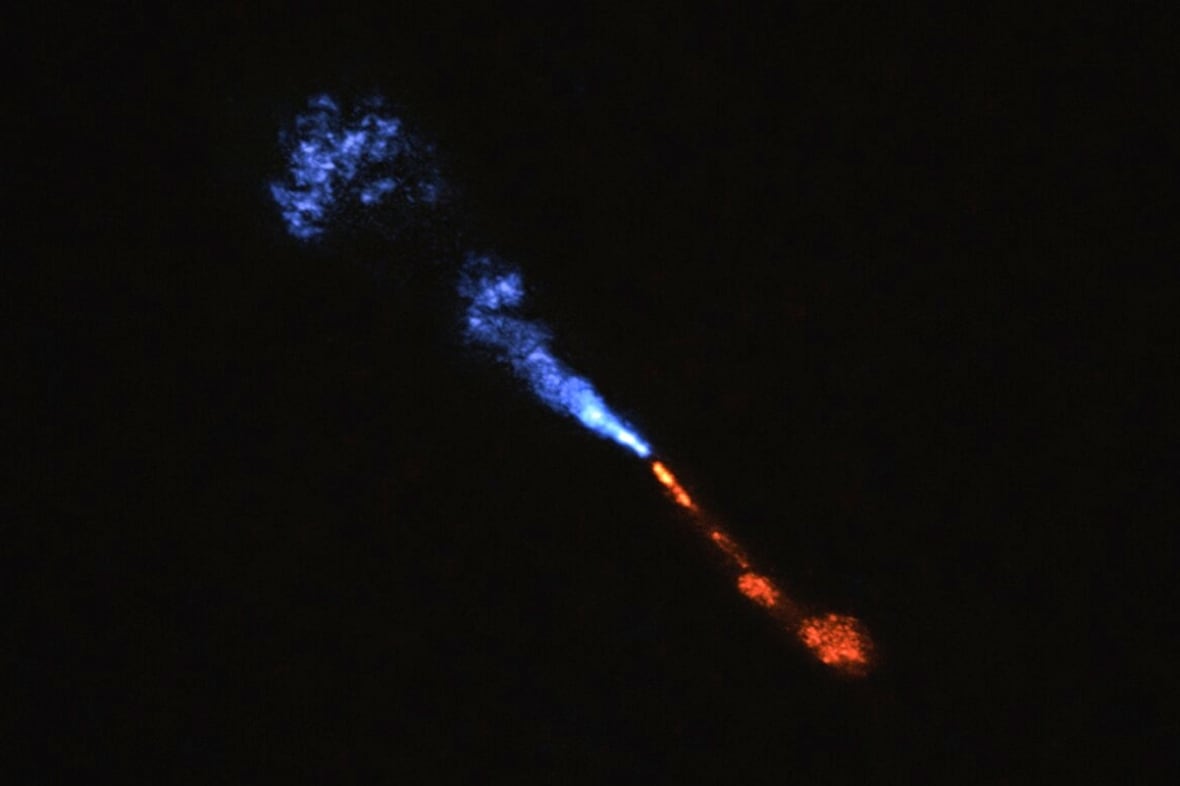
    An explosion of blue and orange light against a black background
    An image provided by the European Southern Observatory shows jets of silicon monoxide blowing away from the baby star HOPS-315. (ALMA/ESO/NAOJ/NRAO/M. McClure et al/The Associated Press)

    NASA’s Webb Space Telescope and the European Southern Observatory (ESO) in Chile teamed up to unveil these early nuggets of planetary formation around the young star known as HOPS-315. It’s a yellow dwarf in the making like the sun, yet much younger at 100,000 to 200,000 years old and some 1,370 light-years away. A single light-year is nine trillion kilometres.

    In a cosmic first, McClure and her team stared deep into the gas disk around the baby star and detected solid specks condensing — signs of early planet formation. A gap in the outer part of the disk allowed them to gaze inside, thanks to the way the star tilts toward Earth.

    They detected silicon monoxide gas as well as crystalline silicate minerals, the ingredients for what’s believed to be the first solid materials to form in our solar system more than 4.5 billion years ago. The action is unfolding in a location comparable to the asteroid belt between Mars and Jupiter containing the leftover building blocks of our solar system’s planets.

    The condensing of hot minerals was never detected before around other young stars, “so we didn’t know if it was a universal feature of planet formation or a weird feature of our solar system,” McClure said in an email. “Our study shows that it could be a common process during the earliest stage of planet formation.”
    WATCH | Some days feeling shorter? Here’s why:

    Why Earth will spin slightly faster on 3 days this summer

    On July 9, July 22, and Aug. 5, Earth will rotate a tiny bit quicker making those days ever so slightly shorter than 24 hours.

    While other research has looked at younger gas disks and, more commonly, mature disks with potential planet wannabes, there’s been no specific evidence for the start of planet formation until now, McClure said.

    In a stunning picture taken by the ESO’s Alma telescope network, the emerging planetary system resembles a lightning bug glowing against the black void.

    It’s impossible to know how many planets might form around HOPS-315. With a gas disk as massive as the sun’s might have been, it could also wind up with eight planets a million or more years from now, according to McClure.

    Purdue University’s Merel van ‘t Hoff, a co-author, is eager to find more budding planetary systems. By casting a wider net, astronomers can look for similarities and determine which processes might be crucial to forming Earth-like worlds.

    “Are there Earth-like planets out there or are we like so special that we might not expect it to occur very often?”


    Source link

    Post Views: 21
    Share. Facebook Twitter Pinterest LinkedIn Tumblr Email
    Olive Metuge

    Related Posts

    Birthright citizenship: the exceptions provide the rule

    March 7, 2026

    Former assistant district attorney charged with strangulation of family member

    March 7, 2026

    Emirates suspends all Dubai flights until further notice

    March 7, 2026
    Leave A Reply Cancel Reply

    Top Posts

    Birthright citizenship: the exceptions provide the rule

    March 7, 2026

    Did Paul Biya Actually Return to Cameroon on Monday? The Suspicion Behind the Footage

    October 23, 2024

    Surrender 1.9B CFA and Get Your D.O’: Pirates Tell Cameroon Gov’t

    October 23, 2024

    Ritual Goes Wrong: Man Dies After Father, Native Doctor Put Him in CoffinBy

    October 23, 2024
    Don't Miss

    Birthright citizenship: the exceptions provide the rule

    By Olive MetugeMarch 7, 2026

    The battle over birthright citizenship is a battle over its exceptions. The 14th Amendment’s first…

    Your Poster Your Poster

    South Africans Urged to Use ‘Limited’ Flights to Flee Middle East As Conflict Escalates

    March 7, 2026

    Former assistant district attorney charged with strangulation of family member

    March 7, 2026

    Australian Grand Prix: George Russell says Mercedes’ advantage a ‘perfect storm’ as Lando Norris criticises new cars

    March 7, 2026
    Stay In Touch
    • Facebook
    • Twitter
    • Pinterest
    • Instagram
    • YouTube
    • Vimeo

    Subscribe to Updates

    Sign up and get the latest breaking ABS Africa news before others get it.

    About Us
    About Us

    ABS TV, the first pan-African news channel broadcasting 24/7 from the diaspora, is a groundbreaking platform that bridges Africa with the rest of the world.

    We're accepting new partnerships right now.

    Address: 9894 Bissonette St, Houston TX. USA, 77036
    Contact: +1346-504-3666

    Facebook X (Twitter) Pinterest YouTube WhatsApp
    Our Picks

    Birthright citizenship: the exceptions provide the rule

    March 7, 2026

    South Africans Urged to Use ‘Limited’ Flights to Flee Middle East As Conflict Escalates

    March 7, 2026

    Former assistant district attorney charged with strangulation of family member

    March 7, 2026
    Most Popular

    Birthright citizenship: the exceptions provide the rule

    March 7, 2026

    Did Paul Biya Actually Return to Cameroon on Monday? The Suspicion Behind the Footage

    October 23, 2024

    Surrender 1.9B CFA and Get Your D.O’: Pirates Tell Cameroon Gov’t

    October 23, 2024
    Facebook X (Twitter) Instagram Pinterest YouTube
    • About Us
    • Contact Us
    • Privacy Policy
    • Terms Of Service
    © 2026 Absa Africa TV. All right reserved by absafricatv.

    Type above and press Enter to search. Press Esc to cancel.