

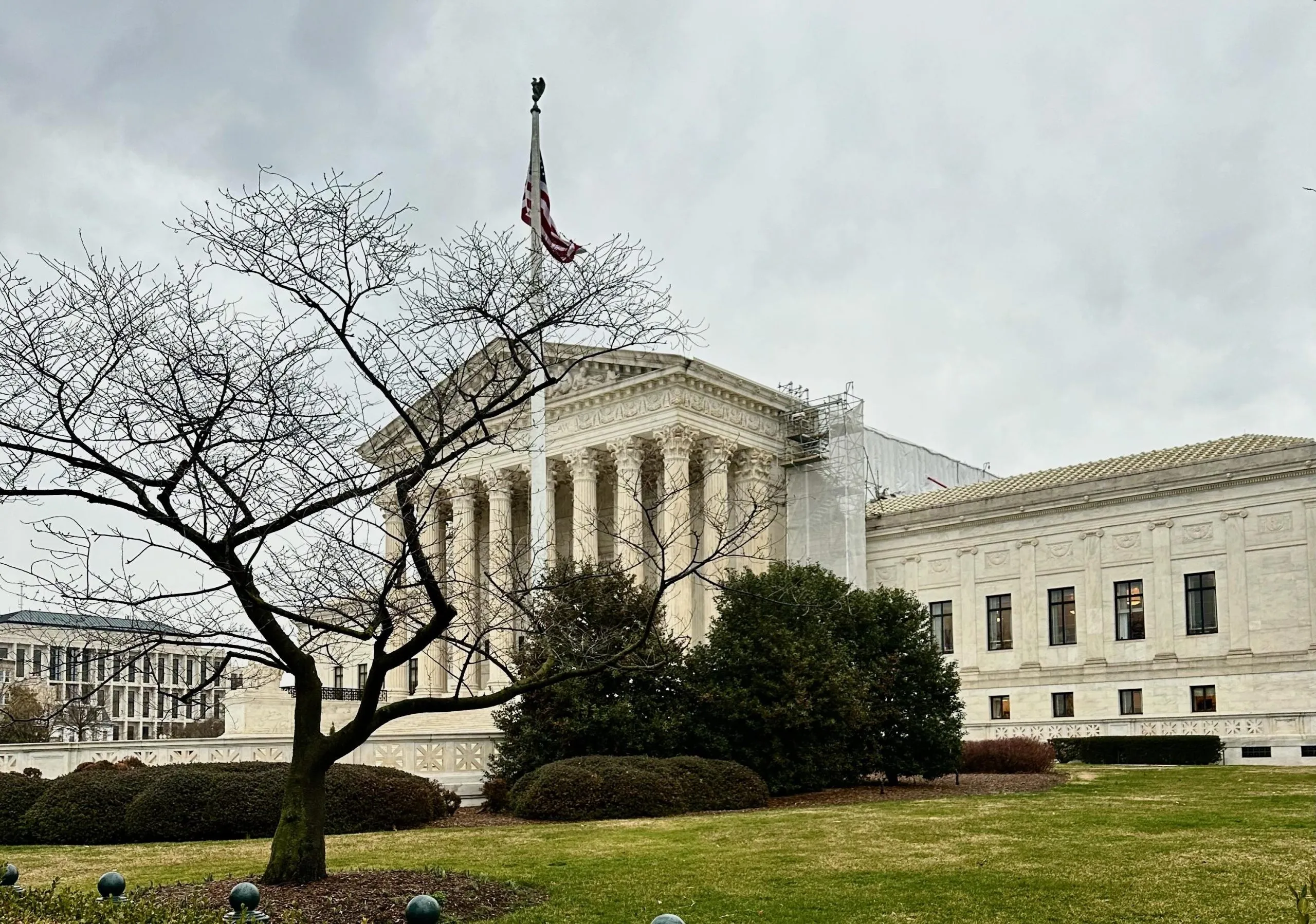
ScotusCrim is a recurring series by Rory Little focusing on intersections between the Supreme Court and criminal law.
Please note that the views of outside contributors do not reflect the official opinions of SCOTUSblog or its staff.
Welcome to the second installment of ScotusCrim, a recurring column focused on criminal-law-and-related cases at the Supreme Court. Today I focus on juries and sentencing in criminal cases; and at the end I introduce a feature called “Out of My Lane” in which I hope to offer brief thoughts on non-criminal aspects of Supreme Court practice.
The Sixth Amendment provides, without qualification, that “[i]n all criminal prosecutions, the accused shall enjoy the right to a … trial.” Article III similarly directs that “[t]he trial of all Crimes, except in Cases of Impeachment, shall be by jury.” As the only right guaranteed in both the body of the Constitution and the Bill of Rights, this concept was aptly described by Justice Antonin Scalia in 1999 as “the spinal column of American democracy.” Or as John Adams put it in 1774, the right to “trial by jury [is] the heart and lungs of liberty.”
Yet despite the wording of the Sixth Amendment, the right to jury trial has not been interpreted to extend to “all criminal prosecutions.” When the jury right was extended to state criminal prosecutions, the court held (in Duncan v. Louisiana in 1968 and in Frank v. United States in 1969) that “petty offenses,” including crimes “with possible penalties up to six months,” do not fall within the Sixth Amendment’s jury trial meaning. As for civil cases, the Seventh Amendment explicitly limits the jury trial right only to “suits at common law, where the value in controversy shall exceed twenty dollars.”
Twenty-five years ago, in Apprendi v. New Jersey (the “sleeper decision of 2000”), the Supreme Court adopted Scalia’s view that criminal sentencing disputes should be considered part of the “criminal prosecution[],” thereby requiring trial by jury – at least in some cases. Prior to Apprendi – and still today for most cases – the decision of what sentence to impose on a convicted defendant rested with the sentencing judge, not a jury. Apprendi changed this practice, ruling that the Sixth Amendment requires a jury determination on any fact that can raise a statutory maximum (and, by later decision, minimum) sentence. With one glaring exception (Almendarez-Torres v. United States, in 1998, addressing prior convictions), the “Apprendi revolution” has thus slowly extended jury trial rights on factual disputes to various proceedings related to criminal prosecutions.
Enter Justice Neil Gorsuch, who was confirmed in April 2017 to take Scalia’s unexpectedly open seat. Prior to confirmation, Gorsuch, together with Judge Susan Graber of the U.S. Court of Appeals for the 9th Circuit, had proposed a broad expansion of jury trials in civil cases for the federal judiciary. But a review of his opinions in the March 2017 Stanford Law Review mentioned nothing about his views on criminal jury trials.
However, once on the court, Gorsuch has become the primary defender, and expander, of the right to a jury trial. Here are just a few examples; more are possible. In 2020’s Ramos v. Louisiana, he wrote for a majority that a constitutional jury verdict requires a unanimous jury. In 2022, he dissented from the denial of certiorari in Khorrami v. Arizona, a case involving an eight-member jury conviction, writing that the term “jury” in the Sixth Amendment “meant a trial before 12 members of the community—nothing less.” In the 2023-24 term, in Securities and Exchange Commission v. Jarkesy, Gorsuch concurred in the decision to apply the Seventh Amendment jury trial right to SEC civil penalty proceedings; in a lengthy historical examination, he noted that the Declaration of Independence had admonished the king for “depriving [the colonists], in many cases, of the benefits of Trial by Jury.” And this past February, in Rimlawi v. United States, he dissented from another denial of certiorari, arguing that Apprendi should be extended to require a jury trial for fact-finding regarding criminal restitution.
Most recently, in June, a 5-4 majority in Perttu v. Richards ruled that the Prison Litigation Reform Act’s exhaustion-of-remedies requirement – normally a legal question for the judge – must yield to an unexpressed jury trial right when the facts necessary to evaluate exhaustion are “intertwined” with the merits of a prisoner’s claim. Chief Justice John Roberts wrote the decision (as he did in Jarkesy), but Gorsuch’s vote was dispositive – I imagine his voice supporting jury trials in conference was strong. “The right to trial by jury is ‘of such importance and occupies so firm a place in our history’” that any alleged curtailment must be “scrutinized with the utmost care,” wrote the court. This was over the dissenting view of Justice Amy Coney Barrett, who argued that the statute “does not” say a word about jury trials (true), and that the result frustrated the resources-conserving purposes of the PLRA. Gorsuch, normally a strict textualist, wrote nothing. His expansive jury trial views appeared to overcome other concerns.
But of even greater significance is Gorsuch’s little-noticed – so far – writing in the 2023-24 term about criminal sentencing and the right to a jury trial. If his words for a six-justice majority are taken literally, then Erlinger v. United States might well be the “sleeper decision of 2024.” The opinion can be read to require a jury trial for virtually any criminal sentencing proceeding, which would revolutionize criminal sentencing.
The issue in Erlinger was a narrow and relatively rare one. The Armed Career Criminal Act increases a convicted defendant’s possible prison term if the defendant has three prior convictions for violent or serious offenses “committed on occasions different from one another.” At Paul Erlinger’s sentencing, which followed his guilty plea, the question was whether Erlinger’s prior felonies, which consisted of multiple burglaries “within a span of days,” had been on “different occasions” or were part of “a single criminal episode.” (In 2022 the court had ruled in Wooden v. United States that ten burglaries at one storage facility in one day could be “a single criminal episode.”) The court ruled for Erlinger, that this decision should have been made by a jury and not a judge. A fact-laden “qualitative assessment about the ‘character and relationship’ of the offenses” was required, and that is the sort of fact-finding that the Sixth Amendment relegates to juries, not judges.
Explaining the court’s rationale, Gorsuch wrote that the Sixth Amendment right to jury trial and the Fifth Amendment’s guarantee of due process require a “jury to find every fact essential to an offender’s punishment.” I am unwilling to believe that this was just a sloppy way to phrase Apprendi’s “increase the statutory maximum” holding. And as the voluminous federal sentencing guidelines show, a multitude of facts are usually necessary – essential? – to determining exactly what sentence a judge should impose. In fact, Justice Clarence Thomas concurred in Erlinger to express the same view, one that he has espoused since concurring in Apprendi (which Scalia joined). According to Thomas, for every crime, the jury’s province encompasses “every fact that is by law a basis for imposing … punishment.”
Justice Samuel Alito, who has long disagreed with Apprendi, joined Justice Brett Kavanaugh’s dissent in Erlinger, criticizing the seeming extension of Apprendi beyond statutory maximums to other parts of the sentencing process. Interestingly, Justice Ketanji Brown Jackson – a former public defender – dissented separately in Erlinger, arguing that Apprendi was “wrongly decided.” She cited, as Alito has in the past, my 2004 essay explaining that the same First Congress that wrote the Sixth Amendment enacted many criminal laws giving judges, not juries, authority to choose sentences.
It is plausible to interpret Erlinger as applying only to the narrow context presented in that case – ACCA “separate occasions” disputes. Indeed, the chief justice’s three-sentence concurrence says as much. One can also read the case as limited only to facts that raise a potential statutory maximum penalty; under that reading the case was, as Gorsuch suggested, “nearly on all fours with Apprendi.” And so far, lower federal courts appear to have applied Erlinger only in the limited ACCA “separate occasions” context (although as Professor Chad Flanders recently noted, New York courts, in at least two cases, have applied the “every fact essential to … punishment” as extending to the state’s sentencing regimes.)
Nevertheless, Gorsuch wrote for a majority in Erlinger, and the five justices who joined his opinion did not dispute that “every fact essential to … punishment” is subject to jury determination. Criminal defense practitioners, known for both their creativity and their tenacity, can sincerely argue that in any given criminal case, every fact is essential to determining exactly where, within a wide range of punishments, a specific sentence should be imposed. Unless a future majority refines exactly what it meant, Erlinger can therefore provide fertile fodder for arguing for jury trials in many criminal sentencings.
Alito and others would argue, realistically and understandably, that our current judicial system cannot handle that many jury trials. Some 66,000 criminal cases are filed in federal court every year; there are even more state cases. But only 2% currently go to jury trial in the federal system, because the huge majority of defendants are sentenced by judges alone.
An impossible burden argument was made in Apprendi, yet courts and prosecutors then adjusted to accommodate that decision. Furthermore, Gorsuch wrote in Erlinger that “[t]here is no efficiency exception to the Fifth and Sixth Amendments.” He suggested that “bifurcation” – “sequencing and separating the jury’s determinations” – into distinct criminal jury proceedings is the answer. The Erlinger opinion found such systemic “burden” arguments, clearly articulated by the dissenters, simply irrelevant to determining constitutional meaning.
So … are all facts “essential” to criminal punishment subject to jury trials? Should we have “a soft spot for Gorsuch” – as Zach Shemtob has written – here, when it comes to expanding the right to a jury trial? We are not there, yet, and may never be. All we can do is await, with interested anticipation, for further steps in Gorsuch’s repeated commitment to the Sixth Amendment’s unqualified text requiring jury trials in “all criminal prosecutions.”
Out of my lane
When the Supreme Court examined the “birthright citizenship” clause in the 14th Amendment 127 years ago in United States v. Kim Wong Ark, it recognized only two “exceptions to the fundamental rule of citizenship by birth”: “children born of alien enemies in hostile occupation, and children of diplomatic representatives of a foreign state.” This came after an exhaustive review of both British common law and early American cases. In a wonderful July 17 Advisory Opinions podcast, Sarah Isgur, David French, and Kannon Shanmugam discussed the class action injunction of President Donald Trump’s birthright citizenship order recently issued by Judge Joseph Normand Laplante in New Hampshire. I just want to offer the thought that the subject class – sure to be granularly litigated – should be defined to exclude children born in the United States who fall within those exceptions. Although I also like David French’s simpler, but less specific, idea (at 15:45): “everyone who would receive citizenship under existing law.”
Posted in Recurring Columns, ScotusCrim
Cases: Perttu v. Richards, Erlinger v. United States
Recommended Citation:
Rory Little,
Justice Neil Gorsuch’s “right to jury trial” revolution,
SCOTUSblog (Jul. 24, 2025, 10:42 AM),
https://www.scotusblog.com/2025/07/justice-neil-gorsuchs-right-to-jury-trial-revolution/
