

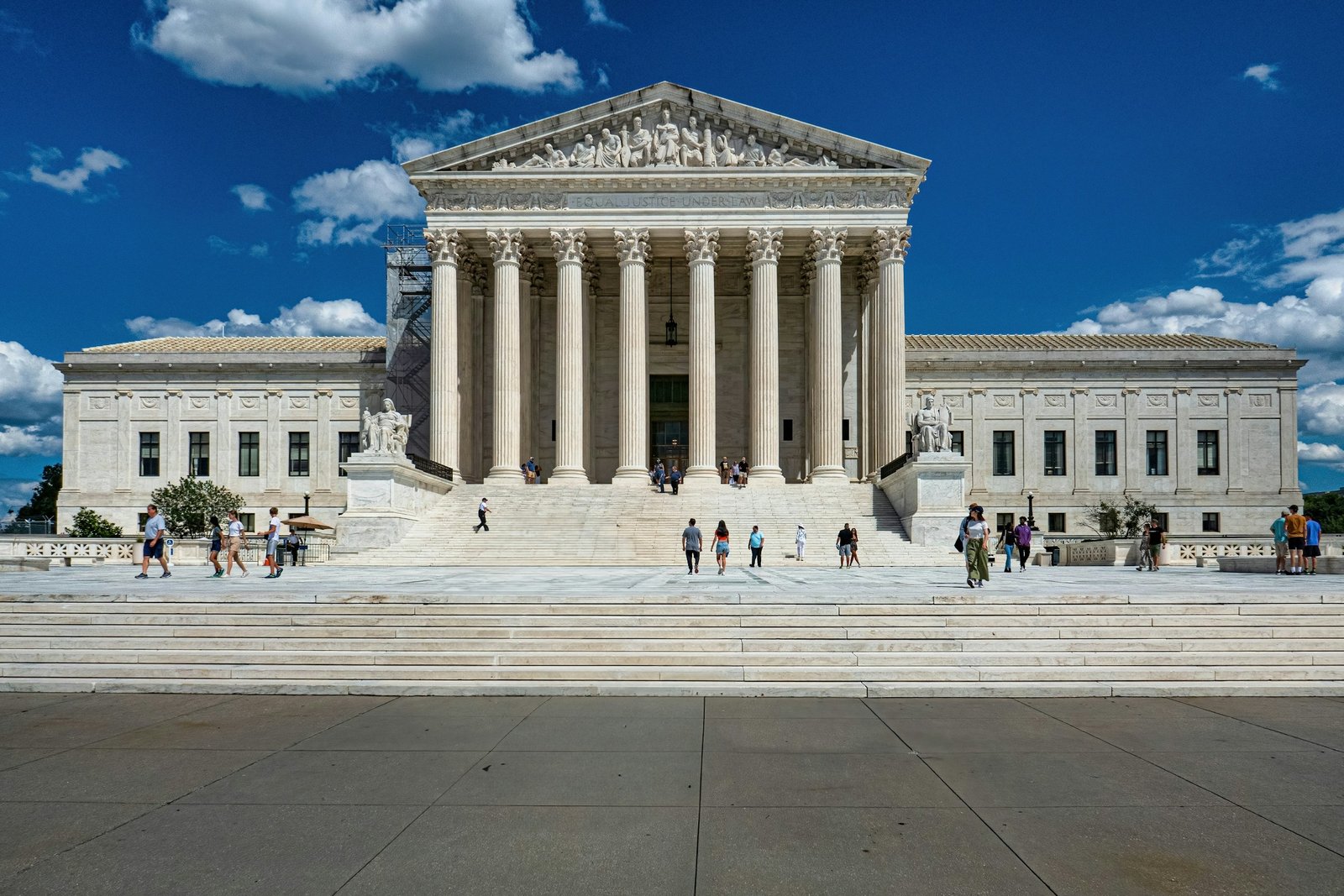
The Supreme Court on Tuesday was sympathetic to a group of faith-based pregnancy centers in their quest to challenge New Jersey’s demand for information about the group’s fundraising practices in federal court. The state contends that the group, First Choice Women’s Resource Centers, must litigate its claims in state court, but after Tuesday morning’s oral argument, a majority of the justices appeared ready to side with First Choice in its bid to litigate its First Amendment claim in federal court.
The oral argument was the latest skirmish in the two-year-old legal battle that began when New Jersey’s attorney general, Matthew Platkin, issued subpoenas to First Choice seeking (among other things) information about the group’s donors. Platkin and his office said they were investigating whether First Choice may have misled women about whether it provides certain reproductive-health services, such as abortions.
First Choice, which describes itself as “a faith-based nonprofit” that provides “material support and medical services like ultrasounds and pregnancy tests under the direction of a licensed medical director,” went to federal court in New Jersey to challenge the subpoena. It argued that the subpoena either had or would have a “chilling” effect on both its own First Amendment rights and those of its donors – that is, that the subpoena would (among other things) discourage donors from making contributions and, because it sought the identities of the group’s staff, caused First Choice to remove videos that identified its staff from its YouTube channel.
A federal judge in Trenton, New Jersey, declined to block the subpoena. U.S. District Judge Michael Shipp ruled that the dispute was not yet “ripe” – that is, ready for the federal court to take up. Only a state court, Shipp said, has the power to enforce or block a subpoena, and no state court had done so yet.
When Platkin attempted to enforce the subpoena, a state court granted his request and directed First Choice to “respond fully” to the state’s demands for information – which, the state court later made clear, would also allow First Choice to object to those demands.
Back in federal court, Shipp once again ruled that the dispute was not yet ripe. Although the state court had granted Platkin’s request to enforce the subpoena, Shipp wrote, it had not yet determined whether First Choice would face sanctions if it did not comply.
The U.S. Court of Appeals for the 3rd Circuit upheld that decision. It wrote that First Choice “can continue to assert its constitutional claims in state court as that litigation unfolds; the parties have been ordered by the state court to negotiate to narrow the subpoena’s scope; they have agreed to so negotiate; the Attorney General has conceded that he seeks donor information from only two websites; and First Choice’s current affidavits do not yet show enough of an injury.”
Judge Stephanos Bibas dissented. In his view, First Choice’s case was “indistinguishable from Americans for Prosperity Foundation v. Bonta,” the Supreme Court’s 2021 decision striking down, on First Amendment grounds, California’s requirement that charities and nonprofits in the state provide the state attorney general’s office with the names and addresses of their largest donors.
Representing First Choice, Erin Hawley told the justices that the “sweeping subpoena” issued by the New Jersey attorney general violated the group’s First Amendment right to association as soon as it received the subpoena, even if the subpoena was not self-executing (meaning that the attorney general cannot himself enforce it or impose penalties for noncompliance, but instead must go to court to do so). And First Choice should have been able to challenge that subpoena in federal court without waiting for the state courts to act, Hawley continued. Federal courts, she said, have a “virtually unflagging obligation to decide cases within their jurisdiction.”
Vivek Suri, an assistant to the U.S. solicitor general who argued on behalf of the federal government, which supports First Choice, offered a slightly different theory. A plaintiff like First Choice, Suri said, has a legal right to sue, known as standing, as long as there is a “credible threat” that the subpoena would be enforced against it.
But Sundeep Iyer, from the New Jersey attorney general’s office, countered that First Choice had not shown that the mere issuance of the subpoena had chilled its First Amendment rights. Any legal duty to produce the documents that the subpoena requests, Iyer argued, are “wholly contingent” on a future order from a state court directing the group to do so. And in this case, Iyer emphasized, the state court has not issued such an order during two years of litigation.
Several justices pushed back against the characterization of the subpoena in this case as non-self-executing. Justice Neil Gorsuch made this point several times, telling Iyer that the subpoena seems “pretty self-executing to me.”
Justice Samuel Alito pressed a related point, appearing to suggest that the state had characterized the subpoena as non-self-executing as a litigation tactic rather than because it necessarily believed that was the case. “When,” Alito asked Hawley, did the attorney general argue that these subpoenas were non-self-executing?
Hawley responded that, to her knowledge, the attorney general had first made that argument in this case.
Iyer conceded that if the Supreme Court rejected the state’s characterization of the subpoena as non-self-executing, there was “no dispute” that a plaintiff like First Choice would have a right to sue “from the moment of the issuance of the subpoena” – a concession that could effectively resolve the dispute.
Beyond the issue of the nature of the subpoena, much of the argument focused on the two theories under which First Choice and the Trump administration argued that First Choice should prevail. Pressing the theory that the subpoena violates First Choice’s constitutional right of association, Hawley told the court that it should look at whether “a reasonable donor would have been chilled” by the subpoena – and that the answer in this case is “yes.”
Chief Justice John Roberts seemed to agree. “You don’t think,” he told Iyer somewhat incredulously, “it might have an effect on future potential donors … to know that their name, phone number, address, et cetera could be disclosed as a result of” a subpoena like the one that First Choice received?
Justice Brett Kavanaugh also was sympathetic to this argument. He noted that a “friend of the court” brief filed by the American Civil Liberties Union voiced concerns about “suppression by subpoena.” “[T]his is just kind of obvious that there’s some kind of objective chill,” he said.
Justice Elena Kagan appeared receptive to this argument as well. In a case like this, she posited, an ordinary person won’t be “particularly reassured by the fact that” you still need a court order before the subpoena will be enforced. The mere issuance of the subpoena, she seemed to suggest, would be enough to deter a potential donor.
Justice Ketanji Brown Jackson was skeptical of the government’s theory that a plaintiff can go to court as long as there is a credible threat that the subpoena will be enforced. The Supreme Court, she said, has generally required “a really clear showing” that a plaintiff faces an imminent injury – a higher bar, and one that she suggested is not met in this case, because it is “not certain” that First Choice will have to disclose information.
Iyer contended that adopting the “credible threat” theory would open the door to a flood of cases challenging state and local subpoenas. First Choice and the Trump administration, he said, “haven’t identified a single case” adopting that theory. And because the theory can’t be limited to First Amendment cases like this one, he warned, “federal courts would potentially be inundated.”
Alito (among others) also expressed concern about the effects of requiring plaintiffs like First Choice to wait until the state court orders them to comply with the subpoena before they can go to federal court to press their First Amendment claim.
Even Jackson, who had been among the justices most receptive to New Jersey’s arguments, jumped in. Wouldn’t First Choice be “precluded,” she asked Iyer, from pursuing a First Amendment claim in federal court once the state court had ruled on it? “I mean, you’ve sort of made it impossible for them,” she added.
Iyer agreed that “we think they would be precluded” from going to federal court in a case like this – a concession that, while candid, likely garnered First Choice more sympathy.
A decision in the case is expected by late June or early July.
Cases: First Choice Women’s Resource Centers, Inc. v. Platkin
Recommended Citation:
Amy Howe,
Court appears sympathetic to faith-based pregnancy centers’ argument,
SCOTUSblog (Dec. 2, 2025, 2:45 PM),
https://www.scotusblog.com/2025/12/court-appears-sympathetic-to-faith-based-pregnancy-centers-argument/
