

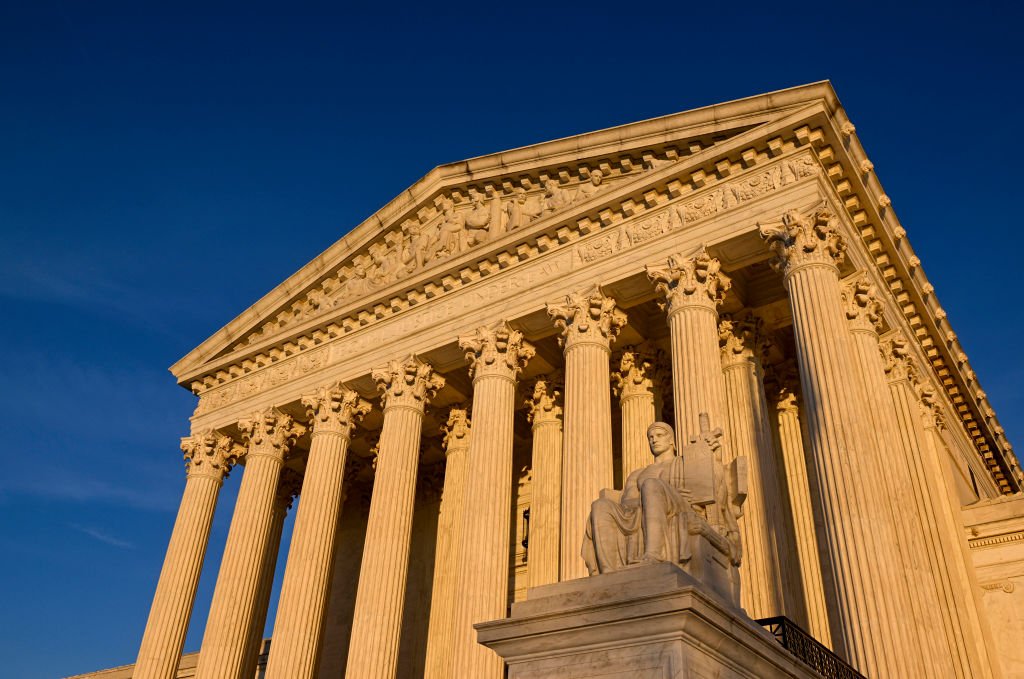
The Supreme Court on Thursday gave the green light to Texas’ efforts to be able to use a new congressional map favorable to Republicans in the 2026 elections despite a lower court’s ruling that the map unconstitutionally sorts voters based on race. In a brief, unsigned opinion, a majority of the court granted the state’s request to pause the ruling issued earlier this month by a three-judge district court in El Paso. That ruling had been on hold since Nov. 21, when Justice Samuel Alito – who handles emergency appeals from Texas – temporarily stayed it to give the justices time to consider the state’s request; Wednesday’s decision extends that hold indefinitely.
The court’s brief, five-paragraph order indicated that “Texas is likely to succeed on the merits of its claim that the District Court committed at least two serious errors.” Moreover, it added, the lower court “improperly inserted itself into an active primary campaign, causing much confusion and upsetting the delicate federal-state balance in elections.”
Justice Elena Kagan dissented from the ruling, in an opinion joined by Justices Sonia Sotomayor and Ketanji Brown Jackson. Thursday’s order, she said, “announces that Texas may run next year’s elections with a map the District Court found to have violated all our oft-repeated strictures about the use of race in districting. Today’s order,” she continued, “disrespects the work of a District Cour that did everything one could ask to carry out its charge—that put aside every consideration except getting the issue before it right.”
Texas currently has 38 seats in the U.S. House of Representatives, 22 of which are controlled by the Republican Party. Republicans as a whole hold a much narrower majority in the House – 219 to 214, with two vacant seats.
For several decades, the president’s party has historically lost seats in the House in the midterm elections. In the hope of retaining control of the House, President Donald Trump this summer called on Texas to redraw its congressional map to flip five additional districts to Republicans. State lawmakers, however, worried that moving Republican voters from “safe” Republican districts to districts that currently favor Democrats, with the goal of turning the Democratic districts red, could backfire by reducing support for Republican incumbents in the supposedly “safe” Republican districts.
But the prospect of a rare mid-decade redistricting returned to lawmakers’ agenda in July, after the Department of Justice sent the state a letter alleging that four of the state’s districts were unconstitutional because they were “coalition districts” – majority-minority districts that lack a single racial majority. If Texas didn’t “rectify” this “racial gerrymandering” immediately, the letter said, DOJ would take legal action.
Two days after receiving the letter, Texas Gov. Greg Abbott directed the state’s legislators to draw a new congressional map that would address the concerns mentioned in the DOJ letter. Under the new map, adopted in August, Republicans hope to win as many as 30 of the 38 seats – an increase of five over the previous map.
The new map quickly drew challenges from several groups of plaintiffs, led by the League of United Latin American Citizens, a civil rights group. They contended that the map was the product of unconstitutional racial gerrymandering, and they asked a three-district court – which Congress has tasked with hearing challenges to the constitutionality of the apportionment of congressional districts – to temporarily bar the state from using the map in the 2026 elections.
Texas countered that it had adopted the map for purely political and partisan reasons, and in particular, in response to Trump’s demands for five new House seats. Racial motivations, it said, were not in play.
On Nov. 18, a majority of the three-judge district court blocked the state from using the 2025 map in the upcoming elections and ordered Texas to instead use the existing map, which it enacted in 2021. U.S. District Judge Jeffrey Brown, in a 160-page opinion joined by Senior U.S. District Judge David Guaderrama, wrote that although “politics played a role in drawing the 2025 Map,” “it was much more than just politics. Substantial evidence,” he concluded, “shows that Texas racially gerrymandered the 2025 Map.”
The Department of Justice, Brown said, was wrong when it told Texas that its “coalition” districts violate the Constitution. “Far from seeking to ‘rectify . . . racial gerrymandering,’” he said, the DOJ letter “urges Texas to inject racial considerations into what Texas insists was a race-blind process.”
Moreover, Brown continued, although the Supreme Court has ruled that courts should generally not change election rules shortly before an election – a doctrine known as the Purcell principle – that rule is based not simply on “counting the number of days until the next election” but “on a fact-intensive analysis that considers the disruption an injunction would cause.” Here, he wrote, because the primary election was still four months away, while the general election was a year away, blocking the new map “would not cause significant disruption.”
The third member of the three-judge district court, Judge Jerry Smith of the U.S. Court of Appeals for the 5th Circuit, wrote a 104-page dissent in which he complained that Brown had not given him a chance to respond to the majority’s opinion. Smith called Brown’s conduct “the most outrageous … by a judge that I have ever encountered in a case in which I have been involved.” Smith then described the majority’s opinion as “the most blatant exercise of judicial activism that I have ever witnessed.”
Texas came to the Supreme Court on Nov. 21, asking the justices to put the majority’s ruling on hold by Dec. 1 and to issue an administrative stay – which would pause the ruling while the justices considered the state’s request – immediately. The latter was granted that same day.
The state told the Supreme Court that, under the Purcell principle, it was too late to revert to the 2021 map. At the time, the deadline for candidates to file for election was just 17 days away, with early voting for the March 3 primary election beginning on Feb. 17. “Changing the primary date,” the state asserted, “could be ‘catastrophically bad.’”
The court should also pause the majority’s ruling, the state asserted, because (among other things) the state is likely to prevail on the merits of the dispute. Under a 2024 decision by the Supreme Court in another redistricting dispute, the state stressed, the challengers should have submitted their own map to show that lawmakers could have drawn a different map that achieved the state’s goals without relying so heavily on race. And there would be no harm to the challengers (another factor that courts consider in deciding whether to grant temporary relief) from using the new map in the 2026 midterms, the state wrote, because “counties, candidates, and voters have been relying” on that map.
The challengers rejected Texas’ contention that the Purcell principle bars the courts from blocking the new map now. They emphasized that the majority’s ruling, by instructing the state to reinstate the 2021 map, rather than an order from the Supreme Court that pauses the majority’s ruling, would truly return the state to the status quo.
And there is no requirement for the challengers to offer an alternative map, they argued, because although the Supreme Court has indicated that such maps may be necessary when there is little direct evidence of discrimination and plaintiffs are instead relying on circumstantial evidence, in this case there is substantial direct evidence of racial gerrymandering.
Posted in Emergency appeals and applications, Featured
Cases: Abbott v. League of United Latin American Citizens
Recommended Citation:
Amy Howe,
Supreme Court allows Texas to use redistricting map challenged as racially discriminatory,
SCOTUSblog (Dec. 4, 2025, 6:26 PM),
https://www.scotusblog.com/2025/12/supreme-court-allows-texas-to-use-redistricting-map-challenged-as-racially-discriminatory/
