


Listen to this article
Estimated 4 minutes
The audio version of this article is generated by text-to-speech, a technology based on artificial intelligence.
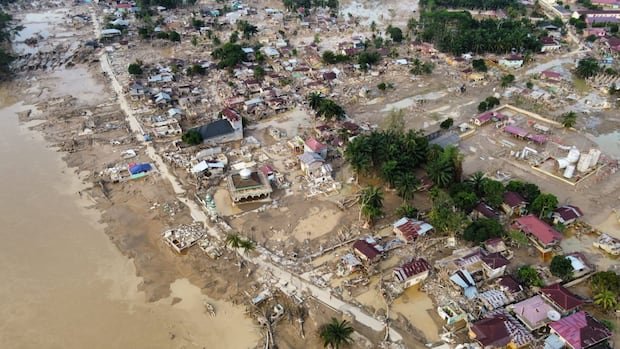
The death toll from last week’s catastrophic floods and landslides in parts of Asia surged past 1,500 on Thursday as rescue teams raced to reach survivors and hundreds of people remained unaccounted for across the region.
The latest figure came as meteorologists warned of renewed rainfall across parts of Indonesia — including the provinces of North Sumatra, West Sumatra and Aceh — in coming days, sparking fears of further devastation in areas already reeling from deadly floods.
The tragedy was compounded by warnings that decades of deforestation caused by unchecked development, mining and palm oil plantations may have worsened the devastation. Calls grew for the government to act.
“We need the government to investigate and fix forest management,” said Rangga Adiputra, a 31-year-old teacher whose home in West Sumatra was swept away. The hills above his village on the outskirts of Padang, Indonesia, had been scarred by illegal logging.
“We don’t want this costly disaster to happen again.”
Authorities said 836 people were confirmed dead in Indonesia, 479 in Sri Lanka and 185 in Thailand, as well as three in Malaysia.
Many villages in Indonesia and Sri Lanka remained buried under mud and debris, with 859 people still unaccounted for in both countries.

Thousands reportedly faced severe shortages of food and clean water in cut off areas. The floods and landslides washed away roads and bridges and knocked out telecommunications, leaving many communities inaccessible.
Indonesian television showed images of huge amounts of felled timber carried downstream in North Sumatra, West Sumatra and Aceh.
The leading Indonesian environmental group WALHI said that decades of deforestation — driven by mining, palm oil plantations and illegal logging — stripped away natural defences that once absorbed rainfall and stabilized soil.
“The disaster was not just nature’s fury, it was amplified by decades of deforestation,” said Rianda Purba, an activist with the group. “Deforestation and unchecked development have stripped Sumatra of its resilience.”

Rescue crews scramble to reach survivors and recover more bodies as the death toll from last week’s disastrous flooding and landslides tipped over 1,300 across Indonesia, Sri Lanka and Thailand. Almost 900 people are still missing.
The group recorded more than 240,000 hectares of primary forest were lost in 2024 alone, leaving Sumatra’s small river basins dangerously exposed.
Another environmental group, Global Forest Watch, has said the three flooded provinces have since 2000 lost 19,600 square kilometres of forest, an area larger than the state of New Jersey.
“Unless restoration begins now, more lives will be lost,” Purba warned.
Indonesian President Prabowo Subianto pledged policy reforms after visiting flood-hit areas on Monday.
“We must truly prevent deforestation and forest destruction. Protecting our forests is crucial,” Prabowo said.
In Batang Toru in North Sumatra, where seven companies operate, hundreds of hectares had been cleared for gold mining and energy projects, leaving slopes exposed and riverbeds choked with sediment. Rivers there were swollen with runoff and timber, while villages were buried or swept away.
Lawmakers called for the companies’ permits to be revoked.
Facing public outrage, Environment Minister Hanif Faisol Nurofiq announced an investigation into eight companies suspected of worsening the disaster. He said environmental permits will be reviewed and future assessments must factor in extreme rainfall scenarios.
“Someone must be held accountable,” he said.
The latest weather forecasts predict heavy rain and thunderstorms on Friday to Saturday, with saturated soil and swollen rivers leaving communities on edge.
For Safnida, a 67-year-old survivor, the forecast brings renewed anxiety.
“We can’t expect life to always be good, right? I’m grateful to be alive while my house collapsed in the floods,” she said, sitting on a thin mat in an elementary school turned evacuation shelter in Padang city on Thursday.
“At my age, I don’t know if I can still survive,” said Safnida, who goes by a single name like many Indonesians.

