

Even before a third federal immigration officer-involved shooting in Minneapolis left 37-year-old Alex Pretti dead, U.S. Vice-President JD Vance remarked upon how that city was different.
On Thursday, while making a visit to the twin cities of Minneapolis and St. Paul, Vance wondered aloud why there didn’t seem to be the “same level of chaos” in other cities that have seen crackdowns by immigration law enforcement officers.
“Maybe the problem is unique to Minneapolis,” Vance said, who also urged local officials to co-operate with federal immigration enforcement.
Part of the answer, perhaps, lies in Minnesota’s robust history of protest going back to the 1890s, and the pivotal moments the twin cities played in labour and civil rights movements.
Take for example, the brutal Teamsters strike in which two protesters lost their lives in a hail of bullets on July 20, 1934, a day which became known as Bloody Friday and eventually led to Congress passing the National Labor Relations Act a year later.

Local historians see echoes of the past in what is playing out in their streets now.
“Tragically, there is quite a parallel,” said Peter Rachleff, a retired labour history professor in St. Paul.
“It certainly seems as if we’re in a historical moment right now where the repercussions of what’s happening … are similar in their consequences,” he said.
Teamsters deaths a rallying cry
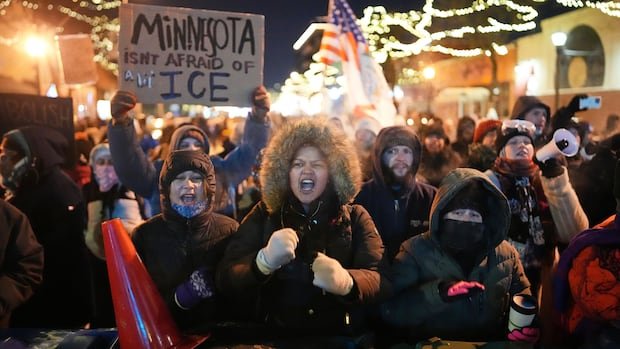
Minnesota’s pro-labour roots were evident Friday as 20,000 braved extreme cold warnings to march against Immigration and Customs Enforcement (ICE), yelling, “Get up! Get down! Minneapolis is a union town.”
Those roots go at least as far back as the Great Northern Railroad Strike of 1894 where Minnesota was ground zero for a successful 18-day labour action which reversed months of consecutive wage cuts, Rachleff said.
That led to a nationwide railroad boycott known as the Pullman strike, Rachleff said, and ultimately led to establishment of Labor Day signed into law by President Grover Cleveland in the fall of 1894 as a national U.S. holiday.
In May 1934, Minneapolis — a major trucking distribution centre for the midwest at the time — was brought to a near standstill in May when truckers walked off the job demanding fairer wages and working hours.
That July, at the height of the Teamsters strike, police opened fire, wounding 67 strikers and killing two: Henry Ness and John Belor.
“Those deaths marked a turning point,” said Chantel Rodrigeuz, the Minnesota Historical Society’s senior public historian.

“It led to increasingly broad support for the Teamsters with Henry Ness’s name, who himself was a World War I veteran. His name became a rallying cry for this labour strike and movement.”
In the aftermath of the shooting deaths the governor declared martial law and mobilized 4,000 National Guard members.
“During that time, the National Guard is doing things like raiding strikers’ headquarters, arresting union leaders, placing them in a stockade at the state fairgrounds in St. Paul,” Rodriguez said.
On this day in 1934, Minneapolis police fired on workers during the seminal Teamsters strike, killing two and wounding sixty. <a href=”https://t.co/n9PJ4ojJNV”>pic.twitter.com/n9PJ4ojJNV</a>
—jacobin
“Despite all of this violence, the two deaths, the many wounded and increasingly broad support for these Teamsters and labour organizing, the Teamsters actually win all of their demands.”
Integrated community organizing
The twin cities also played a prominent role in the civil rights movement, organizing in a way that looks a lot like the current integrated community approach to anti-ICE protests, Rodriguez said.
Currently, a broad base of interconnected volunteers from faith and community organizations have set up ICE neighbourhood watches, grocery deliveries for immigrants afraid to leave their homes, and groups of school and faith institutions observers who try to shield students and worshippers from ICE sweeps.
In the late 1960s, Rodriguez said an interracial coalition began forming in some neighborhoods including the Black Power Movement; the Brown Berets, part of the Chicano Movement which sought to empower Mexican Americans; and the American Indian Movement (AIM), whose roots are in the north side of Minneapolis.

The groups organized neighbourhood patrols for marginalized neighbourhoods.
“You can see that sort of level of organizing of saying, ‘hey, the system is failing us so I guess we have to come together and find ways to protect our neighbours,’ which is what they were doing,” Rodriguez said.
“Some of those patrols were armed, some weren’t, but it was a way of policing the police in community interactions, right? And so you kind of see that level of organizing back in the 1960s.”
Rodriguez drew parallels between that history and the community watches today, including in residential neighbourhoods and around schools.
George Floyd and 2020
And then there is the more recent history of protest in Minneapolis when George Floyd, a Black man, was killed by Derek Chauvin, a white police officer in 2020. It was the epicentre of a wave of racial justice protests across the U.S.
“I feel like that moment was a really important catalyst for creating the opportunity to develop even stronger grassroots organizing and networks,” Rodriguez.
“2020 came and went, but those organizations are still here. Those networks are still here. And … in many ways, you can see that folks today rely on some of those networks and more to react in this moment,” she said.

Rachleff says there is also a new generation organizing for the first time who were inspired by what public activism achieved in 2020 by using strikes, boycotts, protests, marches, and rallies.
What most fascinates him is the diversity of the people making up the movement. He noted that whatever one’s age, physical ability or political ideology, there are many ways people can participate depending on what actions they’re comfortable with.
“Do you want to stand face to face with ICE? Do you want to go to a workshop to learn what to do if you get pepper sprayed or tear gassed? Do you want to police outside of schools and protect kids? Do you want to raise money for resources?” he said.
“In the process of doing that, you’re going to meet people that you didn’t know before. And maybe you’re going to learn new ideas from them, or they’re going to learn new ideas for you. That’s really what a movement is. And what we’re seeing today in Minnesota is an expression of that movement. “
