

Soroush Negahdari,BBC Monitoringand
Ghoncheh Habibiazad,BBC Persian

 WANA via REUTERS
“My friends are all like me. We all know someone who was killed in the protests.”
For Parisa, a 29-year-old from Tehran, the crackdown by security forces in Iran earlier this month was unlike anything she had witnessed before.
“In the most widespread previous protests, I didn’t personally know a single person who had been killed,” she said.
Parisa said she knew at least 13 people who had been killed since protests over worsening economic conditions erupted in the capital on 28 December and then evolved into one of the deadliest periods of anti-government unrest in the history of the Islamic Republic.
With one human rights group reporting that the number of people confirmed killed has passed 6,000, several young Iranians able speak to the BBC in recent days, despite a near-total internet shutdown, have described the personal toll.
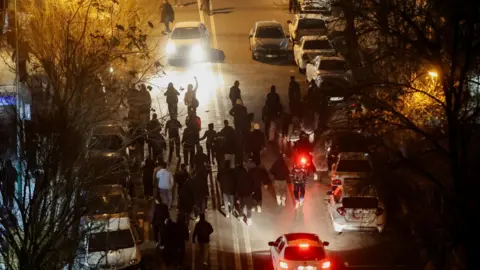
Parisa said one 26-year-old woman she knew was killed by “a hail of bullets in the street” when the protests escalated across the country on Thursday, 8 January, and Friday, 9 January, and authorities responded with lethal force to crush them.
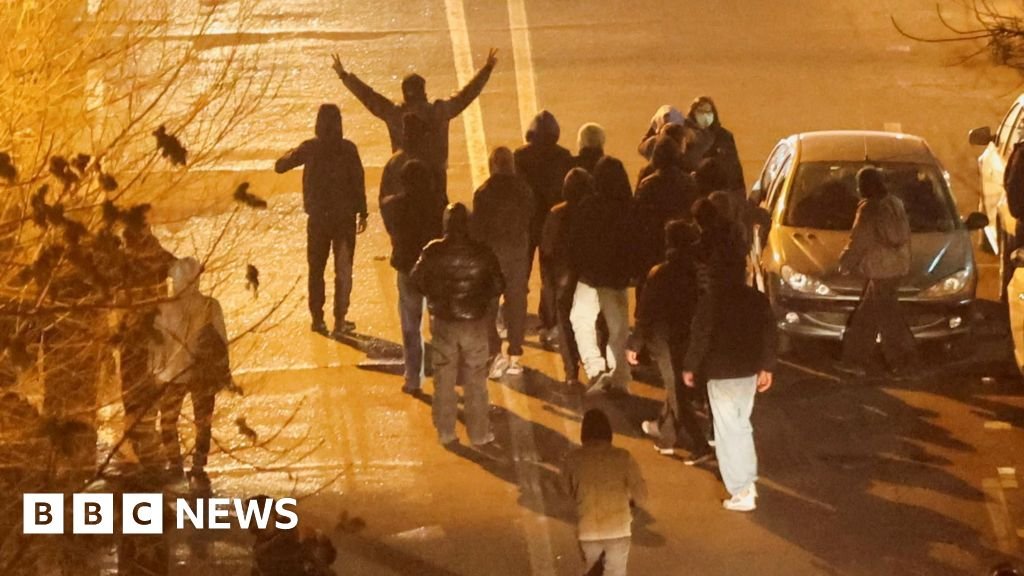
She herself took part in protests in the north of Tehran that Thursday, which she insisted were peaceful.
“No-one was violent and no-one clashed with the security forces. But on Friday night they still opened fire on the crowd,” she said.
“The smell of gunpowder and bullets filled the neighbourhoods where clashes were taking place.”
 SOCIAL MEDIA via REUTERS
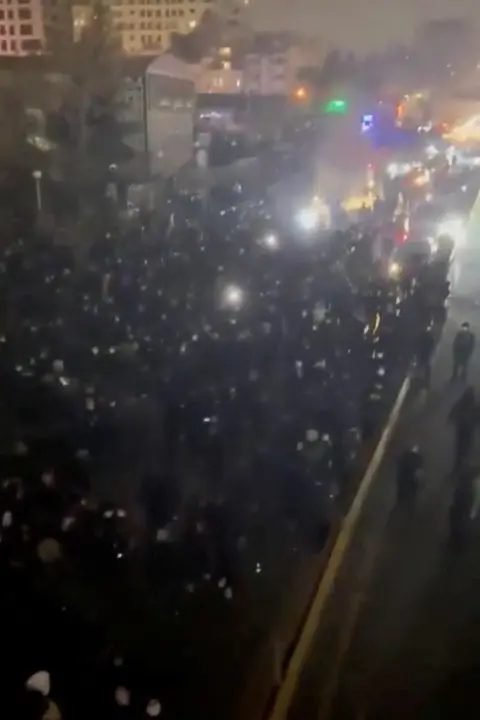
Mehdi, 24, who is also from Tehran, echoed her assessment of the scale of the protests and violence.
“I had never seen anything even close to this level of turnout and such killings and violence by the security forces,” he said.
“Despite the killings on Thursday [8 January] and threats of more killings on Friday, people came out, because many of them could no longer endure it and had nothing left to lose,” he added.
Mehdi described witnessing multiple killings of protesters at close range by security forces.
“I saw a young man killed right in front of my eyes with two live rounds,” he said.
“Motorcyclists shot a young man in the face with a shotgun. He fell on the spot and never got back up.”
The US-based Human Rights Activists News Agency (Hrana) says it has so far confirmed the killing of at least 6,159 people since the unrest began, including 5,804 protesters, 92 children and 214 people affiliated with the government. It is also investigating 17,000 more reported deaths.
Skylar Thompson, from Hrana, told the BBC the confirmed number of dead was very likely to rise.
“We are really committed to ensuring that every single piece of verified information that we report on sits next to a name and a location,” she added.
Another group, Norway-based Iran Human Rights (IHR), has warned that the final toll could exceed 25,000.
Iranian authorities said last week that more than 3,100 people had been killed, but that the majority were security personnel or bystanders attacked by “rioters”.
Most international news organisations, including the BBC, are barred from reporting inside Iran. But videos showing security forces firing live ammunition at crowds have been verified by the BBC.
 AFP
AFPAn Iranian woman who took part in the protests told BBC Newsnight she saw “people on the ground” and children killed in the crackdown.
Parnia, 25, who lives in London, said she was “on the front line” with “hundreds” of protesters as demonstrations grew in the central city of Isfahan where she was visiting family earlier this month.
“I saw people on the ground. I saw blood,” she said, describing her attempt to seek refuge amid clouds of tear gas.
After entering a lobby, she said she “saw so many people hurt by the pellets”.
“You could see children who were on the street and they got killed. Seven years old, eight years old.”
Sahar, a 27-year-old from the capital, said she knew seven people who had been killed.
She described how the security forces’ response to the unrest escalated rapidly on 8 January.
During a protest that evening, Sahar and her friends sought refuge in a nearby house after tear gas was fired.
“My friend stuck his head out of a window to see what was going on and they shot him in the neck,” she said.
Another friend was wounded by pellets and later bled to death after avoiding going to hospital out of fear of being detained, according to Sahar.
Sahar said a third friend died while being detained by the Islamic Revolution Guard Corps (IRGC).
“They [officers] told his family to come to the IRGC intelligence office. After a few days they rang and said, ‘Come and collect the body.'”
On 9 January, Sahar said, live ammunition was fired openly and “without mercy” by uniformed security personnel.
“They were pointing lasers at people, and locals were opening their car park doors for us to hide,” she said.
The communications blackout compounded the trauma.
“Right now there’s no news at all,” Sahar said. “Without internet or phone lines we had no idea what was happening to anyone. We could barely get calls through just to get bits of news.”
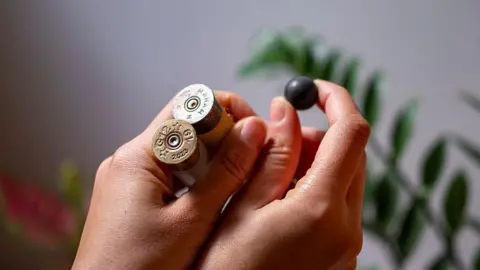
Parham, 27, described widespread use of pellet guns by security forces in Tehran, particularly targeting protesters’ faces and eyes.
One of his friends, Sina, 23, was shot in the forehead and eye on 9 January.
“We took him to a hospital, but the doctor could only give us a prescription and told us to leave as soon as possible,” Parham said.
At an eye hospital, he added, wounded protesters arrived constantly.
“Every 10 minutes, it felt like they were bringing in someone else who had been hit by a pellet.”
A worker at the hospital’s cafe said she had seen “70 people with eye injuries come in during a single shift”, according to Parham.
Sina – who still has pellets stuck behind one of his eyes and in his forehead – said they had been scared of being arrested at the first hospital because of the need to give their ID numbers, so they had gone to a private eye hospital.
He said he was “lucky” compared to the others who he saw at the eye hospital, who had “pellets all over their faces and in both of their eyes”.
The BBC has seen a medical document in Sina’s name that says “there is a 5mm metallic foreign body” behind his eye.
The medical records of a number of other protesters with pellet-gun wounds have also been received and verified by the BBC.
 EPA
EPAProtesters and activists have also described a pattern of refusal by the authorities to hand over the bodies of those killed to their families.
Mehdi said his friend’s cousin was killed and that the family was told by officials to either pay a large sum of money to receive his body or agree to him being recorded as a member of the security forces.
“They said, ‘Either pay 1 billion tomans [more than $7,000; £5,000] for us to hand over the body to the family, or you have to say he was a member of the Basij and was martyred for public security and against the riots.'”
Navid, a 38-year-old from Isfahan, also said two close friends whose relatives were killed had received such an ultimatum.
“They say you have to pay the equivalent of several thousand dollars or let us issue them a Basij card so they are counted among the security forces’ dead,” he cited his friends as saying.
Human rights groups have warned that this practice has served both to punish protesters’ families and obscure the true death toll.
