

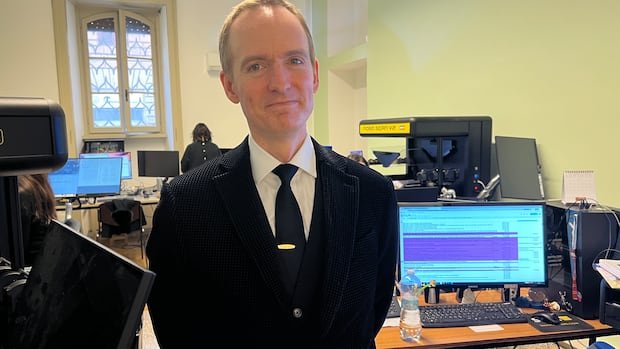
“When ChatGPT dropped, I saw an answer to a problem I was trying to address all my life,” said Matthew Harvey Sanders.
The Torontonian — a serious-mannered 43-year-old in clerical black — stands in the modern library of the Vatican’s Pontifical Oriental Institute. Balconies lined with shelves rise three storeys overhead, housing one of the largest collections of books on Eastern Catholic traditions in the world.
It is a fraction of the Catholic Church’s written record: councils and synods, papal encyclicals, official documents and statistical yearbooks tracking baptisms, marriages and ordinations. Sanders is turning that corpus into Magisterium AI, a Catholic-focused artificial intelligence platform he founded and runs as chief executive.
Around the corner, in a small office near Rome’s Termini station, a staff of young women feed thick theological volumes into refrigerator-sized scanners while robotic arms lift and turn the pages.
“Right now we’re trying to finish the collective works of all the doctors and fathers of the church,” Sanders said.
It is not the most obvious origin story for the world’s most widely used Catholic AI chatbot.

A Toronto convert at the Vatican
Sanders was baptized Anglican, raised Evangelical and converted to Catholicism after a University of Toronto course on Catholic Church history while serving part-time as an infantry officer in the Canadian Armed Forces. Later, helping promote a Catholic youth event for the Archdiocese of Toronto, he noticed the gap between the church’s intellectual tradition and the tools available to access it.
That led him to Rome — first as a technology consultant, then into building Magisterium, backed primarily by private Catholic donors.
Magisterium is a large language model, but its training data is tightly bounded. General-purpose systems such as ChatGPT are trained on internet-wide data, where Catholic doctrine is a small slice — making errors and hallucinations more likely.
Magisterium, Sanders said, is trained on primary Catholic sources, much of it material that would otherwise sit in specialized libraries or church basements. Responses include citations linking directly to those sources.
“We always say: Never trust an AI on faith alone,” he said.
The Vatican hasn’t officially approved the platform — and likely never will, said Sanders. Individual books can receive an imprimatur (“may be printed”) or a nihil obstat (“no objection on moral grounds”) because the text is fixed and unchanging. But a language model changes continuously and can’t be approved by Catholic leadership in the same way.
Still, Sanders keeps a signed letter on the office wall from Pope Leo XIV encouraging Catholic AI developers and suggesting that “technological innovation can be a form of participation in the divine act of creation.”

The Vatican enters the digital age
Leo has made artificial intelligence an early focus of his papacy, warning last spring in his first public address that it could reshape not only economies and workplaces, but also how people understand what it means to be human.
After a few years online, Sanders said Magisterium is active in 185 countries. Most users are professionals — priests preparing Sunday homilies, bishops, seminary professors and chancery staff. But the platform is increasingly being used by lay Catholics, especially in the West, many with personal moral questions — what Sanders calls “scrupulosity.”

From a small office near Rome’s Termini station, Matthew Sanders and his team are scanning Vatican texts to train Magisterium AI, a Catholic language model built to answer questions by drawing on official documents and theological sources.
“A lot of people are struggling with a burdened conscience,” he said. “They’re trying to figure out how serious is the sin. Do they need to go to confession or not? Is this [sin] menial or mortal?”
Common themes include pornography addiction, questions around sexuality, sexual shame, anger and behaviour people feel unable to control.
“People are trying to navigate after their will broke,” Sanders said, asking, “What does this mean? How do they go about fixing the situation?”
Among lay Catholics, he says the user base skews male and Gen Z — one of the loneliest cohorts in the West and one that appears to be rediscovering Catholicism.
Some arrive in a confrontational mood — “yelling in CAPS,” Sanders said — before shifting into questions.
“There’s a lot of anger,” he said. “And a lot of confusion about sexuality.”
Sanders said traffic patterns suggest certain cultural influences: query volumes spike after online lectures or podcasts by former U of T professor turned conservative culture warrior Jordan Peterson.
“People arrive upset that the Catholic Church might say sex outside marriage is harmful,” he said. “They frame it as an argument … thinking they’re pushing back against an AI, but what they’re actually encountering is Augustine, Aquinas, John Paul II.”
Sanders is careful to present Magisterium as a reference tool, not a replacement for clergy, confession or spiritual direction. He bristles at the idea that it should sound like a priest.
“I prefer to think the voice is that of a librarian,” he said, then adding, “one with a confessional seal and no long-term memory.”
The balance between utility and human connection is key. If the interaction is too cold, he said, users might return to ChatGPT. Too warm, and Sanders is concerned it risks becoming a substitute for relationships.
At the boundary between tool and teaching
That boundary matters, said Michael Baggot, a theologian and bioethicist at Rome’s Regina Apostolorum University who sits on Magisterium’s advisory board.
“It’s a positive opportunity for people to explore issues they might not be comfortably addressing with other people,” he said. “But it should always be a first step that leads them to a real person, to a living community.”
The risk, Baggot said, is substitution, replacing human accompaniment with a system that feels safer because it never reacts.
AI ethicist Virginia Dignum agrees that a faith-specific system may reduce factual error, but says it doesn’t change the technology’s limitations.
“It can be relevant and supportive, but it can never be understood as guaranteed in terms of the correctness,” she said. “It’s about generative language, not guaranteeing truth.”
The fine balance — between access and authority, empathy and structure — is a tension that runs through Sanders’s own biography. He describes growing up in multicultural Toronto, where he was exposed to different ideas and cultures, a “privilege,” but also as bewildering — an obstacle, he says, to discerning right from wrong.
“If you’re trying to figure out where the truth resides,” Sanders said, “there’s so much signal that you just give up.”

Closing the knowledge gap
His conversion to Catholicism was intellectual, Sanders said, and later led him to enter a seminary in Washington, D.C. He left after two years, realizing he was more suited to marriage than the priesthood. The period coincided with the height of the Catholic sexual abuse crisis, teaching him, he said, to separate the faith’s claims from the failures of those entrusted with it.
After working at the Archdiocese of Toronto’s Office of Spiritual Affairs, which dealt with abuse cases, Sanders became convinced that many of the Catholic Church’s crises stem from isolation.
“It’s unacceptable,” he said, “that clergy get five years of formation and everyone else is on their own.”
Magisterium, he argues, is one attempt to address that imbalance, giving clergy and regular Catholics easier access to the church’s intellectual tradition — and, in his view, stronger participation and accountability.
One long-term goal is to digitize the Catholic Church’s statistical yearbooks, making data on baptisms, marriages and ordinations searchable by diocese.
“If your diocese is declining,” Sanders said, “you should be able to ask why.”
