


Listen to this article
Estimated 5 minutes
The audio version of this article is generated by AI-based technology. Mispronunciations can occur. We are working with our partners to continually review and improve the results.
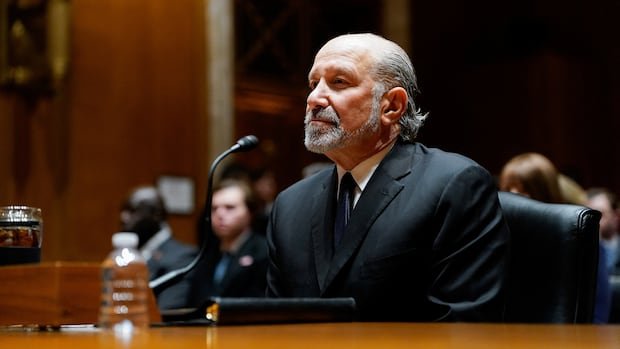
U.S. Commerce Secretary Howard Lutnick sought to distance himself on Tuesday from Jeffrey Epstein, alleging he “barely had anything to do with” the convicted sex offender amid calls for his resignation over new revelations about ties between the two.
The U.S. Justice Department in January published millions of new files related to Epstein, including emails that show Lutnick apparently visited Epstein’s private island for lunch years after he claimed to have cut off ties. Lutnick is facing calls from both Democrats and some Republicans to resign.
Lutnick pushed back in a Senate hearing, saying the two men had exchanged only about 10 emails over 14 years and that a lunch with Epstein only took place because Lutnick was on a boat near his island, and added that his family was present.
“I did not have any relationship with him. I barely had anything to do with that person,” he told a Senate Committee under questioning from Democratic Sen. Chris Van Hollen.
The hearing comes a day after Epstein associate Ghislaine Maxwell refused to answer questions at a deposition before the House oversight committee on Monday, according to lawmakers, drawing criticism from both Republican and Democratic members of the committee.
Immigration chiefs to testify in Congress
Meanwhile, the heads of the agencies carrying out U.S. President Donald Trump’s mass deportation agenda will testify in Congress today and face questions over how they are prosecuting immigration enforcement inside American cities.
Trump’s immigration campaign has been heavily scrutinized in recent weeks, after the shooting deaths in Minneapolis of two protesters at the hands of Homeland Security officers. The agencies have also faced criticism for a wave of policies that critics say trample on the rights of both immigrants facing arrest and Americans protesting the enforcement actions.
Todd Lyons, the acting director of U.S. Immigration and Customs Enforcement (ICE), Rodney Scott, who heads U.S. Customs and Border Protection (CBP), and Joseph Edlow, who is the director of U.S. Citizenship and Immigration Services (USCIS), will speak in front of the House committee on homeland security.
The officials will speak at a time of falling public support for how their agencies are carrying out Trump’s immigration vision, but as they are flush with cash from a spending bill passed last year that has helped broaden immigration enforcement activities across the country.

The administration says that activists and protesters opposed to its operations are the ones ratcheting up attacks on their officers, not the other way around, and that their immigration enforcement operations are making the country safer by finding and removing people who’ve committed crimes or pose a threat to the country.
Under Lyons’s leadership, ICE has undergone a massive hiring boom funded by Congress last summer and immigration officers have deployed in beefed-up enforcement operations in cities across the U.S. designed to increase arrests and deportations. His appearance in Congress comes as lawmakers are locked in a battle over whether DHS should be funded without restraints placed over its officers’ conduct.
Lyons is likely to face questioning over a memo he signed last year telling ICE officers that they didn’t need a judge’s warrant to forcibly enter a house to arrest a deportee — a memo that went against years of ICE practice and Fourth Amendment protections against illegal searches.
Retired FBI agent Daniel Brunner says that the claims made by the federal officials directly contradict eyewitness videos of a fatal shooting by immigration law enforcement officers in Minneapolis.
Under the leadership of Gregory Bovino, a group of U.S. Border Patrol agents hopscotched around the country to operations in Los Angeles, Chicago, Charlotte and New Orleans, where they were often accused of indiscriminately questioning and arresting people they suspected were in the country illegally. Bovino says his targets are legitimate and identified through intelligence, and if his officers use force to make an arrest, it’s because it’s warranted.
During Scott’s tenure, his agency has taken on a significant role in arresting and removing illegal immigrants from inside the country. That increased activity has become a flashpoint for controversy and marks a break from the agency’s traditional job of protecting borders and controlling who and what enters the country.
A Border Patrol agent and Customs and Border Protection officer both opened fire during the shooting death of Alex Pretti, one of two protesters killed in Minneapolis in January. The other protester, Renee Good, was shot and killed by an ICE officer.
After the Pretti shooting, Bovino was reassigned and Trump sent his border czar Tom Homan to Minneapolis to assume control.
USCIS has also faced criticism for steps it has taken including subjecting refugees already admitted to the U.S. to another round of vetting and pausing decisions on all asylum cases.

