

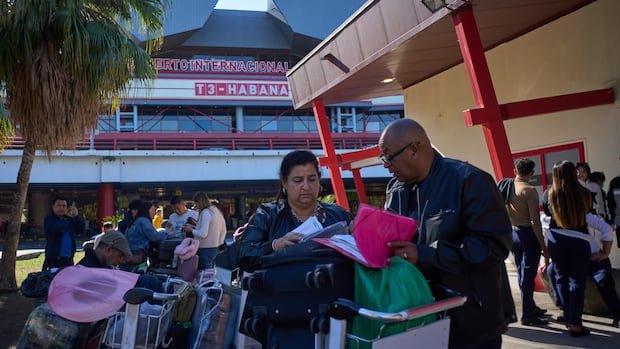
Air Transat says it plans to bring home thousands of Canadians from Cuba in the coming days, while Ottawa tells people to avoid delaying their exit from the island country.
Canada-to-Cuba flights have abruptly wound down in recent days, after Cuban authorities let it be known that a fuel shortage would prevent airplanes from refuelling on the island.
On Wednesday, Ottawa updated its travel advisory for Cuba, urging people to avoid all non-essential travel there and to not extend personal stays within the country.
The situation had already prompted Air Canada, WestJet and Air Transat to curb flights to Cuba and to make plans to bring its customers home.
On Thursday, Air Transat updated its repatriation plan, saying it plans to repatriate all of its customers “to their point of origin” by Tuesday.

The company said new itineraries have been sent to all customers whose returns are scheduled to take place by Saturday.
Customers whose flights are due to take place between Sunday and Tuesday are being sent confirmations for those journeys.
5,000 Transat customers still in Cuba
An Air Transat spokesperson told CBC News that more than 6,500 customers were in Cuba “at the start of the repatriation effort,” but that 1,500 of them either returned yesterday or are flying home on Thursday.
Its planes aren’t ferrying Canadian vacationers into Cuba at this point and are “being used exclusively for customer repatriation, with limited exceptions,” the spokesperson said via email.
“These exceptions involve Cuban nationals who were visiting Canada and are being flown back to their original point of departure in Cuba.“
Air Canada, meanwhile, announced Monday that it had begun flights to retrieve some 3,000 customers from Cuba.
The company told CBC News in an emailed statement on Thursday night that it continues to return customers home, but it did not have any updated numbers on how many were awaiting their trip back.

This week, WestJet also said that it was winding down flights to Cuba and would be sending empty aircraft there to pick up vacationing customers so they could come home.
A WestJet spokesperson said via email Thursday that the airline continues “to make progress toward our goal of repatriating all Canadian guests currently in Cuba,” by Tuesday.
The airline is sending planes equipped with enough fuel to avoid having to fill up in Cuba.
That change has led to “several originally scheduled flights” being adjusted or cancelled, which are now being consolidated through Toronto.
“These changes allow us to maintain safe operations while ensuring we can return guests to Canada as quickly and reliably as possible,” the spokesperson said.
WestJet did not indicate how many of its customers remain in Cuba.
‘A geopolitical mess’
A WestJet flight brought Carrie Davis back to Canada on Thursday. She felt “bittersweet” about getting out of Cuba, under the circumstances.
“Happy to be safe and not caught in geopolitical mess,” Davis said via email, after making her way to her London, Ont., home. “Sad because I love Cuba.”
Albertan Jerry Kitt is due to fly home on WestJet in a few days’ time, but he says he’s in no hurry to end his vacation early.
“We’re all keen to stay,” said Kitt, who’s been to Cuba on six previous occasions, in a brief conversation with CBC News on Thursday evening.
Kitt said he had a message from WestJet saying his flight scheduled for later this month has been cancelled. But he hasn’t heard yet as to when he’ll be flying home.
Ron Berezan is leading an agriculture-focused tour that Kitt is part of in Cuba.
“For us the energy crisis has caused some inconvenience, but only minor and we of course will be leaving soon and won’t deal with the situation becoming more dire as our Cuban friends will,” Berezan said via email on Thursday.
His main stress, at this point, is dealing with his flight home. Berezan said he got a notification from WestJet that his Feb. 24 return flight was cancelled, but he’s unclear if he’ll be able to arrange an alternate flight home.
U.S. pressure on Cuba
Cuba’s fuel supply has come under pressure as the United States has moved to stop nearby suppliers, including Venezuela and Mexico, from providing oil to Havana.

U.S. President Donald Trump is applying severe economic pressure to an already-strained Cuba mired in a food and power crisis. Andrew Chang explains why the U.S. is choosing now to cut off the country’s oil supply, and why, for Trump and U.S. Secretary of State Marco Rubio, it’s also personal.
The U.S. forcibly removed Venezuelan President Nicolás Maduro from power in January and now exercises a strong influence on Venezuela and its oil.
The U.S. has also pressured Mexico to halt sending oil to Havana and threatened sanctions on any country selling or providing oil to Cuba.
On Thursday, two Mexican navy ships docked in Cuba carrying humanitarian aid, including food supplies and personal hygiene items.
“Sometimes you think that things are going to improve, but it’s not like that,” said Javier González, a Cuban who spoke to The Associated Press on Thursday, as he watched the Mexican ships arrive.
“We can’t stay how we are because it’s too hard. We’ll have to wait and see.”

Mexican President Claudia Sheinbaum pledged Thursday that her country would send “more support of different kinds” when the ships return to Mexico.
Cuba has begun to ration fuel and take other measures in attempt to mitigate the U.S. effort to squeeze its access to fuel.
Ricardo Torres Pérez, an economist and research fellow at American University’s Center for Latin American & Latino Studies, says Cuba has been dealing with entrenched economic and infrastructure problems that pre-date the trouble with the Trump administration.
He said the U.S. government’s actions will exacerbate the problems on the island, but Cuba’s government doesn’t have many reliable allies it can look to for assistance.
“It’s a very difficult moment for the Cuban government, I believe,” he told Germany’s Deutsche Welle.
A blow to a crucial industry
The cuts in fuel are expected to be another blow to Cuba’s once-thriving tourism economy.

Cuba routinely welcomed more than one million Canadian visitors annually in the years before the COVID-19 pandemic.
But Cuba’s tourism industry has been struggling more recently, and fewer Canadians have been travelling there.
Cuba analyst Andrés Pertierra said the damage being done to the country’s tourism industry will have spinoff effects.
“Tourism being throttled during what is supposed to be high season is going to touch everything else,” Pertierra told CBC News by email earlier this week.
