

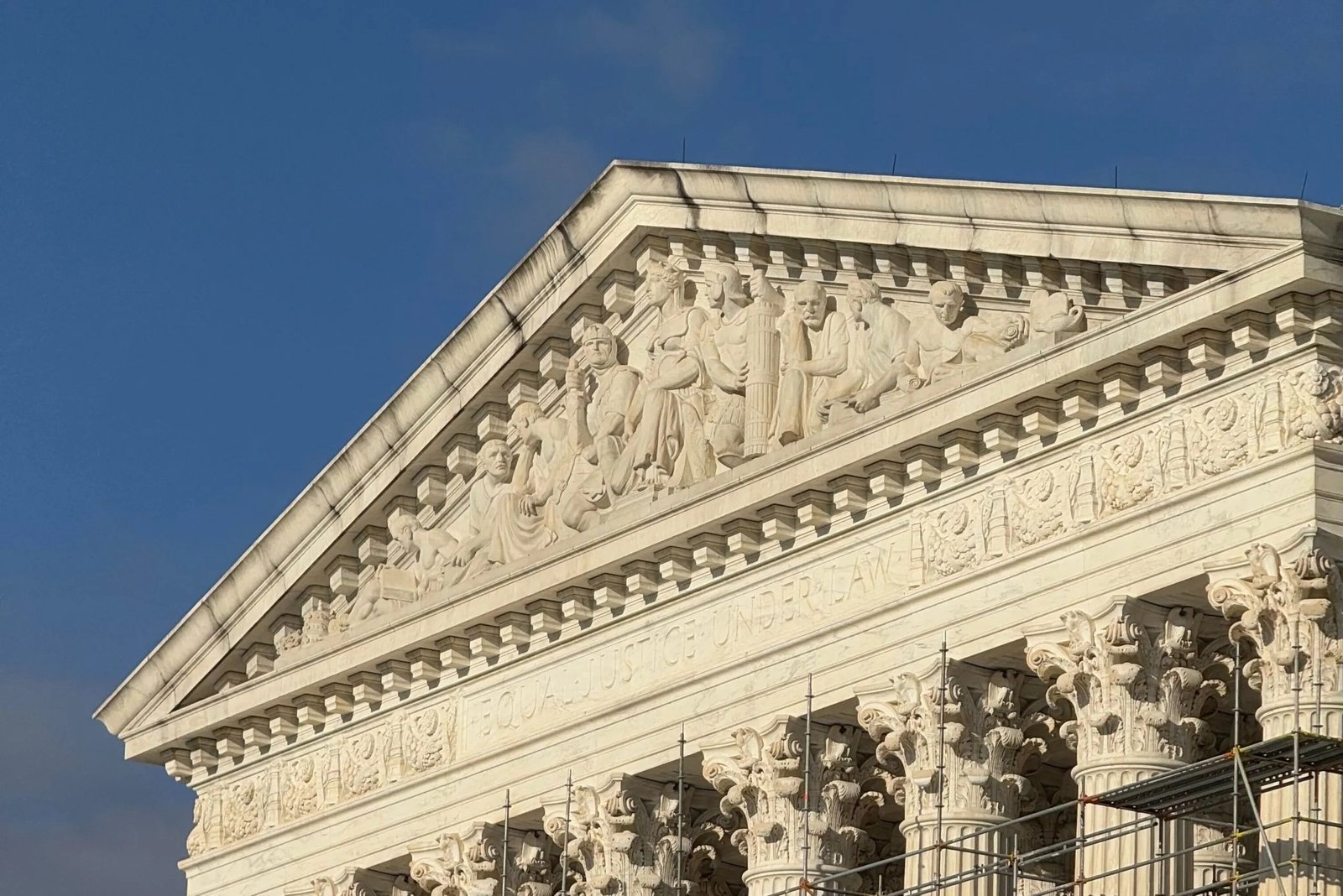
Good morning, and welcome to what is likely to be the first opinion day of the month, as the justices reconvene after their winter recess. We will be live blogging the court’s possible announcement of opinions beginning at 9:30 a.m. EST. Join us!
SCOTUS Quick Hits
- Last week, a Republican member of Congress, a group of voters, and New York election officials asked the Supreme Court to allow New York to proceed with the 2026 elections using its existing congressional map. The voters and elected officials challenging the current map responded to that request yesterday. For more on the new filing, see the On Site section below.
- As noted above, the court may announce opinions this morning at 10 a.m. EST. SCOTUSblog’s live blog begins at 9:30.
- Later today, the justices will meet in a private conference to discuss cases and vote on petitions for review. Orders from that conference are expected on Monday at 9:30 a.m. EST.
- The court may also announce opinions on Tuesday, Feb. 24, and Wednesday, Feb. 25. We will host live blogs on those days, as well.
- The court could rule at any time on an interim docket case on California’s policies for parental notification if a student chooses to use different names or pronouns.
- On Monday, the court will hear arguments in two cases brought by U.S. businesses that are seeking to recover losses they suffered when Cuba’s communist government came to power and seized their assets more than 65 years ago. The cases are Havana Docks Corporation v. Royal Caribbean Cruises and Exxon Mobil Corp. v. Corporación Cimex, S.A.
Morning Reads
- Trump defiant on tariffs in Georgia, lambasts waiting ‘forever’ for Supreme Court ruling (Julia Manchester, The Hill) — During a visit to Georgia on Thursday, President Donald Trump “forcefully defended his administration’s implementation of tariffs while expressing frustration for how long he has been waiting for the Supreme Court to determine if the authority he used to impose the duties is lawful,” according to The Hill. “I’ve been waiting forever, forever,” he said. “And the language is clear that I have the right to do it as president. I have the right to put tariffs on for national security purposes, countries that have been ripping us off for years. You know what they were doing? They were using tariffs.”
- Wait for Supreme Court tariff decision reveals potential fallout (Michael Macagnone, Roll Call) — In the three months since the Supreme Court heard oral argument on President Donald Trump’s authority to impose tariffs under the International Emergency Economic Powers Act, the country has gotten a taste of how difficult it will be for Congress to push back against the president’s trade policy if the court rules in Trump’s favor, according to Roll Call. That taste came in the form of “a joint resolution that would end Trump’s 35 percent tariff on Canadian goods imports,” which passed the House last week. Even if it passes the Senate, it does not have enough support to overcome an expected veto. House Speaker Mike Johnson described the House vote as a “fruitless exercise and a pointless one.”
- New York courts give Democrats go-ahead to redraw Malliotakis’ district (Bill Mahoney, Politico)(Paywall) — Although the legal battle over New York’s congressional map is already in front of the Supreme Court on its interim relief docket, the case has continued to proceed through New York’s judicial system. On Thursday, a “mid-level state court … unanimously sided with Democrats hoping to redraw Republican Rep. Nicole Malliotakis’ district,” upholding a lower court ruling stating that “the makeup of Malliotakis’ seat runs afoul of language in New York’s Constitution prohibiting maps that damage minority voting rights,” according to Politico. “The ruling likely settles the matter for good in New York’s judicial system,” raising the stakes of the Supreme Court’s eventual decision.
- Surging prediction markets face legal backlash in US: ‘Lines have been blurred’ (Anna Betts, The Guardian) — As prediction markets become more popular, debates are raging over the regulatory landscape, leading to legal battles. “At least 20 federal lawsuits have been filed nationwide, disputing whether companies such as Kalshi and Polymarket should be treated as federally regulated financial exchanges, as they maintain, or as gambling operations that should be regulated like state-licensed sportsbooks,” according to The Guardian. On these sites, “users in effect bet, or ‘trade,’ against one another rather than against an established ‘house,’ with platforms collecting transaction fees.” That’s why, so far at least, they haven’t been under the purview of state gaming regulators. Legal scholars told The Guardian that efforts to reclassify prediction markets as gambling operations “could ultimately reach the supreme court.”
- A Press Freedom Case in Peril, From a Lawyer Who Helped Write It (Adam Liptak, The New York Times)(Paywall) — In the latest edition of his legal newsletter for The New York Times, Adam Liptak explored a challenge to a landmark 1964 Supreme Court ruling on press freedom from a man who worked for the court when it was handed down. Alan Dershowitz was a law clerk during the term in which the court issued New York Times v. Sullivan, a ruling that has “made it very hard for government officials and public figures to win libel suits.” Dershowitz now says it is standing in the way of his effort to hold CNN accountable for “mischaracterizing his defense of Trump during an impeachment trial,” and that the ruling “has outlived any claim to validity it might once have had.”
A Closer Look: Chief Justice Morrison Waite, the Surprise Choice
While the seventh chief justice of the United States might be an unfamiliar name to most, we promise his story is worth the “waite” (I’m so very sorry).
Morrison Waite, nicknamed “Mott,” was born in 1816 in Lyme, Connecticut, to a father who later became chief justice of the Connecticut Supreme Court. After Waite graduated from Yale in 1837, he moved to Ohio to study law under attorney Samuel Young in Maumee City (located in the northwest part of the state). Admitted to the bar in 1839, Waite then spent the subsequent 11 years practicing in Maumee City before moving to Toledo (where he would practice until 1874 under the firm he established with Young, Young & Waite).
In 1840, Waite married his second cousin, Amelia Warner. A devoted Episcopalian, Whig, and abolitionist (though “less fiery than some”), Waite entered public life in a relatively modest fashion: the future chief justice was elected to the Ohio General Assembly and served one term, and he also served on the Toledo City Council. At the time, Waite proved less successful at obtaining more prominent positions: He had two fruitless runs for the U.S. House of Representatives, in 1846 and 1862, and then declined an appointment to Ohio’s Supreme Court in 1863.
In 1871, President Ulysses S. Grant appointed Waite to an international commission in Geneva tasked with settling U.S. claims against Britain from the Civil War (Britain had built and equipped Confederate boats in British ports, such as the Confederate States Ship (CSS) Alabama, which violated the principle that, in wartime, a neutral nation needed to be careful to prevent either warring side from benefitting from its ports and warships). The commission’s proceedings ultimately resulted in over $15 million being paid out to the United States, and Waite’s role garnered him some national praise.
In 1873, after returning from Europe, Waite was unanimously selected as a delegate to and president of the Ohio state constitutional convention. In the midst of the convention, Grant named Waite to the role of chief justice of the United States; the Senate confirmed him unanimously two days later, and he was sworn in on March 4, 1874. This came as a bit of a surprise appointment; Grant had offered the chief justiceship to several others (who all declined the offer – Grant’s administration had a reputation as “notoriously corrupt,” which scared off certain candidates), and generated some consternation among the sitting associate justices who would have apparently accepted the position.
Waite’s peers described him as distinguished yet collegial. In the words of the Supreme Court of Ohio’s website, “While Waite never became a significant intellectual force on the Supreme Court, his social and managerial skills, especially his good humor and sensitivity to others, helped him to maintain a remarkably harmonious and productive court.” One article at the time referred to him as “representative of that respectable mediocrity which seems to be most esteemed just now.”
Mediocre or not, Waite’s court was highly productive, spanning a period of 14 years and issuing roughly 3,470 opinions, with about one-third of these drafted by Waite himself. The Waite court supported broad national economic authority (in general, its decisions on economic regulation supported federal commerce powers), although it narrowly interpreted the Reconstruction Amendments, prioritizing state sovereignty over federal power. In other notable cases, the Waite court decided that the 14th Amendment did not guarantee women the right to vote; determined that the First Amendment right of assembly and the Second Amendment did not apply to the states; and upheld Alexander Graham Bell’s telephone patents in what are known as the Telephone Cases. (Waite also refused to sit on the Electoral Commission resolving the disputed Hayes-Tilden 1876 presidential election, citing ties to both candidates.)
Despite having a breakdown in 1885 from overwork and the court’s massive backlog (Waite appealed publicly for relief for the public against the “tedious and oppressive delays” of federal justice in 1887), he refused retirement. Finally, in 1888, at the age of 71, Waite died unexpectedly of pneumonia while in office. Although Waite’s legacy is a complicated one, his tenure is generally regarded as having helped to restore faith in the court following the 1857 Dredd Scott ruling. Waite’s funeral in the House Chamber drew President Grover Cleveland, Congress, and the diplomatic corps, with $5,000 appropriated for expenses.
***
A correction: Yesterday’s Closer Look on District of Columbia v. R.W. incorrectly referenced the U.S. Court of Appeals for the District of Columbia Circuit. The case came to the Supreme Court from the District of Columbia Court of Appeals.
SCOTUS Quote
MR. DUGGAN: “Well, I think the Court has already ruled in the Duke Energy case that regulators, in appropriate circumstances, can even take a defined term under the statute, in that case the term ‘modification,’ and cause it to mean different things in different subsections.”
JUSTICE SCALIA: “I never liked that case.”
MR. DUGGAN: “My apologies.”
— Justice Antonin Scalia in Hawkins v. Community Bank of Raymore
On Site
From the SCOTUSblog Team
Democrats ask Supreme Court not to disrupt New York redistricting dispute
Two separate groups of New York voters and elected officials on Thursday afternoon urged the Supreme Court to leave in place a ruling by a state trial judge in Manhattan that would bar the state from using its existing congressional map in the 2026 elections. Instead, the ruling by Justice Jeffrey Pearlman of the New York Supreme Court – which is a trial court in that state – would require New York to redraw the map on the ground that it diluted the votes of Blacks and Latinos in the only New York City congressional district represented by a Republican.

Case Preview
Can courts excuse late removals to federal court?
When a plaintiff files suit in state court asserting a claim over which a federal district court would have jurisdiction, federal law permits the defendant to remove the case to federal court. But the defendant must act quickly – within 30 days of receiving the complaint or being served with process, to be exact. On Tuesday, in Enbridge Energy LP v. Nessel, the Supreme Court will consider whether district courts can extend this 30-day deadline.

Contributor Corner

Posted in Featured, Newsletters
Recommended Citation:
Kelsey Dallas and Nora Collins,
SCOTUStoday for Friday, February 20,
SCOTUSblog (Feb. 20, 2026, 9:00 AM),
https://www.scotusblog.com/2026/02/scotustoday-for-friday-february-20/
