

[ad_1]
Posted: 3 March, 2026 Filed under: Selamawit Tsegaye Lulseged | Tags: accountability gap, AU-CEVAWG, conflict-related sexual violence, CRSV, customary international law, enforced sterilisation, forced abortion, forced marriage, forced pregnancy, forced prostitution, humanitarian law, international human rights, legal standards, rape, regional human rights mechanisms, Sexual and Gender Based violence, sexual slavery, sgbv, systemic failures, United Nations Security Council (UNSC)
 Author: Selamawit Tsegaye Lulseged
International Human Rights Professional
Introduction
Conflict-Related Sexual Violence (CRSV) remains one of the most serious yet under reported and prosecuted violations of international human rights and humanitarian law. The term “Conflict-Related Sexual Violence” refers to rape, sexual slavery, forced prostitution, forced pregnancy, forced abortion, enforced sterilisation, forced marriage, and any other form of sexual violence of comparable gravity perpetrated against women, men, girls, or boys that is directly or indirectly linked to a conflict. As one form of Sexual and Gender Based violence, (SGBV), CRSV is both a manifestation and a tool of gendered power imbalances. It’s frequently employed as a weapon during conflict/violence to assert control over populations, enforce ethnic cleansing, or punish perceived adversaries, with women and girls disproportionately impacted. It further constitutes grave breaches of the Geneva Conventions and can amount to a war crime, crime against humanity, or constituent element of genocide under international criminal law. The prohibition of rape and other forms of sexual violence during conflict is not only widely accepted as part of Customary International Law, but it’s also considered a jus cogens norm – a peremptory norm from which no derogation is permitted (ICC, Prosecutor v. Bosco Ntaganda, 26 Jan 2017, para. 3).
Further, the United Nations Security Council (UNSC) has recognised CRSV as an international peace and security concern, and through a series of Resolutions on Women, Peace, and Security, it has stressed that sexual violence can significantly exacerbate armed conflict and impede peace restoration. However, despite the existence of a strong international legal framework, CRSV remains a grim and recurring feature of conflicts in Africa, while (quasi) judicial accountability within regional human rights mechanisms remains elusive. In this context, the recently adopted African Union Convention on Ending Violence Against Women and Girls (2025) offers renewed hope, but it must overcome procedural and political barriers within the African human rights system.
Historical patterns of CRSV as a weapon across African conflicts:
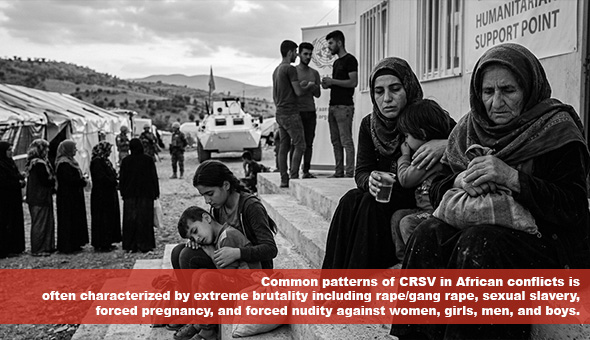
Throughout Africa’s modern history, CRSV has been systematically employed by both state and non-state actors as a deliberate weapon of war, targeting civilians (perceived enemies or adversaries) based on their ethnic, religious, or/and political affiliations. Common patterns of CRSV in African conflicts is often characterised by extreme brutality including rape/gang rape, sexual slavery, forced pregnancy, and forced nudity against women, girls, men, and boys. It is frequently committed during or around military operations to punish, intimidate, control communities and deliberately dismantle social structures.
Few notable examples include, in the Democratic Republic of Congo (DRC) – often been referred as the “rape capital of the world,” to describe the scale and brutal nature of sexual violence during the country’s armed conflicts. The UN and humanitarian organisations have reported that an estimated 200,000 women have been raped during the conflict in DRC since 1998, with the violence committed by both state and non-state armed groups across the country’s eastern regions. In Rwanda, between 100,000 and 250,000 women were raped during the three months of genocide in 1994 while in Sierra Leone, UN agencies estimated that more than 60,000 women were raped during the civil war between 1991 and 2002. Similarly, in South Sudan, the civil war that began in 2013 saw widespread and systematic use of sexual violence as a weapon of war, with over 10,000 survivors (UN OSRSG‑SVC statement, January 2024). In Central Africa since the outbreak of violence in 2013, the United Nations Multidimensional Integrated Stabilization Mission in the Central African Republic (MINUSCA) has recorded hundreds of documented incidents of CRSV while noting that actual figures are likely much higher due to under-reporting and stigma (UN Team of Experts report, 2017). More recently during the 2020 –2022 war in northern Ethiopia, CRSV was reported to be widespread and systematic, constituting grave violations of international human rights and humanitarian law. In Tigray region alone, Amnesty International documented at least 1,288 cases of sexual violence against women and girls between February and April 2021, likely a significant undercount given barriers to reporting. Similar patterns of sexual violence against women and girls were also documented in Amhara and Afar regions, underscoring the use of sexual violence as a weapon of war against civilian populations.
These prevalent and recurring patterns of CRSV across the continent reveal not only the alarming scale and systematic nature of these crimes but also the culture of impunity that allows its persistence. This crime leaves survivors with long-lasting physical and psychological harm, including traumatic injuries, reproductive organ damage, sexually transmitted infections, unwanted pregnancies, and mental health conditions such as depression and post-traumatic stress disorder (PTSD). The impact extends far beyond the individual victim, with their families and communities including children born of rape facing discrimination and stigma, breakdown of social cohesion, and the transmission of trauma across generations.
Regional mechanisms and enforcement gaps
A range of core instruments within the African human rights system directly or indirectly addresses CRSV. The African Charter on Human and Peoples’ Rights, also known as the Banjul Charter and regarded as the foundation of Africa’s human rights framework, does not explicitly mention CRSV. However, it provides a key legal basis for protection against sexual violence such as, the rights to dignity, freedom from torture, health, and protection of vulnerable groups. On the other hand, the Protocol to the African Charter on Human and Peoples’ Rights on the Rights of Women in Africa (the Maputo Protocol) provides a clear regional protection, with Article 11 prohibiting sexual violence in armed conflict and Article 14 safeguarding sexual and reproductive health rights. Similarly, the African Charter on the Rights and Welfare of the Child (ACRWC) also directly address CRSV, prohibiting sexual violence in conflict settings.
These instruments are legally binding on State parties that have ratified them, and their enforcement is primarily the responsibility of national governments, while regional bodies like the African Commission on Human and Peoples’ Rights (ACHPR) and the African Committee of Experts on the Rights and Welfare of the Child (ACERWC) monitor compliance primarily through state periodic reports. Both the ACHPR and ACERWC also have quasi-judicial mandates that allow them to adjudicate alleged violations of their respective treaties. Furthermore, individuals and non-governmental organisations with observer status before the ACHPR may directly file cases before the African Court on Human and Peoples’ Rights (AfCHPR) for adjudication of alleged violations of these treaties.
Further, the ACHPR has issued soft-law instruments, including Resolution 283 (2014) on the Situation of Women and Children in Armed Conflict, Resolution 365 (2017) on Developing Guidelines for Combating Sexual Violence and its Consequences, and Resolution 492 (2021) on Violence Against Women in Armed Conflict in Africa, affirming its commitment to prevent and respond to CRSV. Other guidelines directly addressing CRSV include the 2019 African Union Transitional Justice Policy, explicitly recognising CRSV as a grave human rights violation. These interpretative tools, alongside the core regional human rights instruments, affirms States obligations to prevent, investigate, prosecute, and punish acts of CRSV, and to ensure reparations for survivors, as part of their commitments under both the African Charter and the Maputo Protocol.
However, these obligations are undermined by weak enforcement, as they often rely on state cooperation which is rarely forthcoming. This challenge is further compounded by political inertia, entrenched gender inequality and ongoing conflict. Additionally, judicial enforcement of these treaties through the AfCHPR faces significant barriers such as the requirement of a declaration by member States under article 34(6) of the Protocol for direct access by individuals and NGOs. This restricts the ability of CRSV survivors to directly seek redress through the AfCHPR. As of 2024, only eight States currently maintain this declaration, significantly limiting access to justice for most victims across the continent.
It should also be emphasised that, while the African Court has dealt with numerous human rights violations, including some involving sexual violence, none of its decisions have been directly centered on CRSV as a standalone crime. Similarly, despite the widespread and devastating impact of these crimes across African conflicts, the ACHPR, as a quasi-judicial body, has only rarely addressed CRSV through its decisions; first in the S.I. v. Sudan case adopted in 2022 and communicated in 2023, and more recently in April 2025 with the Minova case in the DRC. This limited jurisprudence displays an alarmingly delayed institutional response to decades of impunity.
A further point of concern is that, even though regional and international courts are meant to complement each other, African regional mechanisms lack institutional bridges with international tribunals or domestic systems to facilitate cross-jurisdictional accountability for CRSV. Therefore, it’s safe to conclude that CRSV persists in Africa not due to a lack of legal standards, but because of systemic failures in implementation highlighting an accountability gap within regional human rights mechanisms.
A Step Forward: How the 2025 AU Convention advances the fight against CRSV in Africa
The 2025 African Union Convention on Ending Violence Against Women and Girls in Africa (AU-CEVAWG), adopted in February 2025, represents a significant development in the regional legal framework on SGBV and CRSV. While earlier instruments, most notably the Maputo Protocol and the ACRWC, laid the groundwork by obligating States to protect women and children in armed conflict and criminalise sexual violence, the AU-CEVAWG expands and hones these obligations in keyways.
Unlike the Maputo Protocol’s broad prohibitions on sexual violence, AU-CEVAWG explicitly defines violence against women and girls (Article 1) including a wider contextual reach and clarifies that State obligations apply across diverse contexts, including conflict, displacement, transition, and post-disaster situations (Article 3). This approach places CRSV within the broader continuum of violence against women and girls rather than an isolated phenomenon of wartime while closing a normative gap by ensuring that State obligations extend to crisis and transitional settings as well.
The AU-CEVAWG further strengthens accountability by requiring States to adopt survivor-centred justice measures that turn commitments into practice, including timely investigations, specialised courts, expedited prosecutions, witness protection, and access to compensation and reparation (Article 12). These provisions represent a move from abstract obligations to concrete, operational tools that, if effectively implemented, could significantly improve survivors’ access to justice.
While the African Commission and African Court already hold adjudicatory authority under AU human rights treaties, Article 14 of AU-CEVAWG reaffirms their role in relation to violence against women and girls, embedding CRSV within a dedicated normative framework. This strengthens the legal basis for litigation and accountability efforts before regional bodies, although barriers of access, enforcement, and political will remain critical challenges.
Beyond judicial remedies, the AU-CEVAWG adopts a holistic approach that integrates a more comprehensive operational framework for prevention including, education, survivor reintegration, and institutional reform, recognising that sustainable responses to violence require systemic change in both conflict and non-conflict settings (Articles 10 &11). In addition, Article 13 obliges States to strengthen collaboration and cooperation nationally, regionally, and internationally in addressing violence against women and girls, reinforcing collective responsibility.
In this sense, the Convention marks a qualitative shift in Africa’s response to CRSV, moving from broad normative commitments towards detailed, survivor-centred obligations that, if effectively implemented, could transform accountability within the regional human rights system. However, its potential to transform accountability will ultimately depend on effective domestication, resource allocation, and political will at the national and regional levels.
In summary, CSRV is not an accidental byproduct of war but a deliberate tactic of domination and dehumanisation, as evidenced across multiple African conflicts where women and girls are most often the primary targets. It further continues to fuel cycles of violence, fracture social structures, and undermine efforts towards lasting peace and reconciliation. The AU‑CEVAWG is a significant step forward in the fight against CRSV in Africa, but without effective enforcement and judicial accountability, it risks becoming yet another unfulfilled paper promise. Africa’s regional human rights institutions must rise to the challenge, not only to deter this heinous crime but to uphold the continent’s legal and moral credibility.
About the Author:
Selamawit T. Lulseged holds an LL.M. and a master’s degree in human rights, with over 11 years of professional experience in human rights, including in conflict and post-conflict settings. She has worked with international organisations monitoring, investigating, and reporting on violations of international human rights and humanitarian law. Her work further focused on promoting accountability for grave violations, including conflict-related sexual violence, while supporting state stakeholders on rule of law and justice. The views expressed herein are personal and do not necessarily reflect the views of the United Nations.
[ad_2]
Source link
