
[ad_1]

Listen to this article
Estimated 4 minutes
The audio version of this article is generated by AI-based technology. Mispronunciations can occur. We are working with our partners to continually review and improve the results.
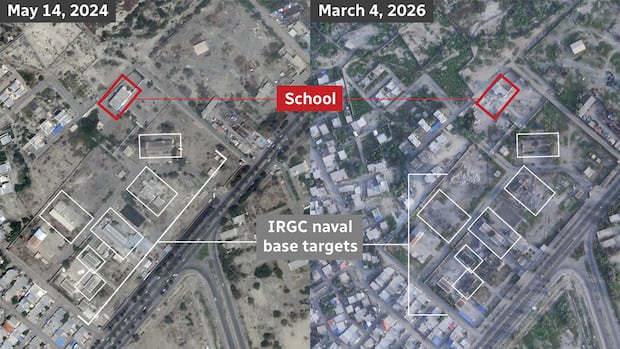
A CBC News visual investigation of new satellite imagery and social media footage suggests the bombing of an Iranian elementary school on Saturday was the result of a precision airstrike on a military complex immediately adjacent to the building.
The strike, which killed at least 165 people, mostly children, according to Iranian state TV, occurred on Saturday, during the first wave of U.S. and Israeli operations against Iran. Shortly after, several videos appeared showing a girls’ school in Minab largely destroyed.
While the facility was functioning as a school, CBC News has confirmed a previous New York Times report stating the building was once part of an Islamic Revolutionary Guard Corps (IRGC) base.

Almost immediately after the bombing, there were competing narratives about who struck the school — and whether it was intentional — from people on social media and from official sources. Iranian state media said it was a “brutal attack by the American-Zionist enemy.” Others, such as social media posts, suggested it was a failed Iranian missile that hit the school.

CBC’s visual investigations team reviewed and verified multiple videos from the scene showing several distinct smoke plumes, indicating the area was hit more than once. This was confirmed by satellite imagery released Wednesday by Planet Labs, which revealed multiple impact craters within the complex.
“It was precise targeting of a military facility for the IRGC,” said Yousef Riazi, a military researcher at Factnameh, an Iranian fact-checking group out of Toronto. “According to satellite images, the impacts shows a pattern of precision guided munitions … there shouldn’t be any mistakes.”
He says the fact a school was struck shows it was “either the fault of a weapons system or a huge mistake CENTCOM made with intelligence gathering.”

According to the Washington D.C.-based Middle East Institute, the site houses the 16th Assef Coastal Missile group, as well as Martyr Absalan Specialized Clinic, a part of the Medical Command of the IRGC navy. The unit is a component of the Saheb al-Zaman 1st Naval District, a strategic command that monitors and controls traffic through the Strait of Hormuz.
“This missile complex belongs to the IRGC navy and operates in the field of offensive naval cruise and ballistic missiles,” said Mahdi Saremifar, another researcher at Factnameh. “This the [headquarters] of Asef Missile Group.”
Neither Israel’s military nor the U.S. military have claimed responsibility for the strike. An Israel Defence Forces spokesperson told CBC News, that an IDF strike in the area was “not familiar” and told us to reach out to the U.S. Central Command.
CBC News shared its visual analysis with CENTCOM, but did not receive a response by deadline.

According to the International Institute for Strategic Studies (IISS), the location of the strikes corresponds with a clear “division of labour” in the ongoing campaign. The U.S. has primarily targeted missile bases and launchers in south and central Iran, while Israel has focused its operations on the north.


Minab’s location in the south, near the Strait of Hormuz, places it within the U.S. military’s primary area of operations, and lines up with other U.S. strikes on the Bandar Abbas Naval Base, about 80 kilometres west of Minab, and facilities in Konarak, which is 400 kilometres to the southeast.
U.S. Secretary of War Pete Hegseth was asked about the incident during a Wednesday news conference and confirmed they will be investigating the strike that hit the school.
On Tuesday, thousands of people gathered in Minab for mass funerals of the victims of the strike.
“What is clear is that elementary school children and teachers were killed,” said Shiva Amelirad, of the Canadian-based Cooperative Council of Iranian Teachers Trade Associations, a network of teachers’ unions in Iran.
“The place that should be safe regardless of who carried out the strike,” said Amelirad. “[We have a] human and legal obligation to protect the school and children.”
[ad_2]
Source link
