

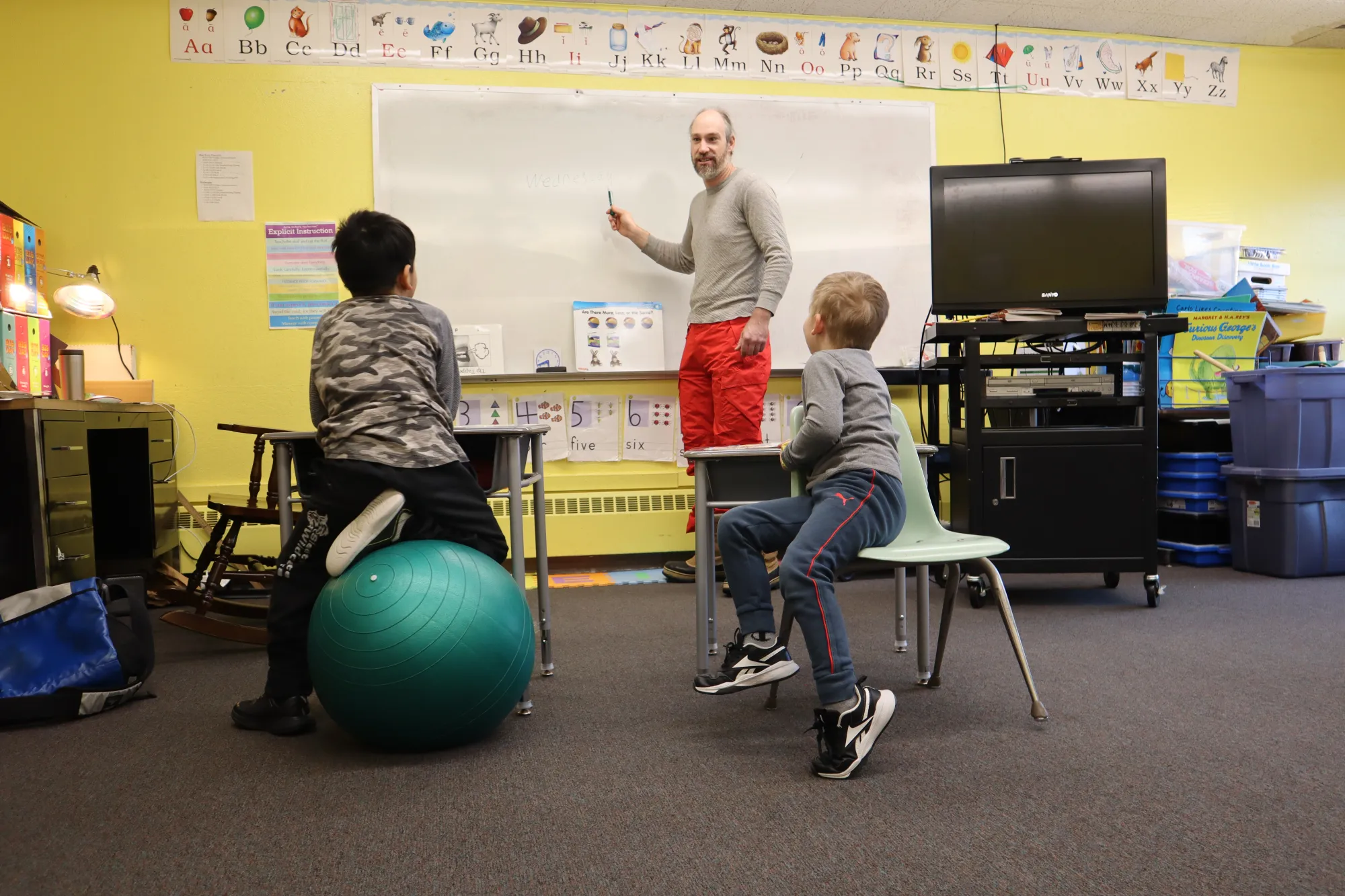
Alaska would more than triple the funding it devotes to school construction and maintenance projects next year under a budget approved this month by the state Legislature. The funding, which awaits Alaska Gov. Mike Dunleavy’s signature, follows reporting by KYUK, ProPublica and NPR last year that documented a severe health and safety crisis inside the buildings used daily for public education.
The bill would allocate more than $148 million toward construction and maintenance in the 2027 fiscal year, up from $40 million in fiscal 2026, which ends June 30. The new budget line is an effort to help with millions in backlogged major maintenance needs for schools around the state. Years of lacking investment in Alaska’s public schools have resulted in leaking roofs, broken water pipes and failing foundations. If the governor signs off, it would be the largest allocation in more than a decade. The money could pay for more than 30 projects but would still cover only a fraction of the requested repairs.
Some of the worst conditions exist inside rural public schools that serve predominantly Indigenous student populations and are often used as emergency shelters. In December, former students and concerned parents told the State Board of Education about squalid conditions inside Alaska’s only state-owned boarding school. Their testimony further fueled efforts by lawmakers to help unburden cash-strapped rural school districts in communities where residents don’t pay taxes to help fund education.
As Alaska legislators wrestled with statewide budget shortfalls, money for education, including for school construction and maintenance, “bubbled to the top,” according to state Sen. Lyman Hoffman, an Alaska Native Democrat who represents the largest rural school district in the state. “Even though the whole state is having a problem balancing its checkbook, at the top of the list is education,” he said during an Alaska Senate Finance Committee meeting in March, at which legislators questioned state education department leadership.
Every year, districts follow an application process to submit their construction and maintenance funding requests to Alaska’s education department. Since 1998, the Legislature has funded only a fraction of those proposed projects. Last year, lawmakers were able to secure about 5% of the nearly $800 million that both rural and urban school districts said they needed to keep their buildings safe and operating. This year, school districts requested more than $1.12 billion for infrastructure — the second-highest total requested statewide since 1998. Despite the legislative infusion of cash, the 2027 budget for school infrastructure will cover only about 13% of what school districts asked for.
“I do appreciate it,” said Kuspuk School District Superintendent Madeline Aguillard, “but the hole that the state is in is so deep and so big. It’s going to take a long time to hit that word ‘enough.’”
Aguillard’s district includes schools in nine roadless communities along the middle stretch of the Kuskokwim River in the heart of Alaska’s interior. The district first requested funds from the state to repair a leaking roof at its school in Sleetmute in 2007. For nearly two decades, the leak persisted, resulting in other problems for the building. In 2021, an architect inspected the building and uncovered severe structural damage. Further reporting by ProPublica, KYUK and NPR revealed a bat infestation and other serious health and safety issues in Sleetmute’s school.
At least one lawmaker has publicly labeled that school “the poster child” for what’s wrong with Alaska’s public school infrastructure. Aguillard said news reporting in 2024 on serious structural deficiencies inside Sleetmute’s K-12 Jack Egnaty Sr. School “really lit a fire” in the state Legislature.

For years, lawmakers and state education department staff have blamed each other for the annual school infrastructure shortfall. Last year, education Commissioner Deena Bishop told Propublica, KYUK and NPR that she can do little more than advocate on behalf of districts. “The power of the purse is with the Legislature,” said Bishop, who has served as the state’s education commissioner for three years.
But this March, at the Senate Finance Committee meeting with education department leaders, co-chair Bert Stedman, a Republican, suggested the committee had not received sufficient information from school districts and Bishop. “She’s responsible. The buck stops with her,” Stedman, from the coastal hub community of Sitka in Southeast Alaska, told his colleagues. (In response, education department staff said they rely on information school districts provide about conditions inside buildings; those districts have an annual opportunity to make requests for money for maintenance and construction.) Stedman, Hoffman and one other ranking co-chair have been on the Finance Committee for more than 15 years. None of the co-chairs agreed to comment for this story.
Previous reporting by the news organizations has also brought to light several problems with the system school districts must use to request funds and the process the state education department relies on to rank those projects. “There is, I would personally say, a flaw in the system, in the ranking that we are trying to fix,” Bishop said during that March hearing.
Bishop described how wealthier urban school districts with more staff fare better than more remote districts. Those urban districts have more resources to hire professional grant writers and pay for building inspections, which can help elevate applications. More than half of the projects approved for funding this year are in urban school districts that also have access to local tax revenue to pay for education. Alaska’s rural school districts are almost entirely reliant on state funding because they serve communities where residents do not pay taxes to help fund education.
“Some are winners and some are losers,” Bishop said.
In the absence of a permanent solution to pay for decades of backlogged major maintenance projects, the Legislature has relied on a few stopgap measures. For instance, the incorporated Galena City School District proposed a $36.5 million major renovation project that includes the removal of hazardous materials and major upgrades to outdated critical systems like heating and ventilation, plumbing and electricity. In its first year on the state’s list, it was ranked second for funding priority, above several other projects in rural school districts that have waited several years, and in some cases decades, for approval. So lawmakers reduced the amount of money that will go to Galena in order to deliver money to a larger overall number of projects.
In recent months, Lawmakers have also taken steps to help schools deal with the rising price of heating fuel, which is delivered by barge or air in ice and snow-free months to districts that are not accessible by road. Approached by Aguillard about the issue, state Sen. Löki Tobin, a Democrat from Anchorage who chairs the Senate Education Committee, led an effort to create a one-time grant program to help defray those rising energy costs. “It’s hard to argue against keeping the facilities warm and the lights on,” said Tobin, who acknowledges that the money only scratches the surface.
“There’s so many competing priorities in our state,” she said. “I think we’re all kind of competing for scraps of a pie.”
Three days before the session was set to end, Alaska’s Senate voted to make Tobin’s program permanent beginning in 2028. Dunleavy has until early June to sign the budget lawmakers sent to his desk. According to Tobin, there’s no indication this year that he won’t sign off. In his eight years as governor, Dunleavy has acknowledged the budget shortfall but used his veto power to cut state investment in public school infrastructure.
Alaskans pay the most for phone and internet but get the slowest service. Please fill out our quick survey to share how much it costs you to get online and what you think of the service.

