

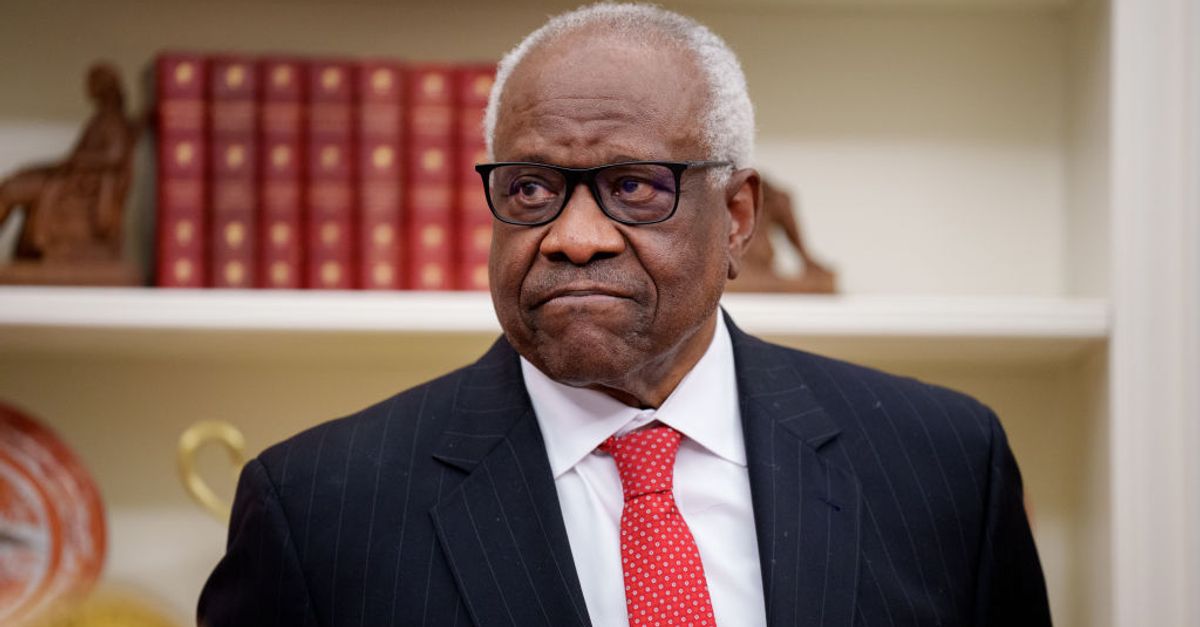

On May 7, 2026, Clarence Thomas became the second longest serving justice in American history, surpassing Justice Stephen Field, who had been a justice for 34 years, 195 days, from 1863-1897. If Thomas stays on the bench for two more years, in May 2028, he will replace Justice William O. Douglas as the longest serving justice. Even more remarkable than his longevity is his desire to radically change the law.
Thomas is the only justice that I can identify who has openly said that precedent deserves little weight in constitutional law. In a concurring opinion in 2019’s Gamble v. United States, Thomas said that the court should follow the text and the original meaning of the Constitution and not precedents that are inconsistent with them. He wrote: “In my view, the Court’s typical formulation of the stare decisis standard does not comport with our judicial duty under Article III because it elevates demonstrably erroneous decisions—meaning decisions outside the realm of permissible interpretation—over the text of the Constitution and other duly enacted federal law.” In a speech in Dallas, Thomas once remarked: “I always say that when someone uses stare decisis, that means they’re out of arguments. Now they’re just waving the white flag. And I just keep going.” He also said at another event: “We use stare decisis as a mantra when we don’t want to think.”
Unmoored by precedent, Thomas has called for radical changes in constitutional law, often joined by no other justice.
Reconsidering the right to counsel in state court prosecutions
In 1932, in Powell v. Alabama, the Supreme Court held that a state is obligated to provide counsel to a criminal defendant facing a possible death sentence. In 1962’s Gideon v. Wainwright, the court ruled that state governments must provide a lawyer to anyone being tried for a crime facing a possible prison sentence. My students are always astounded that for the first 145 years of American history, a person could be convicted and sentenced to death without a lawyer being provided, and that for the first 176 years of American history, a person could be convicted and even sentenced to life in prison without being given a lawyer.
Although many have questioned whether enough has been done to ensure adequate representation, rarely were the holdings in Powell or Gideon questioned until Thomas’ dissent in a 2019 case called Garza v. Idaho. There, Thomas argued that the Sixth Amendment simply means that a criminal defendant has the right to bring an attorney to court. He said the Sixth Amendment “ensures fairness in a single respect: permitting the accused to employ the services of any attorney.” He stated that “[n]either of these opinions [Powell and Gideon] attempted to square the expansive rights they recognized with the original meaning of the ‘right . . . to have the Assistance of Counsel.’”
Thomas also argued that the court was wrong in holding that ineffective assistance of counsel violates the Constitution. The Sixth Amendment, in his view, is no more than a right for a person to have a lawyer in court. He wrote: “there is no substantive right to a particular level of reliability. In assuming otherwise, our ever-growing right-to-counsel precedents directly conflict with the government’s legitimate interest in the finality of criminal judgments.”
Rejecting the reasonable expectation of privacy as a basis for the Fourth Amendment
In 1967, in Katz v. United States, the Supreme Court established that a search occurs when a person has a reasonable expectation of privacy that is infringed by the police. Previously, in 1928’s Olmstead v. United States, the court had ruled that there was a search only if there was invasion of a legally protected property interest. Katz, which involved wiretapping of a phone booth, rejected this and stressed that the Fourth Amendment protects people and not property.
In the 2018 case of Carpenter v. United States, Thomas in dissent called for the overruling of the Katz approach and a return to a focus solely on whether there was a police intrusion on to property. He said that “[t]he Katz test has no basis in the text or history of the Fourth Amendment”, lamented that it “distort[s] Fourth Amendment jurisprudence,” and called it “a failed experiment.” Thomas would return to an approach where only intrusions on to one’s property are searches, which would mean that the myriad of ways that the government can collect information without a physical trespass would not be limited by the Fourth Amendment – this would potentially amount to a breathtaking expansion of the state’s ability to monitor people.
Eliminating the exclusionary rule as a remedy for Fourth Amendment violations
In the 1914 case of Weeks v. United States, the Supreme Court held that the federal government could not rely on illegally seized evidence to obtain criminal convictions in federal court. In 1961, in Mapp v. Ohio, the court held that the exclusionary rule applies in state courts as well.
In a concurrence in 2018’s Collins v. Virginia, Thomas said that the “Founders would not have understood the logic of the exclusionary rule.” He wrote that he had “serious doubts about this Court’s authority to impose that rule on the States,” calling the assumption that state courts must apply the federal exclusionary rule “legally dubious.” Thomas declared: “We have not yet revisited that question in light of our modern precedents, which reject Mapp‘s essential premise that the exclusionary rule is required by the Constitution. We should do so.”
Overruling New York Times v. Sullivan
Few cases protecting freedom of speech are more revered than 1964’s New York Times v. Sullivan. The court held that the First Amendment limits the ability of state law to create liability for defamation. The court famously described “a profound national commitment to the principle that debate on public issues should be uninhibited, robust, and wide-open, and that it may well include vehement, caustic, and sometimes unpleasantly sharp attacks on government and public officials.” In that vein, the court ruled that public officials can recover for defamation only if they prove with clear and convincing evidence the falsity of the statement and that the speaker acted with actual malice, knowing the statement was false or with reckless disregard of the truth. University of Chicago law professor Harry Kalven described it as an occasion for dancing in the streets.
But in recent years, Thomas has sharply criticized New York Times v. Sullivan. In 2019’s McKee v. Cosby, Thomas concurred in the denial of certiorari, but used it as an occasion to declare, “New York Times and the Court’s decisions extending it were policy-driven decisions masquerading as constitutional law.” He argued that New York Times v. Sullivan could not be justified based on the Constitution’s original meaning. In 2021’s Berisha v. Lawson, both Thomas and Justice Neil Gorsuch dissented from the denial of certiorari and urged reconsideration of New York Times v. Sullivan.
The establishment clause does not apply to state and local governments
In 1947, in Everson v. Board of Education, the Supreme Court held that the establishment clause of the First Amendment – the provision forbidding any law respecting the establishment of religion – applies to state and local governments. To my knowledge, no other justice besides Thomas ever has questioned that holding.
Thomas has repeatedly done so. He has said that the “Establishment Clause is a federalism provision, which, for this reason, resists incorporation [application to the states].” His view is that the establishment clause was meant to prevent the federal government from establishing a church that could rival state churches. He says that it was not meant to limit state and local governments. He wrote: “On its face, this provision places no limit on the States with regard to religion. The Establishment Clause originally protected States, and by extension their citizens, from the imposition of an established religion by the Federal Government.”
Under Thomas’ view, states could mandate prayer in schools, fully subsidize religious education, and even create an official state religion. There would be little First Amendment limit on the government’s ability to advance religion.
Rejection of all substantive due process and autonomy rights
In 1923’s Meyer v. Nebraska and 1925’s Pierce v. Society of Sisters, the Supreme Court held that the “liberty” in the due process clause protects the right of parents to control the upbringing of their children. Subsequently, the court has safeguarded many other rights of personal autonomy under the due process clause: the right to marry, the right to custody of one’s children, the right to keep the family together, the right to procreate, the right to purchase and use contraceptives, the right to engage in private consensus same-sex sexual activity, and the right to refuse medical care.
Thomas has expressly rejected any use of the due process clause to protect such rights. In his concurring opinion in Dobbs v. Jackson Women’s Health Organization, which overruled Roe v. Wade, he declared: “in future cases, we should reconsider all of this Court’s substantive due process precedents, including Griswold [v. Connecticut] [striking a statute forbidding the use of contraceptives], Lawrence [v. Texas] [striking Texas’ anti-sodomy law], and Obergefell [v. Hodges] [recognizing a constitutional right to same-sex marriage]. Because any substantive due process decision is ‘demonstrably erroneous,’ we have a duty to ‘correct the error’ established in those precedents.”
Conclusion
These are only some of the areas where Thomas has urged radical changes in the law. He would prevent Congress from regulating under the commerce clause based on a substantial effect on interstate commerce, which would make countless federal laws unconstitutional. He would deny constitutional rights to children in schools, and to minors more generally. He would interpret the equal protection clause as mandating that the government always act in a color-blind fashion, something the court never has adopted.
Looked at together, Thomas argues for dramatic changes in almost every area of constitutional law. In some places, like in ending abortion rights and in expanding Second Amendment protections, Thomas’ view has triumphed on the court. But in most other areas, he has been by himself in pushing for a profoundly conservative vision of the Constitution.
Thomas is the second longest serving justice, but in ideology he is easily one of the most radical to ever serve on the court.

