

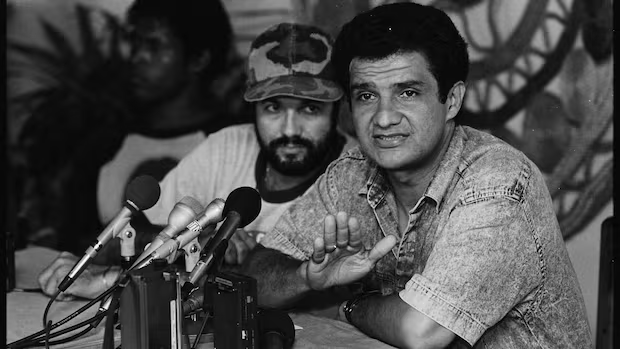
For three years after Nicaraguan Indigenous leader Brooklyn Rivera was arrested, his friends and family had no idea where he was being held, if he was OK, or whether he was even still alive.
Then, last week, the government released photos of 73-year-old Rivera in hospital, emaciated and intubated. Two days later, he was dead.
Métis leader Clément Chartier, a longtime friend and ally of Rivera’s, says it was “heart-wrenching” to learn of his death.
“He was a selfless person,” said Chartier, ambassador of inter-nation and international relations for the Manitoba Métis Federation.
“He was basically just a remarkable man, a brave man, and well-educated — a great spokesman [for his people].”
Calls for an investigation into his death
Riviera was a world-renowned activist who spent decades fighting for Indigenous autonomy in Nicaragua. He served on Nicaragua’s national assembly for 16 years, and was the leader of the Miskito people for more than four decades.
He had been in custody since 2023, when he was arrested as part of what human rights organizations say was a brutal crackdown on political dissent under the leadership of Nicaragua’s married co-presidents, Daniel Ortega and Rosario Murillo, leaders of the Sandinista party.
The Nicaraguan government released a statement on Sunday saying that Rivera had died in custody from a bacterial infection following an earlier case of COVID-19, despite “enormous and intense efforts” to save him.
As It Happens6:31Human rights lawyer demands answers after Nicaraguan leader Brooklyn Rivera dies in custody
U.S. human rights lawyer Reed Brody says it’s impossible to confirm the claims about Rivera’s health, but he blames the government for his death.
“He died of almost three years of detention in the conditions of a disappeared person in which he had no access to his family, no access and medical care,” Brody, a member of a group of United Nations experts on Nicaragua, told As It Happens host Nil Köksal.
“And, unfortunately, he’s not the first person who had been disappeared by the government to die in circumstances that we cannot elicit.”

Nicaragua’s government has said Rivera had a long list of pre-existing health conditions that deteriorated over time, which his daughter, Tininiska Rivera, has denied.
After his death, she issued a statement, calling on the Nicaraguan government to release her father’s body to the family, so he can be laid to rest in accordance with Miskito customs.
Tininiska did not respond to a request for comment.
The United Nations, human rights organizations and Indigenous organizations have all called for a thorough investigation into Rivera’s death.
‘He was truly loved by the people’
Riviera spent most of his career fighting to protect Miskito autonomy over their land in Nicaragua’s northeast coast, which is rich in gold, silver and other valuable resources.
In the ’70s and ’80s, he fought against Ortega’s first Sandinista government as a leader of the Misurasata militia, during which time he was repeatedly forced to flee the country and live in exile in Costa Rica and Colombia.

Chartier says he first met Rivera 1981 at a General Assembly of the World Council of Indigenous Peoples in Canberra, Australia, and they remained close.
They worked side-by-side at the World Council of Indigenous Peoples, and later the American Council of Indigenous Peoples. He says he often visited Rivera in his home village, and spent time with his family.
Chartier also joined Rivera on a tour of Indigenous villages in Nicaragua in 1986 during the armed Indignous resistance, which he documented in his book, Witness to Resistance: Under Fire in Nicaragua.
“He was truly loved by the people. There was always crowds around him,” he said. “In their language, they call them Ta Upla, which is like the maximum leader.”

In the late ’80s, Rivera founded the political party Yatama, which played a key role in securing limited autonomy for Indigenous people following peace negotiations with the Sandinistas.
Yatama was allied with Ortega when he returned to power in 2007, but Chartier says that soon changed as the regime racked up human rights abuses.
In April 2023, Rivera travelled to New York City to participate in a UN forum on Indigenous people, where he spoke out against the Nicaraguan government’s treatment of Indigenous people.
“Daniel Ortega and Rosario Maria do not forgive that kind of behaviour,” Brody said. “So he was barred from coming back to the country, as have so many Nicaraguans.”
124 cases of arbitrary detention in Nicaragua: UN
Yatama was banned as a party, and many of its leaders were arrested. Despite this, Rivera returned to Nicaragua, and lived in hiding until September 2023, when he was detained and accused of terrorism.
Rivera was never formally charged, and Brody says it took nearly two years of diplomatic pressure before the government would even admit he was in custody.
“For years, the family was in anguish not knowing. And then the first thing that they see are these [hospital] pictures,” Brody said. “They’re grief-stricken.”
He says stories like Rivera’s are common.
The UN group of experts on Nicaragua documented 124 cases of arbitrary detention of Indigenous people in Nicaragua between 2018 and 2024. In that same time, it says 46 Indigenous people were killed in violent incidents.
Brody says at least six political prisoners have died in Nicaraguan custody since 2019, including two last August.
“This is a government that has been very vindictive,” he said.

