


Newsweek is a Trust Project member
See more of our trusted coverage when you search.to see more of our trusted coverage when you search.
As much as I can recollect, the words Savannah, Georgia, have been etched in my mental. My mother, and our entire family tree on her side, is from the Low Country of South Carolina. It’s a mere 37 minutes, driving-wise, from Downtown Savannah to Jasper County, S.C., where my kinfolk go back a couple of centuries to wretched, sprawling plantations and weathered, sweeping patches of Gullah-Geechee lands.
I heard tall stories and short tales about the Savannah River, especially as a boy. This water, which italicizes the border between Georgia and South Carolina, is the narrative thread my ma would airdrop to regale me about the relatives of ours, young and old, who crossed—or tried to—the wildly unpredictable Savannah. And how those who did not make it were forever spirits—ghosts—dancing in our midst.
But other than 1990s films like Forrest Gump and Midnight in the Garden of Good and Evil, my interactions with Savannah were mad limited. I gotta admit, with remorse, that even though I spent time in the region, and although my heritage is engrained in the Dirty South, as we hip-hop heads call it, there was a period when I branded Savannah, and that part of the USA in general, with pitiful stereotypes.

Because there are those dreadful twin legacies of slavery and segregation, including innumerable Black bodies that were dangled high from trees like Savannah’s famous Southern Live Oak. For sure, Savannah was a major epicenter of the American enslavement shame. One of the most heartbreaking events, I learned during a trip a few years ago, was in 1859: A rich slave master held a humongous two-day auction on a 10-acre Savannah racetrack to pay off his gambling debts. Over 430 enslaved Blacks were sold—women, men, children, infant babies—quite literally ripping families apart. Because of the heavy rainfall that punctuated this tragedy, and maybe because of the immense pain these discarded persons endured, it is referred to as “The Weeping Time.”
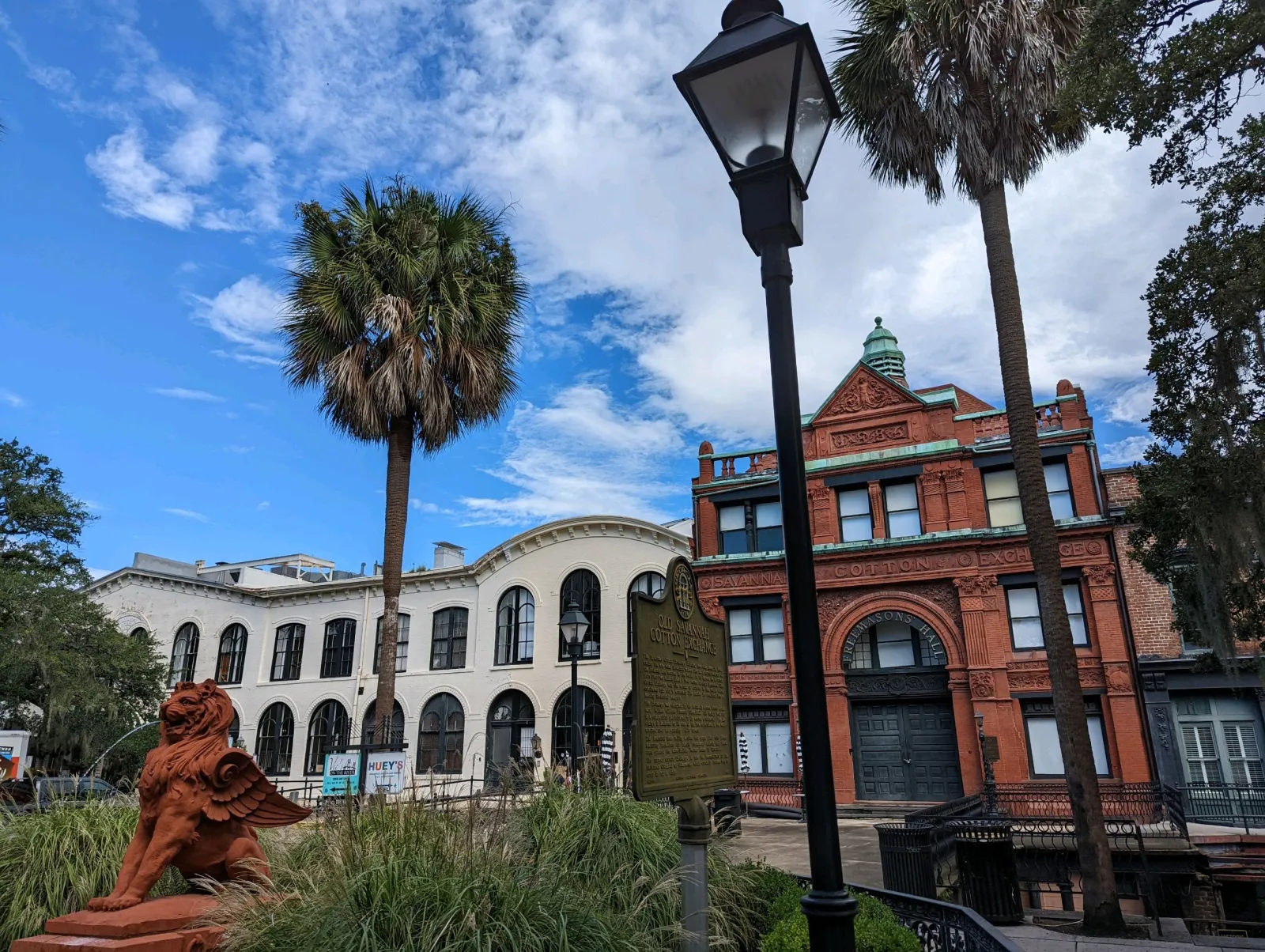
Perhaps this is why I was uncomfortable popping into territories like Savannah: that section of the nation certainly fought the Civil War to preserve the old racist traditions and, well, there are elements of this at the current moment, such as the here-there-everywhere references to “cotton” and “plantation” and “exchange.”
But it is also fact that the Rev. Dr. Martin Luther King Jr., in 1964, referred to Savannah as “the most desegregated city south of the Mason-Dixon line.” That is because this metropolis of 150,000 responded wisely to local Civil Rights protests and decided to grind ahead of others toward a new direction.
That new direction has included four African American city leaders, counting today’s mayor, Dr. Van R. Johnson II, a New Yorker who arrived strictly to study at the historically Black Savannah State University, and simply never left.
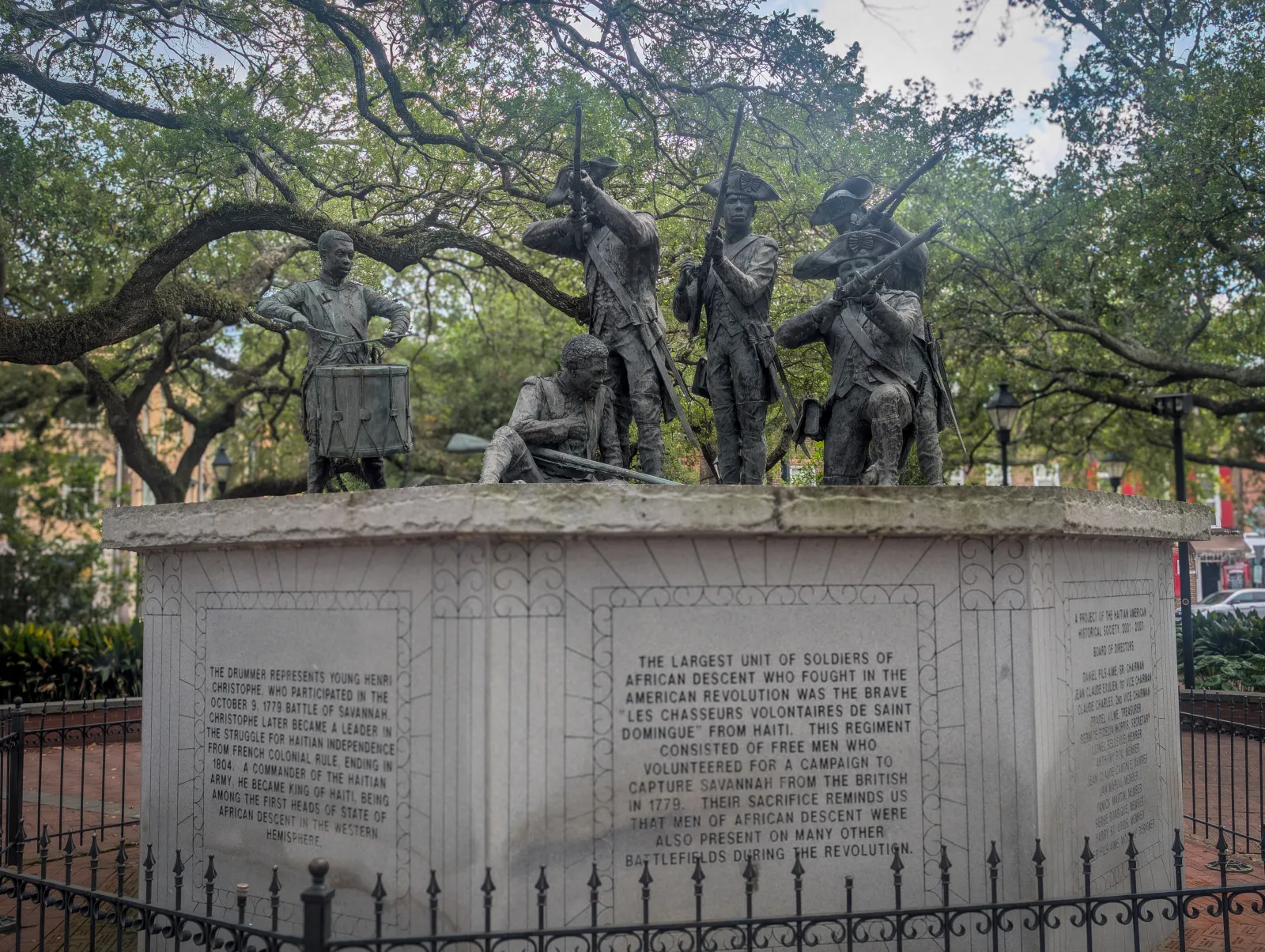
That new direction has included a statue saluting Haitian soldiers, in Franklin Square, who fought in the Revolutionary War. A number of them would also participate in the Haitian Revolution against France years later.
That new direction has included The Savannah College of Art and Design (affectionately called “SCAD”), one of the finest art and design schools on the planet.
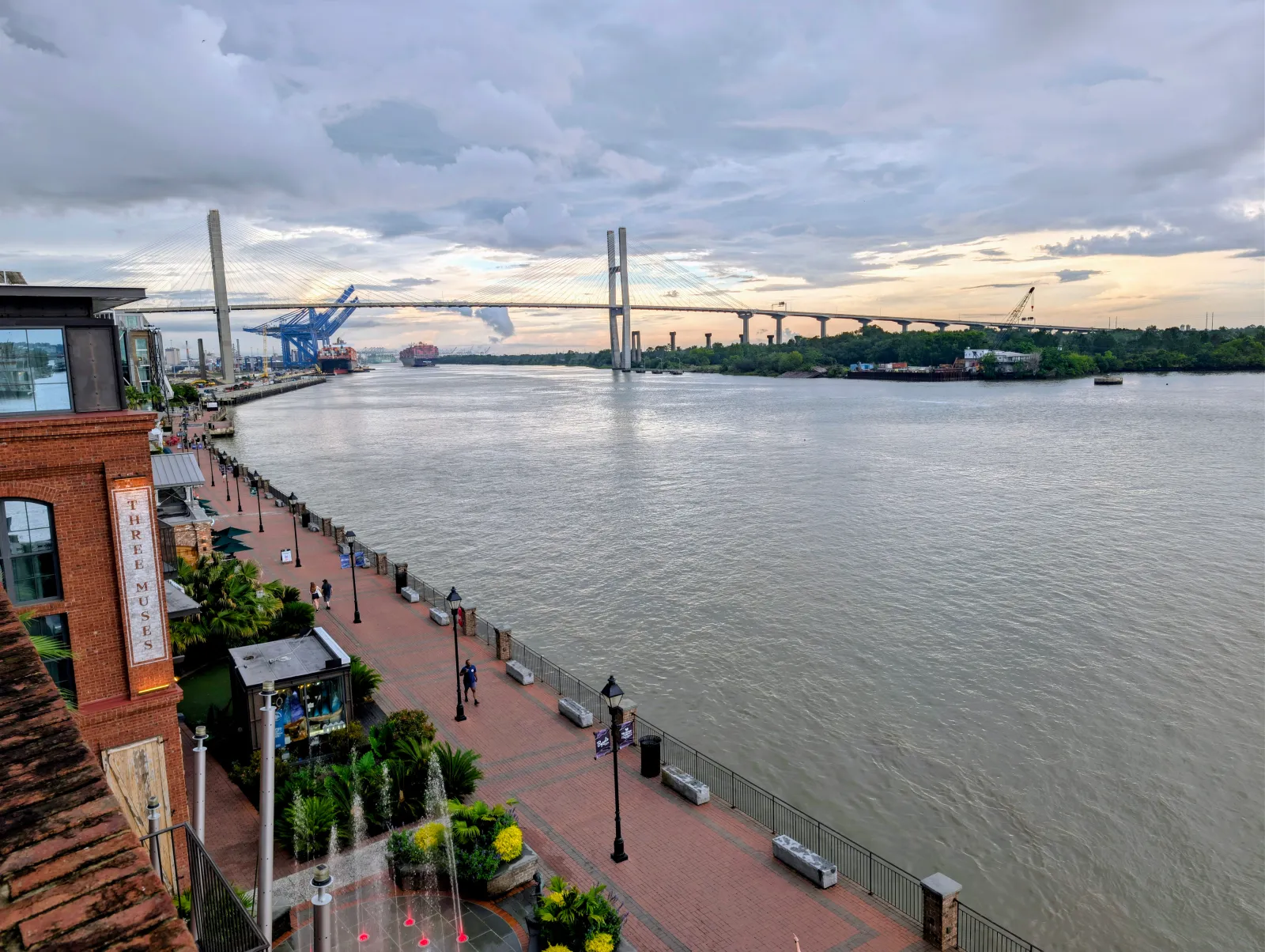
That new direction has included the glorious and game-changing vision of Richard Kessler, an 80-year-old native son of this “Hostess City of the South.” A pioneer in hospitality developments, Mr. Kessler’s masterpiece is The Plant Riverside District, Savannah’s grand dining and entertainment hub. Stretched alongside the Savannah River, its 4.5 acres feature a jaw-dropping, museum-inspired JW Marriott, unlike any I have ever experienced, built inside a decommissioned 1912 power plant.
That new direction has included the Savannah Bananas, without question the most electrifying baseball I’ve ever absorbed, and I am an eternal and diehard baseball fan declaring this. The brainchild of founder Jesse Cole—an animated foot soldier of fun bedecked in yellow tux and yellow top hat—the Bananas are part Negro Leagues cool, part Harlem Globetrotters charisma, part Broadway choreography and part Vaudeville comedy, with a heap of pop and rap moods and moves as its holy core. My wife and I saw the Savannah Bananas at the legendary Grayson Stadium, which seats 5,000. But thanks to a five-part ESPN doc series entitled Bananaland, the baseball team and its in-house rivals have become Rolling Stones-like rock stars, packing stadiums such as Texas A&M University’s football field with 102,000 ticket buyers this past May.
And that new direction, in spite of the harsh trials of any bustling population (homelessness, violence, crime), has included a humane embracing of Savannah’s diversity. Here you will find the oldest continuous Black church in America (First African Baptist); a deeply rooted Jewish community with the third oldest Jewish Congregation (Congregation Mickve Israel) in America; a beautifully visible queer citizenry; ambitious students of various stripes; and every kind of writer, visual artist, dancer, musician or other creatives one can name. You will also find individuals who are the offspring of Irish and Greek ancestors, an established and omnipresent Indian/South Asian enclave, plus scores of Latinx newcomers.
As my wife and I have roamed Savannah’s cobblestone streets, dined at its mosaic of restaurants and been enthralled by Low Country politeness and kindness, we’ve also combed sea islands with handles like Tybee, marched through landmark Black areas like Cuyler-Brownville and Yamacraw, and spiritually inhaled the lush and picturesque Forsyth Park. It is clear Savannah, Georgia, is an unhidden jewel of America, of what was, of what can be. Yes I can say, after several treks, that Savannah is akin to a delightful shrimp-and-grits path to the beloved community of Dr. King’s dream.
However, Savannah is not a perfect place. No, I think of those same legendary Black societies who are struggling, and watching parts of their ‘hoods get bulldozed in the name of gentrification. I think again of Dr. King, he too a native son of Georgia, urging Americans, near his end, not to abandon the poor. Like all urban environments, poverty is absolutely prevalent in Savannah, despite the progress.
That said, yet do I still marvel at this coastal reserve and its sun-swiped beaches. Yet do I still marvel at the Spanish moss jutting spectacularly from burly trees inside the city’s 22 squares, like the one where Forrest Gump sat at a bus stop that never existed in real life. Savannah is easily one of America’s most gorgeous and complex cities. It is a poem to be penciled about possibilities, a colossal collection of Victorian, Greek Revival and Federal-style mansions exhaling with the tugboat of history and the perfumed scents of azaleas.
Indeed, Savannah is the double-crusted pie of America itself, and it also possesses one of the simplest solutions to this struggling democratic experiment as it celebrates its 250th birthday throughout 2026: Leopold’s Ice Cream. It is both a hypnotic social scene and a throwback parlor complete with vintage movie posters and an old-school jukebox spitting gems by Frank Sinatra and other musical icons. There is always a lengthy line, there is always a joyful rainbow coalition of beings. In partnership with his wife Mary, the owner is Stratton Leopold, an 80-something Greek American, conceived by immigrants, who helms a business his father and uncles kick-started in 1919.
Mr. Leopold is a mellow, soft-spoken man with an infectious smile who broke away from ice cream for a spell to toil in the film industry, becoming a producer of blockbusters like Tom Cruise’s Mission: Impossible III. But ice cream, and Savannah, are his supreme passions.
Mr. Leopold talks with unabashed pride of his youth coming of age in Savannah with neighbors of assorted identities. I believe, as I spent an afternoon as intrigued by his storytelling as I was of my mother’s back in the day, that the Savannah Mr. Leopold witnessed is the Savannah, and America, we need more than ever. Where people, if close enough to make eye contact, say hello to each other. Where people may not see soul to soul on everything, but they are not trying to hate or destroy each other either.
These are the musings of Mr. Leopold. Of what was, of what can be, through the lens of Savannah. He himself wears a uniformed shirt and often carries trays of water, and that magnetic grin, to those waiting, and waiting, and waiting on the line outside, particularly during the blistering heat waves this area is known for. He employs Savannahians of all persuasions and generations, including some who have disabilities. He feels good that employees feel good working there, that there is growth from the encounters with everyday people every single day. He does not announce himself as the boss, as the heir to arguably the dopest ice cream in America (including vegan options for people like me). Similar to a fellow Georgian he knew, President Jimmy Carter, Mr. Leopold is a graciously humble man who cannot believe his good luck journey.
Yes, this is so reminiscent of the classic Frank Capra film that starred James Stewart, It’s A Wonderful Life. Stratton Leopold is George Bailey and Savannah, Georgia, is the fictitious Bedford Falls, New York. It is not paradise, but it is a space where both natives and transplants breathe, and upward of 15 million tourists each year from outposts of the world come because, in spite of all, it just feels, well, good to be somewhere that is a welcoming home.
Kevin Powell is a Grammy-nominated poet, humanitarian, filmmaker, public speaker, frequent contributor to Newsweek, and author of 17 books, including his newest poetry collection, A Poem for Evangeline, And Other Songs (Get Fresh Books Publishing). Kevin lives in New York City. You can find him on social media platforms by typing poet kevin powell.
The views expressed in this article are the writer’s own.
Request Reprint & Licensing
View Editorial & AI Guidelines

