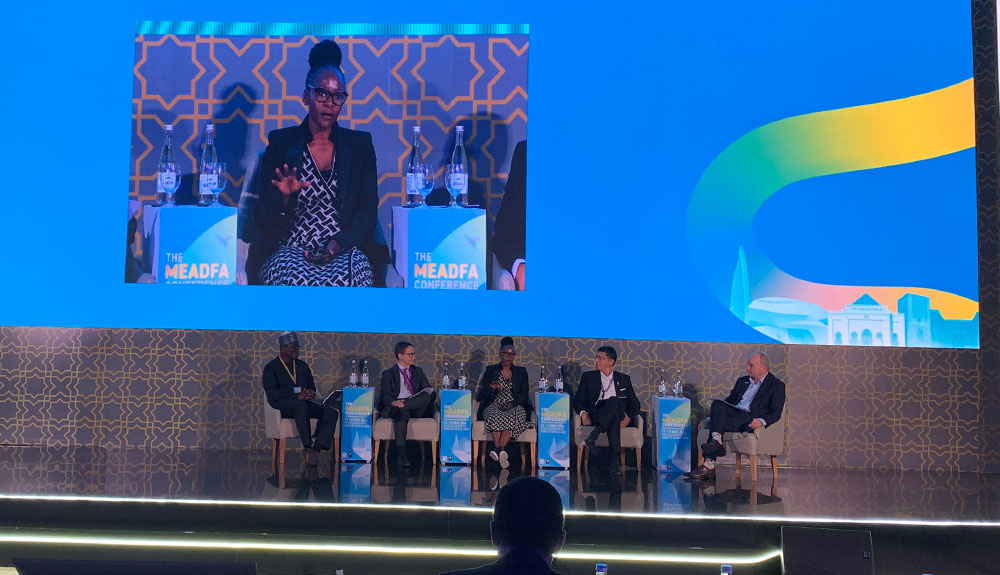
Africa is attracting attention as a market with extensive growth potential, said Ali Tounsi, Director General, ACI Africa in the ‘Africa in Focus’ session on 17 November at the 2026 MEADFA Conference.
His comments came as part of a session dedicated to examining how investments in infrastructure, expanding air connectivity and a growing appetite for intra-African travel are reshaping the continent’s visitor economy, while evolving consumer markets are creating fresh opportunities for the travel retail industry.
“Africa is one of the most promising aoximately +9%. Traffic is expected to increase from 274m passengers in 2025 to 777m in 2055 –that’s 3.5% [annual passenger growth rate] over the next three decades.”
The energy being felt today, he said is being influenced by three factors. Connectivity, adding new routes and intra-African links; tourism – both regional and international; and evolving consumer expectations and spending potential. All of this is presenting new commercial opportunities for travel retail – including in the near-term.
He outlined the significant investment being made in Africa’s next generation of and Dr. António Agostinho Neto International Airport in Angola with an overall level of investment out to 2055 of US$143 billion. Around $66bn is set to be invested over the period into new greenfield a
The panelists agreed that Africa is a market of opportunity and the time to engage is now. When it comes to turning the heads of shoppers, localisation formed a key part of the discussion.
“The key to success will be developing commercial concepts that are adapted to the local markets,” said Tounsi.
He was joined on stage by Sountou Bousso, CEO, Lagardère Travel Retail Africa, Naledi Khabo, CEO, Africa Tourism Association and Isaias Diaz, General Manager Africa, Avolta who took a deep dive into the trends driving growth across the continent, the innovations transforming the traveller experience, and the partnerships that are set to shape the next phase of development.
The group talked about grappling with making sure travel retail has its place within the wider aegulators and government decision-making. The speakers also shared their views on elevating the reputation of travel retail in this part of the world
Key is giving African travellers an experience on a par with what they can expect to encounter at top international hubs.
“I think what is really relevant here is not to consider only the passenger growth – yes it’s important. But the relevance of what we put on the shelf – this is more important,” said Bousso, who went on to describe how an in-depth knowledge of the passengers and what they want is the foundation for experiential retail that makes an impact.
Diaz talked about layering an international approach with a local touch and how drawing on data can help dial up the relevance of the offering.
He talked delegates through key commercial trends the company is seeing, with the future of travel retail set to be smarter, more connected, experiential, local and wellness-led.
Key examples of this include an AI-led assortment and store layout, virtual tools that aid discovery such as virtual try-on, and enriching the shopping experience with social and sensory elements such as the mixed-reality sports experience the company had in Casablanca. In terms of locality, Ghanaian crafts and AFCON activations in Morocco were a case in point while Fairafric chocolate, which is made and sourced in Ghana, feeds into the people, planet, profit strand. Finally, Avolta’s mind, body, soul concept is ideally positioned for consumers who are seeking healthier choices and wellness guidance.
From the Africa Tourism Association perspective, Khabo said: “I think a lot of travellers coming to Africa specifically are more intentional about what their experience on the ground looks like.”
In terms of what the retail experience looks like she said: “Now I think there is a demand for quality, locally driven products.”
She gave the example of people being able to discover one of Africa’s high-end fashion designers at the airport, as well as smaller homegrown brands.
On greater integration and collaboration within the travel and tourism ecosystem, she said: “I think it’s about bringing the heads of the different stakeholders across ats, sharing information on understanding the discovery journey.”
She continued: “I think we need to be intentional across all our sub-sectors about driving engagement.
“Let’s have more comprehensive conversations across the board.”
READ NEXT: QDF: When duty-free performs, the entire ecosystem benefits
READ NEXT: Amadeus data points to Middle East reset and travel growth in Africa
READ NEXT: Charting Morocco’s evolving travel retail landscape to 2030 and beyond
READ NEXT: Putting people first when navigating a crisis – and continuing to invest
READ NEXT: MEADFA President: “We are having to learn some tough lessons”
READ NEXT: VIEW NOW: November issue – MEADFA show edition
READ NEXT: MEADFA Conference in Rabat: 400 delegates registered, 500 targeted