

When Daisy Pak decided she wanted to become a bamboo scaffolder, she had to overcome a fear of heights.
The 32-year-old did so, little by little, and developed a passion for working with a material that has been used in construction in Hong Kong for more than a century. Pak’s speciality is constructing bamboo lattices high up on buildings to replace windows or air conditioners on the outside of buildings.
“I used to work in a nightclub,” she said. “Bamboo scaffolding means so much to me. It’s really changed my life.”
But this life-changing passion was thrust into the spotlight last year following a fatal disaster.
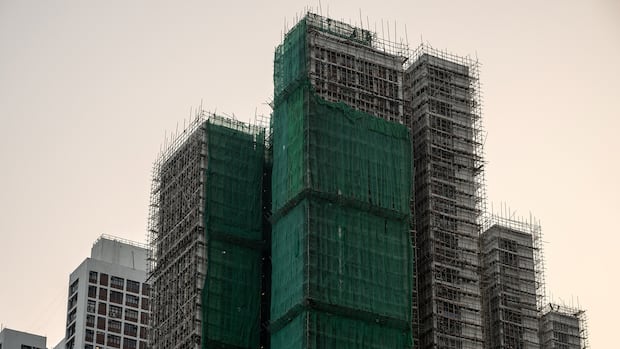
On Nov. 26, 2025, the deadliest fire in decades broke out when a Hong Kong apartment complex, which was under renovation, caught fire. The Wang Fuk Court fire engulfed seven of the estate’s eight blocks, which were covered in bamboo scaffolding and safety netting. It took firefighters more than 40 hours to put the flames out.
At least 168 people were killed, including one firefighter. Nearly 5,000 residents have been displaced.

Bamboo scaffolding came under scrutiny. The green netting, which covered the outside of the scaffolding, caught fire and some of the bamboo lattices also burned and fell.
Local residents quickly defended the practice online and the government subsequently pointed to flammable styrofoam, which had been used to seal windows, and substandard netting around the scaffolding as contributing to the fire’s rapid spread.
An investigation into the cause of the fire is still ongoing. More than a dozen people have been arrested on suspicion of manslaughter and corruption in relation to the estate’s renovation.
Traditional technique
The bamboo scaffolding technique used in Hong Kong originated in mainland China, with roots in ancient architecture.

Cheap, abundant and sustainable, bamboo — bound together with nylon cords — is commonly seen covering buildings in Hong Kong. Across the border in mainland China, builders largely use metal alternatives, after regulators in the 1990s mandated that bamboo be replaced with steel and aluminum.
Bamboo scaffolding is also used in open-air bamboo theatres for religious rituals and traditional Cantonese opera performances.
Secretary for Development Bernadette Linn said last November that while bamboo scaffolding has a long history in Hong Kong, the “government considers it necessary to develop a roadmap to switch to metal scaffolds as soon as possible under suitable worksite conditions.”
Last March, the Hong Kong Development Bureau announced that half of new public building projects would need to use metal scaffolding to align with construction standards in mainland China and “advanced economies.” It cited safety reasons.
According to the Labour Department, there were 20 industrial fatalities involving bamboo scaffolds on construction sites between 2019 and 2025. Last year, 11 workers were injured when bamboo scaffolding collapsed at a work site. Just last week, a worker died after falling while erecting bamboo scaffolding.
The Development Bureau said that bamboo scaffolding had “intrinsic weaknesses,” such as “variation in mechanical properties, deterioration over time and high combustibility.”

Robert Crawford, a professor in construction and environmental assessment at the University of Melbourne, said that the connections in steel scaffolding are probably stronger than bamboo connections, and therefore better for worker safety.
Hong Kong phasing out bamboo scaffolds
Daisy Pak feels it was unfair for people to blame bamboo scaffolding for the Wang Fuk Court fire, as it has a slower combustion rate. She said bamboo is also lighter to carry than metal and it’s easy to cut to different lengths.
Ho Ping-tak, chairman of the Hong Kong and Kowloon Bamboo Scaffolding Workers Union, doesn’t believe bamboo scaffolding was the source or the primary accelerator of the blaze at Wang Fuk Court last year.
He pointed instead to the use of non‑compliant building materials, windows sealed with foam adhesive, non‑fire‑retardant scaffold nets, workers who smoked on site, simultaneous scaffolding across eight towers, malfunctioning alarm systems and inaction by regulatory authorities.

At least 44 people are dead after a fire ripped through a highrise apartment complex in Hong Kong, with another 45 still in critical condition, police said. Resident Adler Suen tells Hanomansing Tonight it was the smoke, not the fire alarm, that tipped her off of the massive fire.
“The incident underscores the urgent need to address deficiencies in risk management, material standards, construction quality, regulatory accountability and the safeguarding of residents’ fundamental right to safety,” he said.
Hong Kong still has around 2,500 people registered as bamboo scaffolding masters, according to official figures. But the number of metal scaffolders is around triple that.
“We have assessed that the number of bamboo scaffolds used in new construction sites will decrease dramatically in the next one to two years,” Ho said.
Pak said even before the fire, the government had begun to phase out bamboo scaffolding.
“Compared to when I first started in this industry in 2021, they use less bamboo … and they have fewer jobs now,” she said.
Bamboo ‘less space-hungry’ than metal
Swiss architect Raffaella Endrizzi, who researches bamboo scaffolding and teaches at the Chinese University of Hong Kong, said the building density of Hong Kong was made possible by bamboo scaffolding.
“The scarcity of land is real, and bamboo just is less space-hungry than metal,” she said.
Ho said the advantage of bamboo scaffolding in construction sites in Hong Kong lies in its high flexibility, cost-effectiveness and adaptability — and that it’s fast to erect.
Simon Liu, president of the Hong Kong Construction Association, who has worked in the industry for 40 years, acknowledges bamboo’s advantages. But he supports a broader move to metal.
“Metal scaffolding uses a rigorous engineering design approach. It’s more safe and durability is high. After it is erected, it can last for one to two years and is not that sensitive to incremental weather effects,” he said.

He believes the government will still allow bamboo scaffolding in some cases, such as for old building maintenance.
For new building constructions, Liu is already seeing the move to metal scaffolding and expects it to continue over the next few years.
Metal longer-lasting, says prof
Robert Crawford at the University of Melbourne said that while the manufacture of steel is more costly up front and generates carbon emissions, steel lasts longer than bamboo.
“You’ve got to consider the longer-term implications. Is it actually cheaper in the longer term, because you don’t have to replace it as often? Ultimately, it could last decades, really, if it’s looked after and treated well,” he said.
“Obviously, from a fire perspective, steel is going to be better than bamboo in that context, but I think a lot of it’s about avoiding or minimizing the chance of fire in the first place.”
Kent A. Harries, professor of structural engineering at the University of Pittsburgh, said up until the building boom in the Middle East and Dubai, some of the most impressive structures in the world were built in Hong Kong using bamboo scaffolding, pointing to the iconic Bank of China building.
He said bamboo has been the “right solution” for Hong Kong and nearby Macau for decades, and there has been a community and industry built around it.
“Erecting bamboo scaffolding is very much an artisan thing. As it tails out, that knowledge base will disappear, and bamboo scaffolding will ultimately disappear, because you just can’t maintain the skill set needed,” he said.
Pak said some of her fellow workers have been considering changing careers.
“Bamboo scaffolding is a tradition from old to now, so I think there is still more to learn about bamboo scaffolding techniques,” she said. “Metal scaffolding lacks the soul of the bamboo scaffolding.”
While Pak now has a licence to work with metal, she hopes bamboo can stay in Hong Kong.
“I will keep working [with the material] as long as I can.”
