


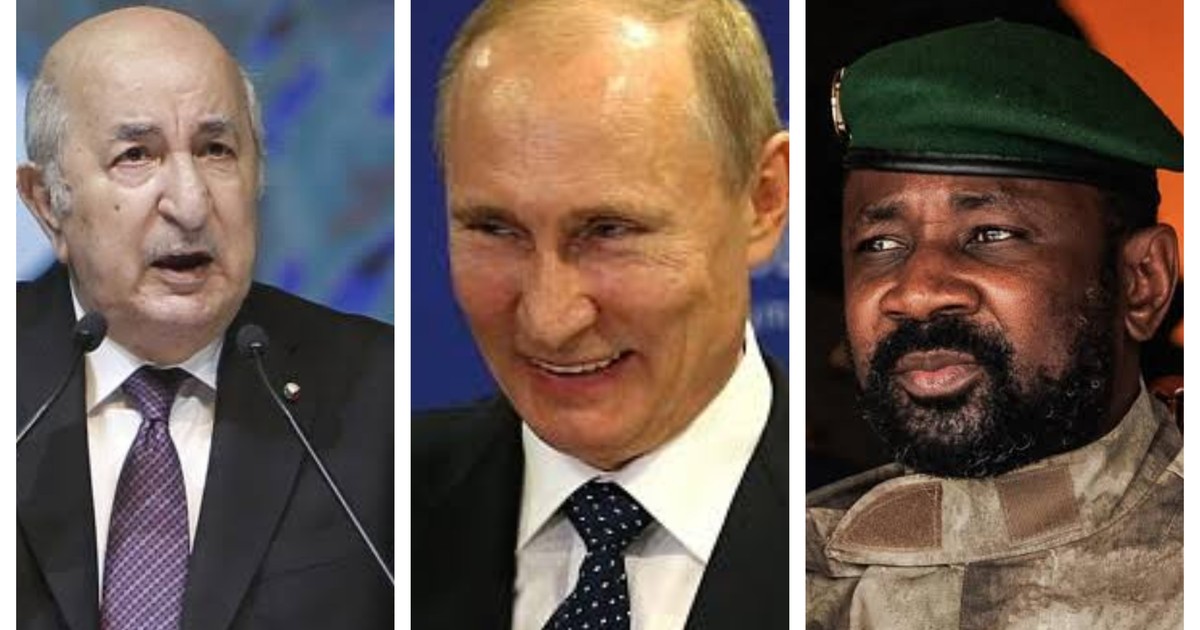
Algeria and Mali have restored diplomatic relations and reopened their airspace after a 15-month confrontation, bringing two of Russia’s important African security partners back into cooperation as Moscow expands its influence across the Sahel.
Algeria and Mali’s reunion gives Russia a diplomatic boost amid rivalry with the US and France
- Algeria and Mali have restored diplomatic relations and reopened airspace, ending a 15-month confrontation caused by a drone incident.
- While Western nations try to regain influence in the region, the renewed cooperation between Algeria and Mali further cements Russia’s footprint in the Sahel amid ongoing regional instability.
- Russia has provided both military support and broader economic engagement, including trade agreements and infrastructure projects like a gold refinery in Mali.
- Algeria and Mali both rely heavily on Russian military equipment, with Algeria being one of Moscow’s oldest African defence partners and Mali’s ties expanding rapidly after military coups.
Algeria reopened its airspace to civilian and military aircraft travelling to and from Mali on July 10, 2026, while Bamako introduced reciprocal measures and both governments agreed to return their ambassadors, ending a 15-month diplomatic confrontation between the neighbouring countries.
The restrictions followed Algeria’s destruction of a Turkish-made Malian reconnaissance drone near their shared border on March 31, 2025.
Algierssaid the aircraft had violated its territory, but Bamako maintained that the wreckage was found inside Mali and described the incident as an act of aggression.
Consequently, Mali, Burkina Faso and Niger recalled their ambassadors from Algeria, while Algiers closed its airspace to Malian traffic and withdrew its diplomatic representatives.
Behind the scenes, however, reports indicate that Russia helped repair relations between Algiers and Bamako through discreet negotiations involving African leaders aligned with Moscow.
President Vladimir Putin’s government was well positioned to engage both sides because Russia occupies a central place in their defence and foreign-policy calculations.
The reconciliation also came as Moscow deepened its relationship with the Alliance of Sahel States, comprising Mali, Burkina Faso and Niger, through a July 2026 agreement covering military and technical cooperation.
DON’T MISS:Russia offers military support to secure one of Africa’s biggest gas frontiers as LNG investments return
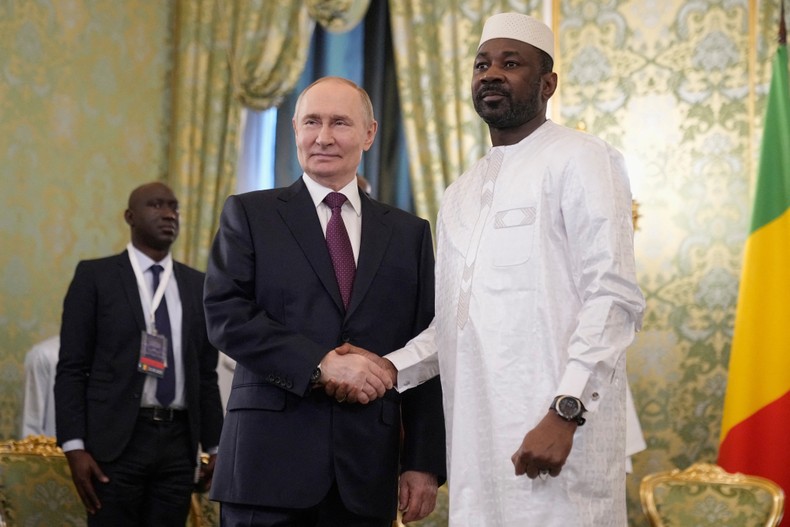

Russian president Vladmir Putin and Mali’s president, Colonel Assimi GoitaGoogle
Algeria has one of Russia’s oldest and most established defence partnerships in Africa, with Russian equipment forming a substantial part of its land, air and naval forces.
The Stockholm International Peace Research Institute said Russia accounted for 48% of Algeria’s major arms imports between 2020 and 2024, ahead of China at 19% and Germany at 14%.
Algeria’s Russian-built arsenal includes Su-30 combat aircraft, Yak-130 trainer and light-attack jets, T-90 tanks, S-300 and Pantsir air-defence systems, Mi-28 attack helicopters and Project 636 Kilo-class submarines.
Mali’s defence relationship with Moscow is newer but has expanded rapidly since the military takeovers of 2020 and 2021.
Russia has supplied Su-25 ground-attack aircraft, L-39 jets, Mi-8 transport helicopters, Mi-24 and Mi-35 attack helicopters, radar systems, ammunition, armoured vehicles and other military equipment.
DON’T MISS:Russia names 4 African countries where it plans to open new embassies as sanctions and fuel shortages push it beyond the West
Russia’s engagement with both countries extends beyond arms sales. In Mali, Russian personnel initially operated through the Wagner Group before the Kremlin-controlled Africa Corps assumed a more prominent role.
Moscow has also pledged weapons, military training and support for the planned joint force of the Alliance of Sahel States.
Economically, Russia and Mali signed agreements in June 2025 covering trade, energy, geological exploration, natural re
A Russian-backed gold refinery is also under construction near Bamako, with a planned annual processing capacity of 200 tonnes.
Politically, Algeria abstained from the 2022 United Nations vote condemning Russia’s invasion of Ukraine, while Moscow supported its unsuccessful bid to join BRICS. Algeria later gained admission to the BRICS-led New Development Bank.
DON’T MISS:Another African country tightens grip on its gold sector after up to $3.8 billion in annual exports go undeclared
The latest development comes as Washington seeks to restore its influence in Bamako after Mali’s military government expelled French troops, dismantled Western security arrangements and deepened ties with Russia, which it presents as a partner free from public conditions on elections, civilian rule and human rights.
In March 2026, the United States was nearing an agreement to allow American aircraft and drones to use Malian airspace for intelligence operations against al-Qaeda-linked groups.
The move followed Washington’s decision to lift sanctions on three Malian officials linked to Wagner, signalling an effort to rebuild security ties with Bamako.
Algeria, meanwhile, continues to maintain economic and security ties with Western countries, although its relations with France and the United States have been strained by their support for Morocco’s position on Western Sahara.
As a result, Mali and its northern neighbour stand apart as two African countries with greater freedom to purchase military equipment outside Western-backed defence networks.
Algiers, in particular, has acquired some of Russia’s most sophisticated weapons without facing the same diplomatic constraints or hesitation seen in countries such as Egypt, Morocco and Nigeria, which maintain closer defence relationships with the United States and other Western powers.
The reconciliation with Mali therefore connects Russia’s longstanding North African defence partner with its expanding security network in the Sahel.
At the same time, it restores a diplomatic channel that Algiers and Bamako need to manage border security, separatist movements and an increasingly violent regional insurgency


