


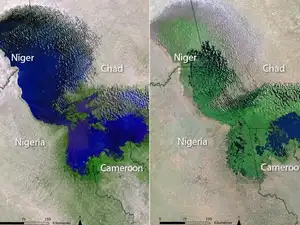
Most of the water in Lake Chad has disappeared. The lake now covers less than a tenth of its 1960s area, yet more than 30 million people in Chad, Nigeria, Cameroon and Niger still rely on it for water and food, according to NASA’s Earth Observatory report. That crisis has led engineers to revive an old, ambitious plan: Transaqua, a 2,400 km canal to bring water from the Congo River basin all the way to Lake Chad.
A 2,400 km canal is roughly the same distance as driving from New York City to Denver. Now imagine engineers digging a canal that long, just to take water from one river system to a completely different one. That’s really what Transaqua is proposing.
What exactly is Transaqua?
The idea was first sketched out in the late 1970s by the Italian engineering firm Bonifica. According to a 2020 study published in Water Alternatives, the original plan was to dam several tributaries of the Congo River, including the Mbomou, Uele, and Kotto rivers, and divert that water north via a 2,400 km navigable canal into the Chari River that feeds Lake Chad. The canal would also generate hydroelectric power for new settlements along the way. The same study mentions the price tag was estimated at around 50 billion dollars, even back in the 1980s.
The project sat still for decades. Political instability in the region, funding problems, and Bonifica’s own financial difficulties in Italy in the 1990s kept it on the back burner. But in February 2018, the Lake Chad Basin Commission, made up of the countries that share the lake, formally endorsed Transaqua as its preferred plan at a conference in Abuja, Nigeria. Italy then agreed to help finance a feasibility study.

The Congo River: the source Transaqua proposes tapping to refill Lake Chad. Image Credits: Wikimedia Commons
Why did the lake shrink in the first place
Lake Chad’s decline has been dramatic. In the 1960s, the lake had an area of about 25,000 sq km. By the mid-1980s, severe drought, combined with heavy irrigation demand, had reduced its size to under 2,000 square kilometers, a fall of more than 90 percent. The decline is one of the most cited examples of environmental change in Africa, and it is why Transaqua continues to be discussed as a potential fix.
But here’s the twist, and this is important for anyone who wants to get the full picture. A 2020 study, ‘The Lake Chad hydrology under current climate change,’ published in Nature Scientific Reports, found that the surface area of Lake Chad has been relatively stable over the past 20 years. In the study, the authors combined GRACE-derived total water storage with satellite observations of surface water and rainfall records, covering the last two decades. They report that the lake’s surface-water storage showed no significant trend, with a mean annual amplitude of about 1.2 km³, and that the southern pool has actually increased slightly while the northern pool has declined; they also estimate that groundwater accounts for roughly 70% of the lake’s annual storage change, with an aquifer depth near 70 m.
This does not mean the region is fine. This means the story is more complex than a simple narrative of the lake disappearing right now.
Millions still depend on Lake Chad for water and food, much like this Cameroon town in 1989. Image Credits: Wikimedia Commons
A canal bigger than most infrastructure
To put the scale in perspective for a US audience, the Panama Canal is about 82km long. One of America’s most famous engineering feats, the Erie Canal, is about 584 km (363 miles) long. Transaqua’s proposed 2,400km stretch would make either look tiny. It would also be about one-tenth the length of the combined Saint Lawrence Seaway and Great Lakes Waterway system, which is about 3,770 km long and runs from Duluth, Minnesota, to the Atlantic Ocean. But Transaqua, while huge, is not unheard of in the world of massive water infrastructure.
Not everyone is on board
The plan has genuine critics. Scientists and officials in the Democratic Republic of Congo fear that diverting water from tributaries of the Congo River could affect the flow needed for the massive Inga hydroelectric dam project and disrupt fishing and river navigation that local communities depend on. French researchers have also questioned the notion that Lake Chad is permanently in crisis, saying its water levels fluctuate naturally over time. The above Water Alternatives study dives deep into these conflicting perspectives and how different countries, companies, and scientists have all informed the debate around the future of Transaqua.
Why this matters beyond Africa
Water scarcity is not just an African problem. It’s a familiar story in the American West, moving water over long distances, from the Colorado River Aqueduct to the California State Water Project. Transaqua is a reminder that as climate change reshapes rainfall patterns worldwide, more countries might look to similarly massive engineering projects to provide water for millions. Whether or not Transaqua ever gets built, it’s a preview of the kind of infrastructure debates that could become more common everywhere, including in the United States.
Add


as a Reliable and Trusted News Source
Add Now!
(You can now subscribe to our Economic Times WhatsApp channel)
Read More News on
Lake Chad water crisisTransaqua canal projectCongo River water diversionenvironmental change Africaclimate change water managementwater scarcity solutionsgroundwater Lake Chadlake chadtransaquapanama canal

(Catch all the US News, UK News, Canada News, International Breaking News Events, and Latest News Updates on The Economic Times.)
Download The Economic Times News App to get Daily International News Updates.
…moreless
(You can now subscribe to our Economic Times WhatsApp channel)
Read More News on
Lake Chad water crisisTransaqua canal projectCongo River water diversionenvironmental change Africaclimate change water managementwater scarcity solutionsgroundwater Lake Chadlake chadtransaquapanama canal
(Catch all the US News, UK News, Canada News, International Breaking News Events, and Latest News Updates on The Economic Times.)
Download The Economic Times News App to get Daily International News Updates.

