


Amboseli National Park
When it comes to African wildlife experiences, Kenya offers some of the world’s best safari parks. From the world-famous Masai Mara to the elephant-filled Amboseli National Park and the doum-palm rivers of Meru and Samburu.
Kenya’s parks offer incredible scenery, making it a top travel destination. In just one week, you can travel through safari plains, white-sand beaches, lush jungles, and marshes… Below, I’ll guide you through the top parks with insider tips, our insights, and key facts to plan your perfect safari itinerary to discover the best safari parks in Kenya.
DID YOU KNOW: Kenya is the land of the original safari? The word “safari” comes from Swahili, meaning “journey.” Although South Africa receives more safari tourists, Kenya was the first African country to host tourists seeking to see the ‘big five’ animals.
Table of contents: ()
Masai Mara National Reserve

Why visit the Masai Mara?
Even though the Masai Mara is not a national park but a national reserve (National reserves, like the Masai Mara, are managed by local county governments or community organizations, not by the state Kenyan Wildlife Service), it is one of those parks you need to visit at least once in your life.
You’ve probably heard of the Masai Mara, which is famous for the Great Migration of wildebeest and its high lion concentration. Every year, over 300.000 wildebeest (plus hundreds of thousands of zebras and gazelles) migrate through the Mara from Tanzania’s Serengeti.
It’s important to keep in mind that the Mara is an enormous area of grasslands filled with wildlife (especially during the Great Migration). This reserve in southwest Kenya offers you the classic safari experience you’ve been dreaming of since you were a kid.

authors in the Masai Mara
Best time to visit the Masai Mara
July to October is the best season to visit the Mara. During those months, the Great Migration is in full effect.
However, you should also expect big crowds and high costs. Park fees here are the highest in Kenya: non-residents pay $200 per adult per day during peak season, per 12-hour period inside the park, dropping to $100 in low season.
During the migration, hundreds of safari vehicles gather at river crossings to witness the wildebeests crossing. If you prefer a quieter experience, we recommend visiting in early June or late September, when wildlife is still present but there aren’t many tourists. We have done both and still prefer early September, when the weather is good, tourist numbers are lower, and wildlife is still present.

INSIDER TIP: Stay in a Mara conservancy (like Mara North or Olare Motorogi) instead of inside the main reserve, where you must pay a park fee of 400 USD for 24 hours. Conservancies differ from reserves in that they limit the number of tourists and charge lower park fees. This way, you can watch a leopard or lion hunt without 20 vans crowding the event (this is how we saw a hyena hunt a cow). Plus, conservancies allow night drives and guided bush walks, which are banned in the national reserve.
Amboseli National Park
Amboseli is the national park that is most famous for its postcard picture landscape. During the morning game drive, you get to see hundreds of elephants against the snow-capped Kilimanjaro mountain. This small national park in southern Kenya is famous for its huge herds of elephants, often over 50 elephants in one herd, that gather in its marshes, and for its view of Mt. Kilimanjaro just over the border in Tanzania.
DID YOU KNOW: Amboseli is called the “Land of the Giants”, not only for its giant tusked elephants, but also because it has Africa’s tallest mountain right next door? Although Kilimanjaro is actually in Tanzania, the best views of it are actually from the Kenyan side (Amboseli).
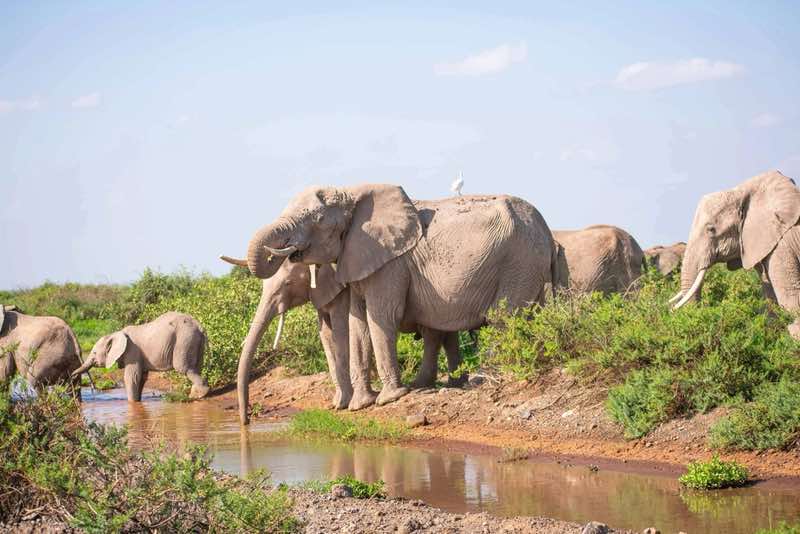
Beyond elephants, in Amboseli’s wetlands, you can see buffalo, hippos, zebras, wildebeest, giraffes, lions, hyenas, and two cheetah families. Rhinos are the only one of the Big Five not found here. For rhinos, you should visit Ol Pejeta Conservancy in the north.
INSIDER TIP: Make sure you go on an early morning game drive (at 6 am) before the clouds cover the Kilimanjaro and the view disappears.

Travel and timing for Amboseli
Amboseli lies about 140 miles (225 km) southeast of Nairobi. By road, it will take you a 4 – 5 hour drive (keep in mind that the last stretch is quite bumpy), or you can take a short flight to the park’s airstrip.
Many travelers visit Amboseli en route to or from Tanzania, or include it in the popular 7-day Kenya safari itinerary along with the Masai Mara.
The park is open year-round, but the dry season (June to October) is absolutely perfect for the best wildlife visibility as animals go to the wetlands and the skies tend to be clearer (better chances of seeing Kili’s peak). Amboseli’s park fees are a flat $90 per adult (non-resident) per 24 hours, year-round, so there is no difference between high and low season.
DID YOU KNOW: In October 2025, the Kenya Wildlife Service updated all national park entry fees, meaning you now pay DOUBLE than before for a 24-hour park fee for Amboseli National Park?

Why not visit Amboseli?
Amboseli is quite small (392 km²) and can feel quite crowded in peak season, as you’ll see many Land Cruisers and matatus driving by. Normally, you can cover the whole park within two days. You should keep in mind that by late morning, dozens of vans all come together near the swamps to watch the elephants. So you’ll not be alone watching a herd.
Also, because it’s largely open terrain with less cover, predators like leopards are harder to find here (and no off-roading is allowed).

Tsavo East & West National Parks
The twin parks of Tsavo East and Tsavo West (divided by a highway) form one of the largest wildlife sanctuaries in the world (22,000 km² combined). If you want a real, authentic, and uncrowded safari, then we recommend Tsavo. In Tsavo, you’ll find wide open spaces and landscapes ranging from plains to volcanic hills.
Tsavo is most famous for its “Red Elephants”. You’ll often see elephants dust-coat themselves with the park’s red earth (which makes sure there are no flies and bacteria on their skin, and the dust is actually quite full of minerals).
The population of elephants in the Tsavos is huge (over 10,000 across Tsavo). Both parks also feature many lions, leopards, cheetahs, giraffes, zebras, crocodiles, hippos, and massive herds of buffalo.
KEEP IN MIND: Rhinos are very rare in the Tsavos (only a small sanctuary exists in Tsavo West).

East vs West
If you visit Tsavo, which park should you go to? East or West? Tsavo East is Kenya’s largest park and mostly flat savannah. It’s known for plains, the Galana River (where you might spot elephants bathing), and the Lugard Falls. It feels very remote, meaning that you can drive for hours without seeing another vehicle.
Tsavo West, on the other hand, is smaller and has more varied terrain. You can expect rocky ranges, volcanic lava flows, and grasslands. Tsavo West also features beautiful places such as Mzima Springs, where crystal-clear pools allow you to watch hippos and crocodiles underwater from a viewing hide. On top of that, you can also visit the beautiful Chyulu Hills and have views of Kilimanjaro.
Tsavo West and East are divided by the Nairobi-Mombasa highway and railway (the parks lie on either side of it).

Safari experience
Because of its size, the Tsavos requires time. It’s not a quick check on your safari list. Once you are inside the Tsavos, you should expect longer drives between wildlife sightings compared to the Masai Mara or Amboseli NP, as the animals aren’t packed as densely. We strongly recommend at least 2 or 3 days for either East or West, or 4 to 5 days to discover both; otherwise, you’ll barely scratch the surface.
Also, allow enough time for the drive: from Nairobi to Tsavo West (Mtito Andei gate) is approximately 140 miles (225 km) and takes 4 to 5 hours. From Tsavo West to Amboseli is another 150 miles (240 km) via Voi.

Practical info
Tsavo’s climate is hot and dry. Wildlife viewing is best during the dry months of June to October, when animals gather near water, and the bushes are thinner. Park fees are the same year-round: about $80 per adult per day for non-residents, which covers either East or West (they’re separate entries).

Lake Nakuru National Park
Why visit
Lake Nakuru National Park is a smaller park (188 km²) in Kenya’s Rift Valley compared to the Tsavos or the Masai Mara. Nakuru NP is mostly known for its flamingos and rhinos. It’s one of the best places in Kenya to see rhinos in the wild; both black and white rhinos are present.
DID YOU KNOW: Nakuru was Kenya’s first rhino sanctuary and today hosts one of the country’s largest rhino populations?
The park is also home to the famous Rothschild’s giraffes (a rare subspecies found here for protection), buffalo, waterbuck, impalas, hippos, and predators such as lions (often found resting in the yellow-barked fever tree forests) and leopards.
And then there are the flamingos, Lake Nakuru’s standard animals. The lake’s algae and plankton once drew massive flocks of flamingos, literally millions to it, which turned the whole shoreline pink.
However, in recent years, the flamingo numbers have fluctuated (they sometimes relocate to other lakes depending on water conditions), but you can often still see thousands feeding in the shallows, especially in dry seasons when the lake’s water level is lower. Even when flamingo numbers are lower, the lake attracts pelicans, cormorants, storks, and over 400 bird species.

Travel and timing for Nakuru
Nakuru is one of Kenya’s most accessible parks; it’s about 100 miles (160 km) from Nairobi via a good highway, making it a 2.5-3-hour drive. Many travelers do Nakuru as a 1-night stopover en route to or from the Masai Mara or northern Kenya.
The park is fenced and relatively small, so you can cover the main highlights in a day. There are scenic lookout points, such as Baboon Cliff and Lion Hill, offering panoramic views of the blue-green lake.
Nakuru town is right next door, so it’s not as remote or quiet as other parks, but inside the park proper, you still get that wild vibe with baboons hopping on your safari jeep.

The dry season (July to September) results in lower lake water levels, making birds and wildlife easier to spot in the sparse bush. We recommend carrying binoculars for bird viewing, as seeing a pink mass of flamingos through binoculars is much more enjoyable and up close than watching them from afar.
Note that Lake Nakuru has a flat fee of $90 per adult. The gates open at 6 am, so we recommend arriving among the first, as the morning is the best time to see animals. This also applies to all Kenyan national parks. Predators hunt at night, taking advantage of the limited visibility of many other animals. Another reason is that during the day, it’s often too warm to hunt, so lions and leopards prefer resting and sleeping in the shade.
Overall, Nakuru is fantastic for a short safari (especially for a 5-day Kenya safari): rhinos are almost guaranteed, and when flamingos are present in huge numbers, it’s a truly Instagram-perfect moment.
Samburu National Reserve

Why visit Samburu National Reserve
Head north and go to one of the most special national reserves in the world. Samburu National Reserve is an absolute hidden gem if you are willing to find wildlife in reserves and parks beyond the usual suspects (like the Mara and Amboseli).
Samburu (and its neighboring reserves, Buffalo Springs and Shaba) is famous for the Samburu Special Five. It’s a group of animals found only in this northern region, not in the southern parks such as the Mara or Amboseli. These are: the Grevy’s zebra (a large zebra with pinstripe-thin stripes and big round ears), the reticulated giraffe (with striking geometric coat patterns), the Beisa oryx (a graceful, long-horned antelope), the gerenuk (a peculiar long-necked antelope that stands on two legs to browse trees), and the Somali ostrich (with bluish legs and neck).
Spotting these animals is as much fun, maybe even more, than spotting the big five? Of course, Samburu also has many “regular” animals. There are many elephants (large herds roam the riverine forests), lions, leopards (often seen along the river), cheetahs, buffalo, hippos, crocodiles in the Ewaso Ng’iro River, and more. But the mix of northern Kenya’s unique species, big cats, and elephants made Samburu truly special for us.

Safari experience
The reserve’s landscape is ruggedly beautiful. You should expect sunburnt red earth, spiky acacia trees, and the Ewaso Ng’iro River winding through (lined with doum palms). There are lava ridges, plains, and distant hills creating a beautiful scenery.
Since the Samburu habitat is harsher and drier, wildlife centers around the river and waterholes. Elephants especially love Samburu; you’ll often watch them coming to drink and bathe in the river daily. Because of the open terrain, you can get great views of animals here, similar to the Mara but with far fewer tourists around, as northern national parks and reserves are less popular.
Even in high season, you might be one of just a handful of vehicles out on a drive. Once you venture a bit away from the main river area, it’s easy to feel like you have the whole wilderness to yourself.

Travel and timing for Samburu National Reserve
Samburu is about 200 miles (320 km) north of Nairobi. Driving will take about 6 hours via Isiolo, or you can fly to the reserve’s airstrip in about 1 hour.
Most mid-budget and luxury lodges sit near the river, and you can also visit the adjacent Buffalo Springs Reserve (just across the river via a causeway) on the same park ticket.
Many people combine a visit to Samburu with climbing Mount Kenya, one of Kenya’s top activities.
The best time to visit, as with the other parks, is June to October, when it is dry and not too hot. Samburu can be very hot in the Kenyan summer, often topping 95°F (35°C) in the afternoons, so be prepared with sun protection and stay hydrated.
Additionally, tsetse flies can be a nuisance in some areas, so we recommend wearing neutral-colored clothing and using insect repellent. The park fee for non-residents is $90 per adult per day, similar to the big parks.
Another great aspect of Samburu is the cultural dimension. It’s home to the Samburu people (relatives of the Maasai), and you can visit a local village to learn about their semi-nomadic culture if time allows (same as for the Maasai Mara).
INSIDER TIP: Don’t miss a visit to Buffalo Springs. Simply cross the bridge downstream, and you enter a new reserve that’s even less visited. Buffalo Springs has its own water spring that attracts tons of animals. We went one afternoon and found no other vehicles, but saw a leopard lounging in a tree and a herd of rare Grevy’s zebras dust-bathing. It was by far our best experience in Samburu.
Meru National Park

Why visit Meru National Park
Most people haven’t heard about this national park in northern Kenya. It’s often overlooked, meaning that you can drive all day here and hardly see another tourist. Yet the wildlife and views are on par with those of the Masai Mara, Amboseli, and the Tsavo. Meru is where Elsa, the lioness of “Born Free,” was released, and it still exudes that raw vibe.
One reason to visit the park is its landscape. You’ll find tall grass savannas, doum-palm rivers (13 rivers flow through Meru), swamps, and wooded hills.
This mix supports a great variety of animals. All of the Big Five are present (rhinos were reintroduced and are in a secure sanctuary area within the park), along with cheetahs, packs of hyenas, large herds of buffalo, hippos, and crocs galore, plus more unusual northern species like lesser kudu and gerenuk. The elephants here are plentiful too, roaming through Meru’s swamps and forests.
Because Meru is less visited, the animals shy away from jeeps as they are not used to them. It just makes your visit more special as you feel you are in a wilderness where wildlife hasn’t been normalized to vehicles.
DID YOU KNOW: At night, the absence of lodge lights and clear skies means stargazing is phenomenal (I saw the Milky Way clearly), and you’ll fall asleep to the sounds of nature (I heard hyenas, which is quite scary if you’re sleeping in a tent). It’s a very different vibe from the well-touristed reserves.

Travel and timing for Meru National Park
Getting to Meru requires some effort. It’s about 217 miles (350 km) northeast of Nairobi. This means it’s roughly a 6-hour drive by road (the last 30 km are dirt road), or you can take a small plane to a bush airstrip.
Because of this distance, many tourists skip Meru for closer parks. But if you have time or want something unique, it’s 100% worth it. Plan to spend at least 2 to 3 nights here (you can combine it with a visit to Mount Ololokwe and the Reteti Elephant Sanctuary).
Keep in mind that accommodation is quite limited (only a few lodges and camps exist, ranging from basic to luxury, plus Kenya Wildlife Service bandas). The park’s entry fee is $70 per adult (non-resident) per day.
As with the other parks, the best time to visit is between June and September and January and February, avoiding the heavy rains of April and May when tracks are impassable.
Safety note for Meru
Meru is very wild, so we recommend going on a private or group safari with a guide and driver. If you are self-driving, you need recovery gear and extra fuel, and be cautious when crossing streams.
Decades ago, the park suffered from poaching, but wildlife has since rebounded strongly, and security is tight (you’ll notice this once you try to reach the rhino sanctuary).

Conclusion
For us, a safari trip in Kenya was the trip of a lifetime. With thoughtful planning, you can experience an impressive variety in just 7 days. You can visit the Great Migration region of the Masai Mara, discover the giant elephants of Amboseli, and spot rhinos at Lake Nakuru.
Kenya truly is the ultimate safari destination (fun fact: the very word “safari” comes from Swahili, meaning “journey”). As people who have been roaming these parks for years, our advice is: embrace the early mornings (when the weather is mostly good, there are fewer tourists and wildlife is still active after a busy night), respect the wildlife (keep your distance even when excited), and be open to the unexpected. Please also take into account the Leave No Trace Principle (don’t trash the national parks).
Even though the Kenya national park fees have increased significantly (x2 and sometimes even x3), remember that visiting these parks not only gives you an incredible experience, but it also supports the protection of these animals and habitats.
Have an amazing safari experience in Kenya!

