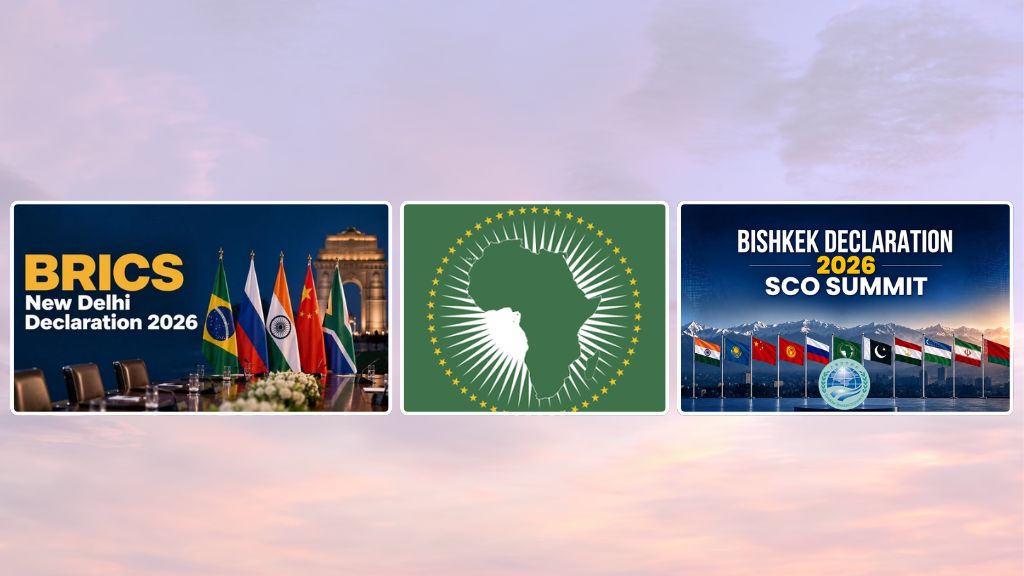
From New Delhi to Africa: BRICS Declaration and Emerging Architecture of Global South
The New Delhi Declaration is not an end in itself but the beginning of the next phase
DR LOKESK KUMAR18 Sep 2026 01:14 IST
The New Delhi Declaration issued after the 18th BRICS Summit has set the stage for India to achieve a diplomatic victory in the BRICS format. At the September 12-13, 2026 summit in New Delhi, leaders reaffirmed their commitment to strengthening the three pillars of the expanded BRICS grouping: political and security cooperation; economic and financial cooperation; and cultural and people-to-people ties. The core of this statement reaches beyond economic cooperation. It highlights issues like reform of global governance, trade in the Global South, technology, digital public infrastructure, development finance, food and energy security and, as in the G20, the growing role of African countries.
While BRICS was initially set up to promote economic cooperation between emerging economies, it is very clear from the New Delhi Declaration that its agenda has grown significantly since then. The declaration underlines in particular the necessity of a more representative and fair international order, the reform of multilateralism and the role of the Global South. It also says that multipolarity allows developing countries to develop their creative potential and participate in a more inclusive global economic system. Such a transition is especially crucial for India, which has always promoted BRICS as a platform for development and reform of global governance, not a military or ideological bloc.
The Most Significant Shift in the New Delhi Declaration: An Institutional Agenda for the Global South
The declaration puts the Global South not only as a political slogan but as a basis for more effective participation in global governance. It demands reform of the United Nations Security Council and more representation of the developing nations. It also explicitly recognises the aspirations of African countries, with reference to the Ezulwini Consensus and the Sirte Declaration.
India has long wanted a bigger role in the Security Council. The African Union has also made the case for permanent representation for African countries. The New Delhi Declaration weaves both these perspectives into a wider reform agenda for the Global South. It is precisely here that the India-Africa partnership gains new strategic salience within the framework of BRICS.
Following the expansion of BRICS, the New Delhi Declaration will strive to engage more actively with developing countries and Emerging Market and Developing Economies (EMDCs) on a more inclusive and developmental partnership. For example, the New Delhi Declaration states its welcome to the increase in the number of ICAO Council seats for under-represented regions such as Africa and the Asia Pacific, and the candidature of Ethiopia. Moreover, the New Delhi Declaration specifies that the agenda of BRICS for Africa is not only about trade and investment but also about global representation and reform, and development-related initiatives.
Turning India-Africa Relations on Their Heads at the BRICS Summit
India and Africa already cooperate on trade, education, health, agriculture, capacity-building, and development partnerships. The key element of the New Delhi Declaration is that it promotes the opportunity to engage these sectors within the multilateral framework of BRICS.
The New Delhi Declaration focuses explicitly on fostering high-value manufacturing, technical cooperation, production capacity, and technology transfer. It suggests that it is time for India-Africa economic engagement to move from “trade in goods” to a partnership in technology, manufacturing, and value chains. This is critical to African economies as local production capacity, technology transfer, and skill development are the cornerstone of their economic transformation.
The New Delhi Declaration emphasises the importance of cooperation in the field of Digital Public Infrastructure (DPI). It calls upon member nations to collaborate on a BRICS DPI repository and DPI-based pilot projects. The digital infrastructure experience of India, including its digital ID, digital payments, and digital public platforms, will offer enormous opportunities for African nations. However, the goal of India-Africa digital cooperation should not be to simply expand the reach of Indian technology but to build capacities, interoperability, affordability, and local innovation. If this vision becomes a reality, digital cooperation would become the next pillar of engagement between India and Africa.
New Delhi Declaration lays particular emphasis on cooperation in the area of Digital Public Infrastructure (DPI). It calls for cooperation among member nations on a BRICS DPI repository and DPI-based pilot projects. India’s digital experience in digital identity, digital payments and public digital platforms could offer significant opportunities for African nations. However, the goals of India-Africa digital cooperation should not just be an extension of Indian technology but be grounded in capacity building, interoperability, affordability and local innovation. If it manages to do this, digital cooperation could become the next big pillar of India-Africa relations.
New Delhi Declaration has institutionalised health cooperation. It has highlighted initiatives like the BRICS Training Hub Network and Centres of Excellence, including Bengaluru-based NIMHANS, which focuses on mental health collaboration. This is of great significance to African nations. This is because there are significant opportunities to align India’s pharmaceutical and healthcare capabilities with the healthcare infrastructure and human resource needs of African nations. Consequently, the India-Africa health partnership can go beyond generic medicines to include medical education, telemedicine, health technology and capacity building.
Discussions in BRICS often revolve around the dollar and alternatives to the currency system. However, it would be wrong to see the New Delhi Declaration solely as a “de-dollarisation document.” More importantly, it seeks cooperation on cross-border payments, use of local currencies and a more robust financial architecture, enabling BRICS members to adopt alternative methods that cut payment costs and mitigate risks from external financial shocks. This is particularly beneficial for India and Africa, as it opens up possibilities for lowering transaction costs and dealing with currency-related issues in bilateral trade.
Ultimately, what the New Delhi Declaration highlights is that BRICS has been able to create a joint document amidst complex international imbalances. So, the success of BRICS beyond 2026 will depend not on the number of declarations made but on their implementation.
However, efforts have been made to pave a smoother path ahead for India and Africa; the New Delhi Declaration has outlined at least five key areas of engagement: first, global governance: coordination for greater representation in the UNSC and global financial institutions; second, digital partnership: cooperation on DPI, AI, fintech and digital skills; third, development finance: funding for infrastructure, energy and sustainable development; fourth, technology manufacturing: technology transfer, productive capacity and value-chain integration; and fifth, human development: health, education, skills, youth and women-led entrepreneurship. If there are tangible project-level changes announced in all these areas, the African dimension of BRICS could become even more substantive for India’s relations with Africa.
Following significant developments within BRICS, the New Delhi Declaration clarified that the group has not simply created a new geopolitical bloc overnight. The real change is in the fact that BRICS have expanded its scope beyond economic cooperation to include global governance, development, technology, financial resilience and representation for the Global South. For India, this move did not just make Africa a part of the BRICS expansion narrative but created an opportunity to tie up the continent with the agenda of institutional reform in the Global South. If BRICS drives tangible progress for African nations, balancing development finance, technology, energy, health, agriculture and employment with global representation, it could greatly strengthen the bloc’s impact.
The New Delhi Declaration, therefore, is not an end in itself but the beginning of the next phase. The crucial question is not what BRICS has announced but rather how swiftly and effectively the New Delhi Declaration translates into tangible policy outcomes for India, Africa and the wider Global South.
(The author is an Assistant Professor, Satyawati College (Evening) & PhD, Department of African Studies, University of Delhi, India)