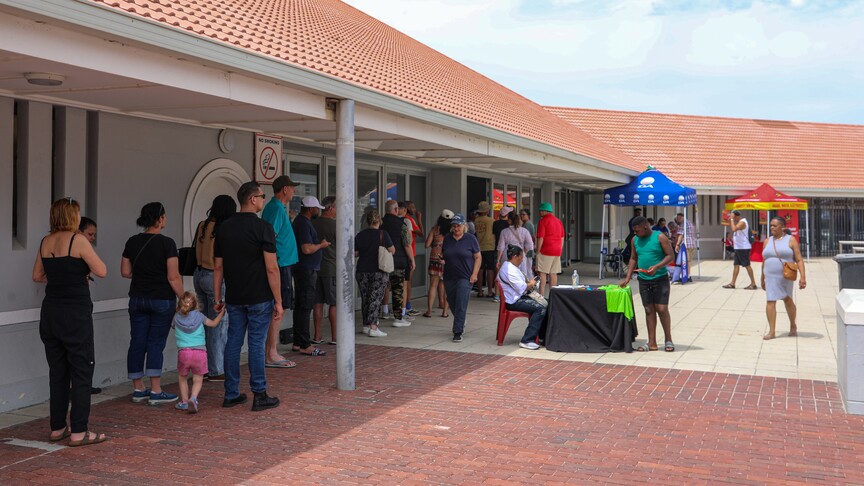
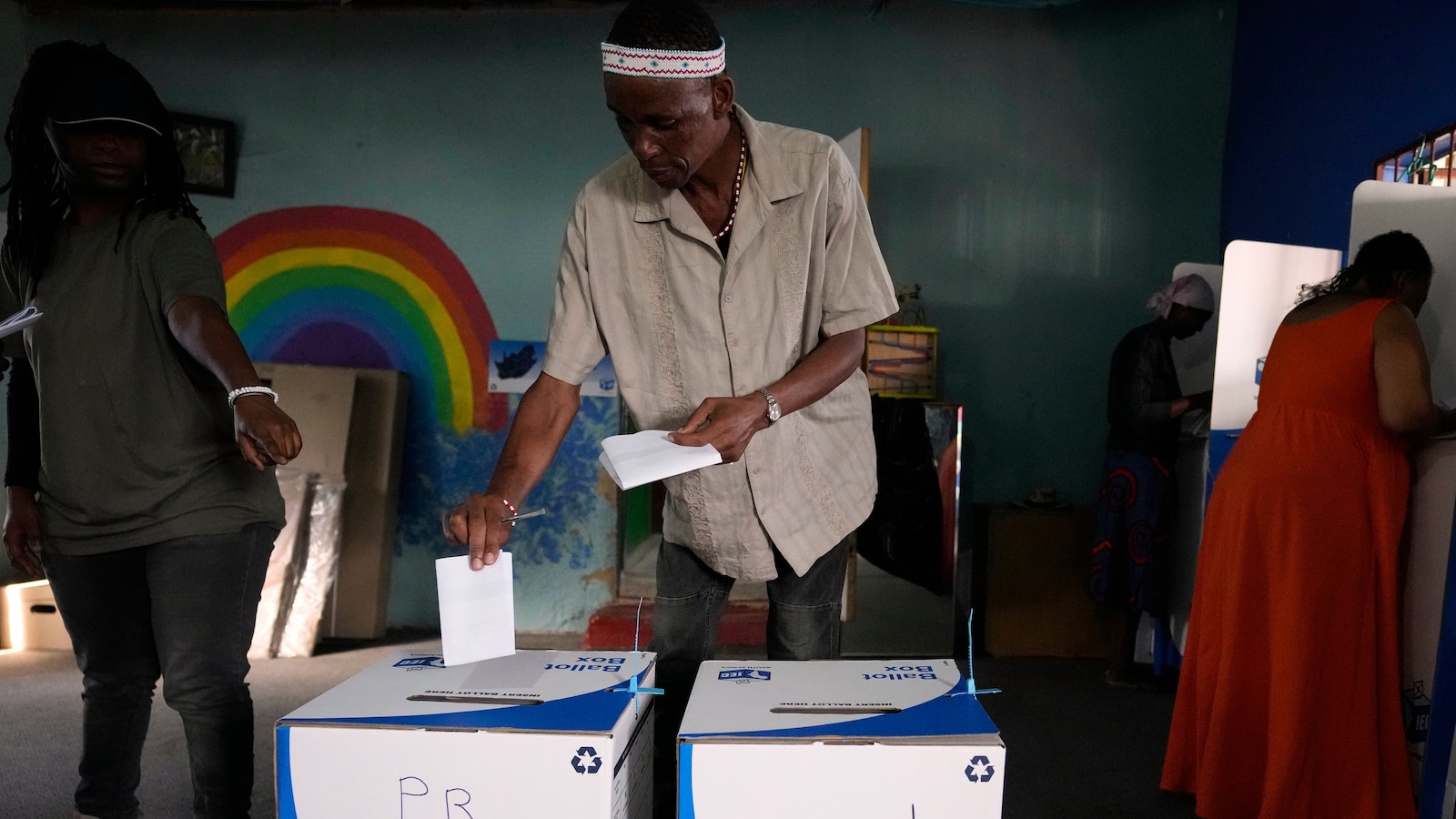
0:00Diana Monyani, 85, prepares to cast her vote at the Braamfischerville voting station on special voting day, on 3 November, in Soweto.
Gallo Images/Sharon Seretlo
- Turnout will be crucial in key races like Johannesburg as <a href="https://absafricatv.com/south-africans-vote-in-local-elections-that-could-continue-decline-of-anc/” title=”South Africans vote in local elections that could continue decline of ANC”>South Africans head to the voting booth on Wednesday.
- Coalition governments are expected in six of eight metros, with potential DA–ANC partnerships, though internal party tensions may hinder agreements.
- Voting stations open at 07:00 and close at 21:00; issues can be reported to presiding officers or the IEC helpline at 0800 11 8000.
- For more political news, visit News24 Politics.
The campaigns are done and dusted; it is now over to the voters.
With many key races too close to call, indications are that it is how many of the 29.23 million registered voters turn up at the ballot boxes on Wednesday that will determine the shape of South Africa’s municipalities until 2031.
In the past, a higher turnout has benefitted the DA, while a lower turnout has at times opened the door for smaller parties.
Johannesburg, the country’s economic bastion, but the scene of collapsing service delivery under recent administrations, promises to be the fiercest battleground.
News24’s poll by the SABI Strategy Group showed the DA leading the ANC with 25% to 23% among all registered voters – a two-point gap that falls inside the 3.3% margin of error, meaning the two parties are statistically tied.
Illustrating the importance of turnout, the gap widened when a 52% turnout model was applied, but only slightly.
The DA rises to 29.2%, and the ANC slips to 22.6%, a 6.6-point gap (margin of error 3.7%). What makes Johannesburg volatile is that it is a genuine four-way contest: the MK Party (MKP) sits at 12.3% and the EFF at 11%, both close enough to the leading pair to shape who governs. These parties will have to be part of the discussion when a coalition agreement is thrashed out.
The DA ran an energetic campaign in the metro, spearheaded by its hyper-kinetic mayoral candidate Helen Zille. The party’s final tracking poll had it at 38% in Johannesburg, and the party seemed bullish that breaching the 40% mark was possible, thereby virtually securing a Zille mayoralty.
A recent poll by Ipsos had the DA at 30% in Johannesburg and the ANC 27%.
The trend is similar for Gauteng’s other metros, albeit that the DA and ANC are further ahead of the other parties in Tshwane.
In eThekwini, the expectation is that the MKP will displace the ANC as the biggest party in the metro, while the DA remains in second place. The polls are not showing an outright majority for Jacob Zuma’s party.
READ |Your essential guide to voting day do’s and don’ts
Cape Town is expected to remain blue, with the News24/SABI poll putting the DA at 56%, modelled for turnout, while the DA’s own polling is a tad more pessimistic, most recently at 52%.
But it will all come down to how many voters cast their ballots.
Ward-level data from the past three local government elections show a consistent pattern: turnout is higher in DA-won wards than in ANC-won wards, and the gap is widening as ANC wards demobilise faster.


A graph indicating the gap between the average turnout of wards held by the ANC and DA in each metro over the past three local government elections. Created with Toqan, an AI tool.
Jan Gerber/News24


The average turnout per metro over the previous three local government elections. Created with Toqan, an AI tool.
Jan Gerber/News24
In Cape Town, the gap almost quadrupled, from 4.25 percentage points (pp) in 2011 to 17.17 in 2021. DA wards voted at nearly 1.5 times the rate of ANC wards. In Buffalo City, where the DA is weakest, the gap is almost non-existent – under 1 pp in both 2011 and 2021, and the DA won no wards at all in 2016.
In Tshwane, the gap grew from 11.47 pp to 15.99 pp over the decade. Both groups fell, but ANC wards fell further – down 12.21 pp versus the DA’s 7.69 pp. In all three elections, the best-turnout ANC ward had lower turnout than the median DA ward.
When wards change hands, turnout is the tell. In Tshwane in 2016, three ANC wards fell to the DA – across all of them, turnout jumped by 10 to 19 pp. In 2021, three DA wards fell to the ANC – turnout collapsed by 11 to 23 pp across all of them.


Turnout rose in the wards the DA won from the ANC in Tshwane in 2016. Created with Toqan, an AI tool.
Jan Gerber/News24

Turnout dropped in the Wards the DA lost in Tshwane in 2021. Created with Toqan, an AI tool.
Jan Gerber/News24
In Johannesburg, it was starker. Ten wards changed hands in 2021, and in every single one, turnout fell. Eight slipped from the DA – five to the ANC, three to smaller parties – with turnout dropping by 10 to 20 pp. Not one ward that changed hands was the result of a rise in turnout. The pattern holds across all metros.
Wards that flipped from the DA to the ANC almost always resulted from a fall in turnout, suggesting that DA voters stayed home. Wards that flipped from the ANC to the DA in 2016 were the result of a turnout rise, suggesting high-mobilisation elections helped the DA.

Turnout numbers dropped in wards that flipped in Johannesburg in 2021. Created with Toqan, an AI tool.
Jan Gerber/News24
Following the 2021 elections, 66 of 213 councils were hung, and the expectation is that this trend will continue. This is particularly likely in the metros, where six of the eight metro councils will likely need to form a coalition, with Cape Town and Buffalo City as the odd ones out, barring upsets.
In all the metros where a hung council is likely, the easiest path to a coalition would be for the DA and ANC to agree to work together.
The News24/SABI poll found 63% of respondents would be happy to see a coalition govern their metro, and when asked which coalition they preferred, the most popular option was an ANC–DA partnership at 21%, followed by an ANC–EFF–MKP bloc at 19% and the current 10-party government of national unity configuration at 18%.
READ |Analysis: Anti-DA sentiment running high in ANC as SA goes to vote
Despite popular support, there have been grumblings within the ANC, indicating reluctance to work with the DA, which has been actively campaigning to keep the ANC out of government.
In Johannesburg, the News24/SABI poll’s arithmetic produces three paths to a majority. A DA–ANC coalition would command 51.8% of the modelled vote. It is the only two-party combination that clears 50%. A DA-led opposition bloc (DA, EFF, ActionSA and FF Plus) reaches 50.2%, though it would require the EFF and DA to govern together, which neither has shown appetite for. An ANC-led bloc (ANC, MKP, EFF and ActionSA) reaches 52.9% but would require that the ANC co-govern with the MKP.
In Tshwane, a DA–ANC coalition would command 56% of the modelled vote, going by the News24/SABI poll. To form a DA-led coalition here without the ANC, the DA would need either the EFF, which it said it would not form a coalition with, or ActionSA and at least four more parties.
The DA and ActionSA’s relationship is fraught, and the campaign exchanges between the two parties in Tshwane have been bitter.
A return of the current ANC–ActionSA–EFF coalition thus remains a possibility. But they would likely need to get other parties on board.
At a briefing on Tuesday evening, the Electoral Commission of South Africa (IEC) said it was fully prepared for election day at its 23 696 voting stations nationwide, where 188 000 IEC officials have been deployed.
Voting stations will open at 07:00 and close at 21:00. People who are still in the queue at 21:00 will be allowed to vote.
Voters who encounter problems at their voting stations should immediately approach the presiding officer. They can lodge a formal objection, which must be investigated and recorded. For further assistance, voters can contact the IEC on 0800 11 8000. Intimidation or threats should be reported to the presiding officer or police.
Methodology for turnout analysis: Voter turnout figures are drawn from the IEC’s published ward-level results for the 2011, 2016 and 2021 local government elections. For each ward, the IEC’s turnout figure is the highest of either the ward or proportional representation ballot votes cast, divided by registered voters. Each ward is classified by the party that won the ward councillor seat. Toqan, an AI tool, was used to manage the dataset and create the graphics.
Next on News24
The invisible kingmakers: Why Gauteng’s minority parties will decide 4 November elections


description
username
Currencies
Commodities
Jse Indexes
Rand – Dollar
16.63
-0.2%
Rand – Pound
22.32
-0.2%
Rand – Euro
18.62
-0.2%
Rand – Aus dollar
11.59
+0.3%
Rand – Yen
0.10
+0.3%
Platinum
1,417.65
-2.1%
Palladium
935.88
-3.4%
Gold
3,919.53
-0.7%
Silver
49.54
-2.2%
Brent Crude
104.77
-8.3%
Top 40
101,192
-0.2%
ALSI
109,275
-0.2%
RESI 10
110,913
-0.6%
INDI 25
122,639
-0.2%
FINI 15
25,734
-0.0%
All JSE data delayed by at least 15 minutes
Your neck may thank you


Pensioner ‘Auntie Erica’ votes for the first time, at 86

This West Coast police station scooped top honours for being the neatest

‘Hundreds of hours of work’: St John’s College pianist wins national competition

Hit by a drunk driver and told she’d never run again. She just clocked her fastest…

How a mobile cinema is building creative careers in South Africa


Zaio Institute of Technology wins big at News24 x Lula SME Awards

Shifting gears: SA’s auto industry takes stock and looks ahead