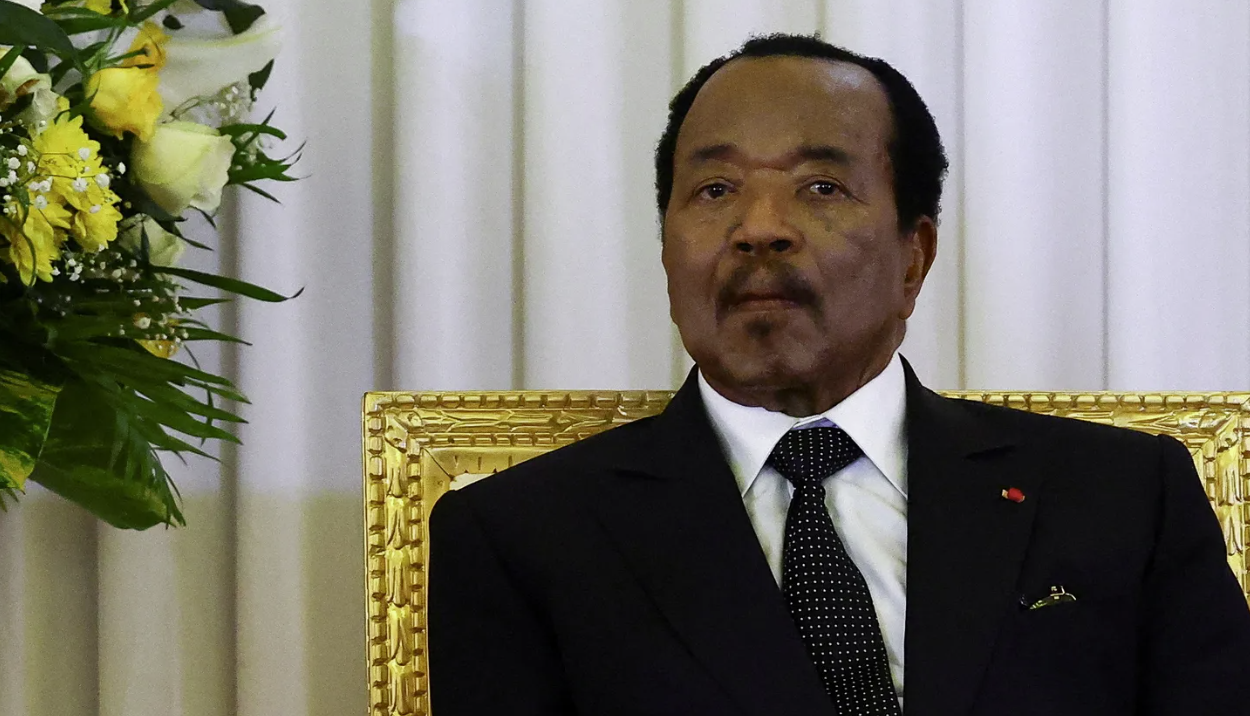
Yaounde, Cameroon – Sixty-six days. Sixty-six days since Paul Biya left Cameroon for Geneva, and not a soul in the entire architecture of the Cameroonian state — not the Senate, not the National Assembly, not the Constitutional Council, not the PM, and not a single minister- has stood before this nation and said what everyone already knows: the presidency is vacant.
Not in the legal sense that anyone has died. Not in the technical sense that a formal declaration has been issued. But in every practical, moral, and observable sense — there is no president in Cameroon tonight. There is a man in a Swiss clinic, reportedly unable to walk, who has not been seen in public since May 20, who has not spoken a word to his people in over two months, and who has apparently been too incapacitated to sign the one document — the appointment of a Vice President — that would answer the succession question tearing his palace apart. That is not a presidency. That is an absence wearing the clothes of a government.
The government’s defenders have bent themselves into extraordinary contortions to justify that silence. CPDM communications secretary Jacques Fame Ndongo has argued that no constitutional vacancy exists. Minister Owona went further, describing Biya’s absence as annual leave — arguing that an employee, even a president, is entitled to leave of up to 80 days. The man is 93 years old, reportedly bedridden after knee surgery complications, unable to board a flight, and his government is calling it annual leave. The insult to the intelligence of Cameroonians is itself a kind of governance.
Here is the constitutional reality. Under the April 2026 constitutional amendment, a vacancy arises through the president’s death, resignation, or permanent incapacity — formally declared by the Constitutional Council. That is the mechanism. And there lies the trap. Because every institution that could trigger that declaration is staffed, appointed, or controlled by people whose careers, whose safety, and whose freedom depend entirely on the continuity of the system that Paul Biya built. The Constitutional Council would need to act. The President of the Senate — currently Aboubakary Abdoulaye — would need to step forward as interim leader, triggering elections within 120 days. But who among them will move first? Who will be the one to say it?Nobody. And that silence is itself the most damning legacy of 43 years of Biya’s rule.
This is what four decades of political domestication produces. It produces a Senate that watches the presidency empty out in real time and issues no statement. It produces a National Assembly whose members go home and wait. It produces ministers who sign decrees in a dead man’s name — or an absent man’s name, which at this point is functionally the same thing — and tell the nation everything is normal. Mamadou Mota of the opposition has called it a “glaring institutional vacuum.” The Cameroon Democratic Union has urged officials to provide “necessary clarifications regarding the effective continuity of the state.” These are opposition voices. Where are the voices from inside? Where is the ruling class? Cowering. Exactly as Biya trained them to do.
Because make no mistake — this silence is not confusion. It is fear. Forty-three years of watching what happens to those who step out of line has produced a political class incapable of independent action even when the man they fear is lying in a hospital bed in another country. That is the true measure of what Biya built — not roads, not schools, not a functioning economy — but a governing class so thoroughly broken to his will that even his physical collapse cannot free them from his psychological grip.
And here is what makes it worse. The April constitutional amendment was sold as a stability measure — a guarantee of continuity. But it created a Vice Presidency appointed entirely by the president, answerable to no electorate, confirmed by no independent body. A position that would automatically inherit power. And then Biya left without appointing anyone to it. The mechanism designed to prevent a vacuum has itself become the vacuum. The reform that was supposed to answer the succession question has only sharpened it.
Time, however, is not an ally of delay. Observers say the Constitutional Council should have acted after 45 days. We are now at day 66. Every day that passes without a declaration deepens the crisis, hardens the factions, and narrows the options available to whoever eventually must act. The ruling class can delay the announcement. They cannot delay the reality. Cameroon has no president. The throne is empty. And the longer nobody says so, the more dangerous the moment when someone finally does.
That moment is coming. Because time does not negotiate, and it does not fear Ferdinand Ngoh Ngoh.