

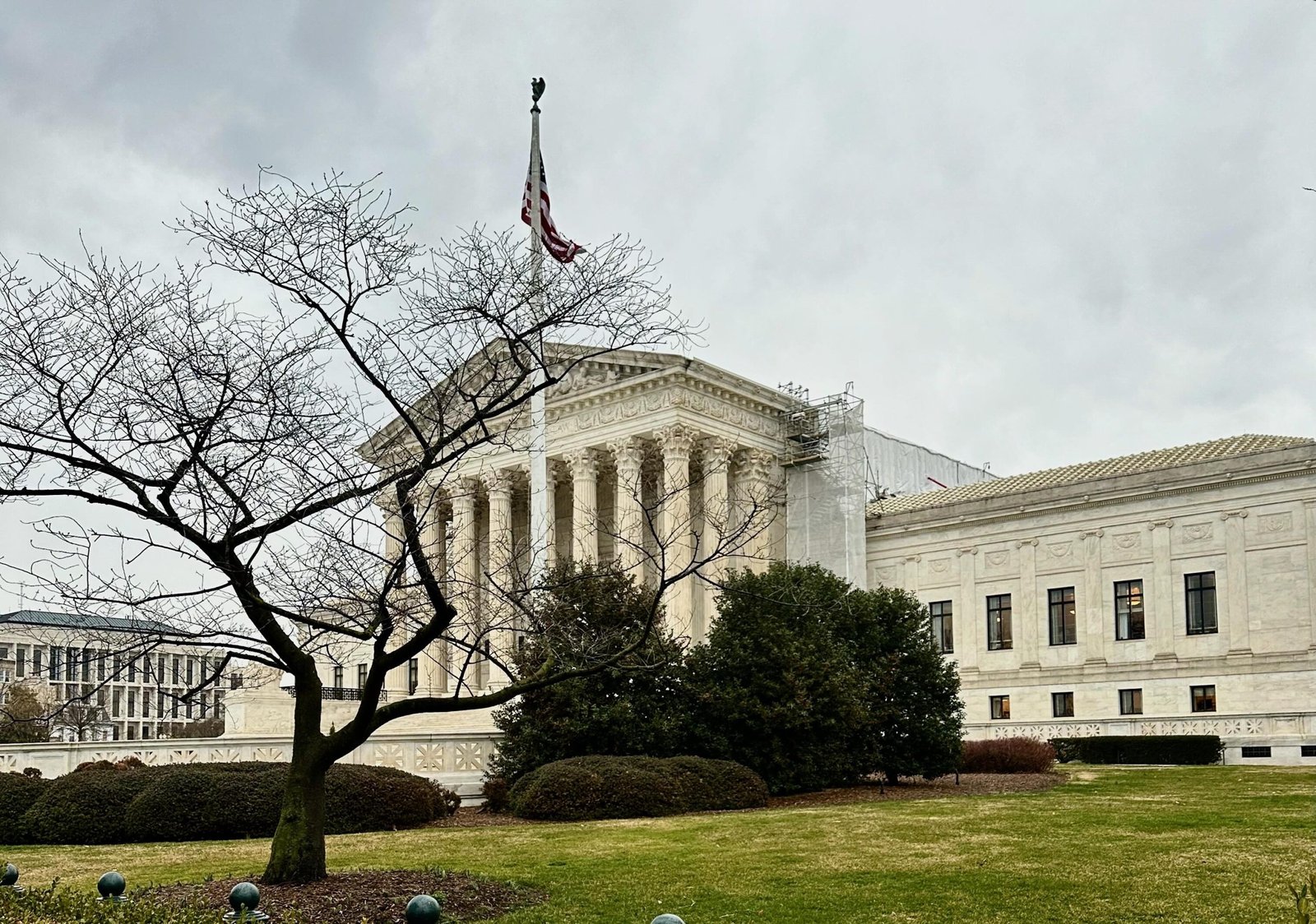
ScotusCrim is a recurring series by Rory Little focusing on intersections between the Supreme Court and criminal law.
Imagine: A group of drug dealers beat and shoot dead a citizen they felt was interfering with their work. There are witnesses as well as video evidence establishing these facts and enabling identifications. The gang is in constant electronic communication with their bosses who are miles away in a plush office. With the bosses’ knowledge and approval, the drug dealers do a hurried clean-up of the scene and spirit away the shooters and physical evidence before law enforcement can investigate.
Facts can always be distinguished. But if a gang of drug dealers acted as imagined above, I have no doubt they would be arrested and charged with crimes, including their bosses if they could be identified.
The internet is awash with speculation about possible state criminal charges arising out of the killing of Alex Pretti, and a number of serious state crimes seem apparent in videos that show facts better than any written description. Yet I have not seen obstruction of justice crimes explored for the Department of Homeland higher-ups who may have aided, counseled, and commanded various actions related to the shooting. Is there a theory by which a federal crime might be charged? Although the prospect seems unlikely at the moment, what do relevant statutes and the Supreme Court have to say about potential federal charges for DHS decisionmakers?
First, what happened to the Pretti crime scene, shooters, and evidence?
There has been great unusual secrecy on the part of DHS about the actors and evidence in the Pretti killing, and there is much we do not know. Three days after the killing, the two federal Border Patrol officers (a component of DHS) who shot Pretti were identified to Congress. But we do not know where they are. News accounts indicate that they left the scene quickly, in the company of other federal officers. In the absence of additional information, my former-federal prosecutor instincts say that the officers were quickly moved out of Minnesota. I doubt this was done without DHS management approval or orders.
Similarly, as far as we know, the weapons used or recovered at the scene (and perhaps shell casings, bullets, etc.?) were apparently taken from the scene by DHS personnel. There is no evidence that the federal agents secured the crime scene (say with yellow tape, physical barriers, or personnel) to avoid evidence spoilation or tampering, and a federal judge has said that some evidence was probably damaged or lost in the initial hours.
After agents left the scene, Minnesota obtained a court order that merely (and temporarily) directed DHS not to destroy whatever evidence it has. Pro Publica reports that Customs and Border Patrol “has disclosed few other facts.” Minneapolis city officials have said “[w]e don’t have any information on the shooters,” and the Minneapolis district attorney for Hennepin County, Mary Moriarty, stated that the Minnesota Bureau of Criminal Apprehension (a state equivalent to the FBI) “has been blocked” from getting evidence from relevant federal officials.
Finally, the DOJ announced approximately a week after the killing only that it has opened “a civil rights investigation” into the incident. Democratic members of Congress have officially complained that DHS has “actively obstructed any investigation.”
Does the conduct amount to obstruction of justice?
Obstruction of justice is statutorily defined in many different ways across a multitude of jurisdictions. The court has rejected the idea of an easy or general “coverall” obstruction of justice concept. Meanwhile, facts in the real world often escape easy definition or application. So I’m going to assume here the reader’s familiarity with the general concept.
As the Supreme Court explained in the 1980 case of United States v. Apfelbaum, “[i]n the criminal law, both a culpable mens rea [guilty mind] and a criminal actus reus [guilty act] are generally required for an offense to occur.” (In addition, the court has noted that there are often special “jurisdictional elements” for federal crimes, as I discuss more below.)
If a gang of drug dealers acted as imagined above, I believe their conduct could easily meet the actus reas (conduct component) of obstruction of justice, having quickly spirited away the shooters and physical evidence before the police could investigate. Concealing evidence in various circumstances, as well as destroying or tampering with it, can itself be federal criminal conduct. As can witness tampering (for example in 18 U.S.C. 1512), which can include, as the U.S. Court of Appeals for the 9th Circuit has held, moving witnesses out of state to frustrate a criminal trial.
(As a sidenote, the federal Racketeer Influenced and Corrupt Organizations Act has been successfully applied to law enforcement agents committing a pattern of crimes; and the Supreme Court in United States v. Turkette noted that Congress intended to reach “the illegal use of force” as well as “legitimate and illegitimate” groups, with that statute.)
Finally, any person “who aids, abets, counsels, commands, [or] induces” a federal crime, can be convicted as fully for that crime as the direct actor. Similarly, federal conspiracy law sweeps very broadly, reaching everyone who agrees to a criminal course of conduct, even for crimes unintended but reasonably foreseeable. If DHS supervisors or higher-ups back in Washington, D.C. counseled officers on the scene to flee, and/or counseled, commanded, or agreed to block state investigation, they too might be convicted (if federal crimes could be filed at all, as asked in the following section).
But are other elements of crime, besides the conduct, satisfied here?
Mens Rea? In addition to the conduct, obstruction of justice and other federal crimes can require proof of relatively precise mens rea/mental states, sometimes referred to as “intent,” before charging. As the court surveyed in the 2024 Jan. 6th obstruction case, Fisher v. United States, the mens rea required for any criminal obstruction conviction is a high standard that requires “careful delineation.” Thus, in a 1995 obstruction case, the Supreme Court reversed the conviction of a federal judge whose false conduct was undisputed, ruling that the judge’s knowledge or intention was not sufficiently proved. Similarly, in a 2011 witness-tampering case, the court required that the government prove a relatively specific intent before convicting. That said, the exact mens rea elements in these and other cases are confusing and defy easy description.
What was in a person’s mind, their “intent,” is never a simple thing to prove. Seldom is there irrefutable evidence of mens rea. Mind-reading machines do not (yet) exist and a defendant can always deny they had criminal intent (or simply not testify). In the end, criminal intent must often be inferred in a criminal case, as a necessary fact that a jury can find beyond reasonable doubt based on a commonsense evaluation of the assembled evidence. Lacking an undisputed confession, prosecutors often have to look jurors in the eye and ask, in a tone of disbelief, “really? Do you believe that?” “Are you kidding?!” or just “oh come on!”
When federal officers shot Pretti, they were surrounded by angry (if not also terrified) people. It is possible that they hurriedly left with only an intent to preserve their safety (although the norm and training would be to remain and secure the scene). Their further intention in blocking local law enforcement from the scene is unclear. As for the intentions of DHS higher-ups, why they have still not turned over or given access to evidence for state investigators is unknown. However, the effect of obstructing the state’s investigation seems clear. These and a multitude of other factors concerning intent would have to be evaluated before a federal prosecution would be filed.
As another sidenote, the federal Travel Act makes it a crime to cross state lines with the intent to commit a crime of violence. But the reverse is not true so far as I know; the language of the statute seems to clearly say that traveling with the criminal intent must precede the violent act. Crossing state lines after having committed, or to conceal, a crime of violence is thus not (yet?) a federal crime.
Jurisdictional elements? In addition to actus reas and mens rea requirements, federal crimes commonly include a third requirement, often called “jurisdictional elements.” As the Supreme Court has explained, such requirements provide the federal “hook” necessary to separate federal offenses from general state criminal jurisdiction. These unique federal requirements could provide the largest hurdle to a federal prosecution here (although no one, including me, can pretend perfect knowledge of all the potential crimes that a determined lawyer might find).
Federal obstruction of justice statutes require intent to obstruct an “official proceeding,” defined as a federal (not state) investigation or event. The “omnibus” federal obstruction statute appears similarly limited to intending to obstruct federal persons or events. These jurisdictional requirements might thus block an otherwise attractive federal obstruction charge here. Meanwhile, while federal RICO can be applied to a pattern of predicate state crimes, the list of state crimes does not appear to include obstruction offenses. Section 1959 of Title 18 makes violent crimes committed for pecuniary compensation from an enterprise a crime, but absent proof that DHS officers were paid their salaries expressly to act violently, this statute is an impossible or at least extremely awkward fit.
None of this is to say with certainty that a federal obstruction charge could not be brought. But a serious examination of the entire federal code and its meaning, and good faith prosecution principles, would be needed before federal crimes would go forward here.
What about state prosecutions?
Witness tampering is (as is true everywhere) a state crime in Minnesota. So too is evidence tampering or destruction. Perhaps Minnesota will pursue such charges; the Minneapolis District Attorney, Mary Moriarty, has said that “we have jurisdiction here … and I expect to have enough evidence to decide whether charges are appropriate.”
As has been well explained elsewhere, the Supreme Court’s 1890 decision in In re Neagle provides federal officers no immunity from state prosecution unless the officer’s conduct was “necessary and proper.” (Contrary claims by federal officials are simply wrong.) This so-called “supremacy immunity” – as explained by Carolyn Shapiro in SCOTUSblog – is akin to immunity which is “qualified,” not absolute. In fact, in 1906 in Drury v. Lewis, the Supreme Court rejected Neagle immunity for two federal soldiers prosecuted for murder in Pennsylvania. If the officers shot the victim after, as the state alleged, he had surrendered, then (said the court without dissent) “it could not reasonably be claimed that the fatal shot was fired in the performance of a duty imposed by the federal law, and the state court ha[s] jurisdiction.” Drury, not Neagle, seems more applicable here.
Indeed, an en banc panel of the 9th Circuit ruled in Idaho v. Horiuchi that Drury permitted state prosecution for involuntary manslaughter of an FBI agent who killed the wife of a resisting resident in the infamous Ruby Ridge incident. Of course, qualified immunity itself is a high bar, and the Supreme Court ruled in 2001 that it must be resolved pretrial. However, while removal of a state criminal prosecution of DHS officers and supervisors to federal court would be automatic (since these are federal officers), the case would still be governed by applicable state law. That is the longstanding interpretation of the removal statute and the 1980 case of Arizona v. Manypenny. And some federal judges (and prosecutors) in Minneapolis have not been happy with federal officials, which could influence how such defendants might be treated by federal district courts in Minnesota. Finally, if a precise “clearly established” right is required for qualified immunity, it may be relevant that in the 1997 case of United Statesv. Lanier the court ruled unanimously that some conduct on its face can violate rights “with obvious clarity.”
Conclusion
Look, I’m not naïve. There is likely to be no federal prosecution to address the Pretti killing and its immediate evidence-interfering aftermath by the current DOJ. But the statute of limitations for federal offenses is generally five years, which begins only after the last overt act (in my hypothetical, efforts to conceal witnesses and evidence from state investigators) has been committed. Minnesota, meanwhile, has statutory charging limits ranging from 3-9 years (and none for homicide offenses), and the period does not run while a defendant is not residing in the state. So stay alert. In the words of the immortals (Yogi Berra and Lenny Kravitz), “it ain’t over til its over” – this case might not be closed.
Cases: Fischer v. United States
Recommended Citation:
Rory Little,
Charging Homeland Security bosses: obstruction of justice and the Supreme Court,
SCOTUSblog (Feb. 9, 2026, 10:00 AM),
https://www.scotusblog.com/2026/02/charging-homeland-security-bosses-obstruction-of-justice-and-the-supreme-court/
