

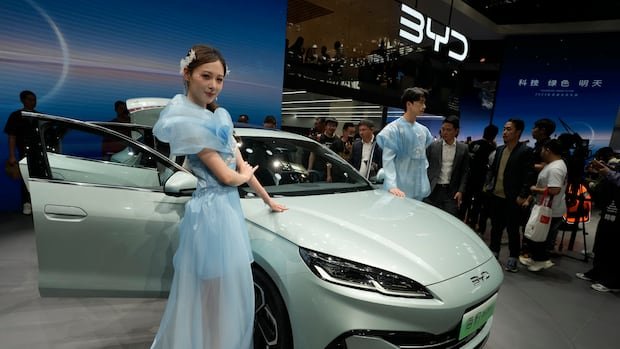
Buckle up! The electric vehicle market in this country is about to take a sharp turn.
Prime Minister Mark Carney is reopening Canada to Chinese-made EVs, lowering a 100 per cent tariff on imports, imposed in 2024, back to six per cent.
There’s demand for more affordable and climate-conscious EVs and, for an average customer, having Chinese EVs in the market means “more choice” and “greater tech,” said Max Morris, sales manager at Shift Electric Vehicles in Burlington, Ont.
While some are applauding the EV market opening up, others are raising concerns about the safety and security of vehicles from companies tied to the Chinese government. Here’s what you need to know:

Prime Minister Mark Carney announced a trade deal with China to allow up to 49,000 Chinese electric vehicles into Canada. In return, Ottawa expects Beijing to drop canola seed duties to 15 per cent by March.
How many are there?
China has shaken up the global EV landscape in recent years, offering more affordable cars, SUVs and other battery-powered and hybrid electric automobiles.
China has more than 100 EV brands, bolstered by heavy subsidies, but there are 15 dominant names, including Geely, Chery, MG, Wulin and U.S.-based Tesla — which also makes some models in China.
- Cross Country Checkup is asking: Why does Canada’s new EV deal with China matter to you? Leave your question here and we may read it or call you back for Sunday’s show
But BYD surpassed Tesla as the world’s top EV seller last year.
BYD intended to break into the Canadian market until then-Prime Minister Justin Trudeau implemented the steep tariff, in line with a similar U.S. measure under President Joe Biden.
Outside of China, BYD’s biggest market is Brazil, where it accounts for 80 per cent of all EV sales. Australia and Mexico are also significant buyers of Chinese EVs.
How many are coming to Canada?
Up to 49,000 EVs a year from China will be allowed into Canada, initially, which Carney says is less than three per cent of the overall car market.
That will increase to approximately 70,000 over five years.

There were are already Chinese EVs in Canada prior to the 100 per cent tariff — exported by Polestar and Volvo, both of which are Swedish companies owned by Geeley, and Tesla.
There appears to be sufficient demand for cheaper Chinese vehicles in Canada.
An Abacus Data poll, released last year on behalf of Clean Energy Canada, suggests most Canadians wanted a lower tariff that would improve consumer affordability (53 per cent) or no tariff at all (29 per cent) on Chinese EVs.
How soon could they arrive?
We don’t have an exact timeline and we don’t know which models might be available.
But vehicles could arrive at Canadian ports in a matter of weeks, says Addisu Lashitew, an associate professor at McMaster University’s DeGroote School of Business.
“Chinese EV makers can ramp production and ship quickly, and BYD even operates its own cargo ships that could further shorten transit times,” he said in an email to CBC News.

The hurdle, he says, will be regulatory clearance and other compliance steps.
That’s something the federal government might want to expedite to avoid reciprocal delays on getting Canadian canola and other products back into the Chinese market with lower duties, he says.
Currently, China is set to ease its tariffs on March 1
Lashitew says he wouldn’t be surprised if new Chinese EVs arrived as early as March or April.

The Liberal government has reached a deal with Beijing to allow tens of thousands of Chinese electric vehicles into the domestic market in exchange for dropping duties on canola products. Get the latest on CBCNews.ca, the CBC News App, and CBC News Network for breaking news and analysis.
Will they be cheaper than other EVs?
It depends on the brand and the model, but Chinese EVs can cost $10,000 to $15,000 less than those of similar size and range that are already popular in Canada.
One of BYD’s top sellers, a compact car with a short range known as both the Seagull and the Dolphin Mini, can go for less than $30,000.
That could be attractive to first-time and returning EV buyers, says Morris at Shift Electric Vehicles, which specializes in used models.
“People that are buying these Chinese EVs might already have an EV and are looking to change things up,” he said, “Perhaps they’re not happy with their current car or perhaps the maker of their current car.”
That would, in turn, put more used EVs into the market which would also be more affordable, he says.
Up To Speed5:44Manitoba Electric Vehicle Association revved up about Chinese EVs being more affordable
Lashitew says it will become “incumbent” upon other automakers to lower their prices, making EVs more accessible to consumers and ultimately helping Canada move toward its emissions reduction targets.
“With EVs still about 30 to 50 per cent more expensive than comparable gasoline cars, lowering trade barriers would meaningfully ease the affordability constraint,” he said.
Who will sell them?
Right now, there aren’t any branded dealerships for EVs made by Chinese companies.
But with Canada rolling out the welcome mat, those companies could move fast.
BYD has opened dozens of dealerships around Australia since entering its market in mid-2022 — and had sold more than 52,000 vehicles there by the start of this year.

How do they compare?
Price is one thing, but consumers also want quality.
In the graphic above, you can see that two Chinese brands surpassed their advertised range compared to their popular Western counterparts when it comes to battery range.
Motortrend in 2024 pitted several Chinese brands against the popular Tesla Model 3, also produced in China, comparing the distance they could drive on a fully charged battery.
Some Chinese makes surpassed the Model 3, though the outlet noted that travel range depends on factors such as driver speed.
Cold weather shortens battery life and causes charging to take longer, but after testing 67 vehicles in extreme-cold the review site ArenaEV said three Chinese brands, including a model from BYD, outlasted a similar Tesla Model Y.
What On Earth25:19The great Canadian EV road trip
Are they safe — and secure?
Safety ratings for Chinese EVs have improved greatly, reports InsideEVs.
Citing rankings from the European New Car Assessment Programme, several Chinese EVs were among the safest last year, including the BYD Seal 6, Volvo EX90 and the Tesla Model Y.
But when it comes to cybersecurity, Carney is facing questions about allowing Chinese-made vehicles into Canada after having previously called China a threat.
Opposition Leader Pierre Poilievre criticized the prime minister over the security issue, as did Ontario Premier Doug Ford, who called Chinese EVs “subsidized spy cars.”
Andreas Schotter, a professor of international business at the Ivy Business School in London, Ont., says Carney needs to take that seriously.
“This is a very big concern to me when it comes to these kind of vehicles that depend very heavily on artificial intelligence with their more modern features and digital data transfer,” he said.
But he says he’s “confident” the federal government will address the issue in a “sophisticated way.”
