


Posted: 17 December, 2025 Filed under: Nasubila Ng’ambi | Tags: African Charter, African Mining Vision, cultural rights, economic differences, foreign exploitation, Global North, Global South, human rights, industrialisation, infrastructural development, international monopolies, Keba M’baye, Mineral beneficiation, mineral wealth, New International Economic Order, raw commodities, sub-Saharan Africa, The Right to Development, value-added processing
Author: Nasubila Ng’ambi
LLM (cum laude), University of Pretoria
It’s time for Africa
Home to approximately 30% of the world’s critical raw minerals, Africa holds a highly coveted position in the low carbon transition. However, at present Sub-Saharan Africa’s (SSA) development index is an alarming 0.568, with 0.5 being the lowest index and 0.9 being the highest, demonstrating that the region is living far below the privileges that could be afforded by its resource endowments. Several African countries have taken steps to capitalise on their mineral wealth, with Malawi being the most recent African jurisdiction to impose a ban on the exportation of raw minerals.
However, what is the legal, rights-based justification for these measures? This article offers the right to development (RTD) as grounding for the recent measures taken to compel external actors to engage in domestic mineral beneficiation.
Mineral beneficiation
Mineral beneficiation – synonymous with value-added processing refers to procedures which transform raw minerals (mineral ores) into more valuable products which earn greater export revenue. In 2023 the exportation of bauxite ores attracted $65 per tonne, whereas processed aluminium garnered $2,335 per tonne.[1] This disparity underscores the importance and urgency of mineral beneficiation.
Mineral beneficiation presents an unparallelled opportunity for structural transformation when paired with effective policies which create economic linkages between domestic industries.[2] Economic advantages include job creation, infrastructural development and industrialisation.[3] Further, mineral beneficiation will shield African countries from the volatility largely associated with trading in raw commodities.
The African Mining Vision (AMV) emphasises that resource-based development and industrialisation depend on governments taking proactive measures to leverage their natural resource endowments through the promotion of mineral beneficiation and value addition.[4] It further recognises that government failure to impose minimal levels of beneficiation has resulted in multinational corporations processing minerals elsewhere to the detriment of African economies.[5] The AMV encourages the creation of resource processing industries through the implementation of flexible beneficiation targets and incentives.[6]
The Right to Development
The RTD refers to the inalienable human right which provides for the ‘participation, contribution and enjoyment of [a people’s] economic, social and cultural rights’. Article 22 of the African Charter guarantees the RTD of all African people; therefore, African states have an obligation to fulfil the RTD for the benefit of their citizens and provide for the exercise of this right both collectively and individually. The RtD was first proffered by Senegalese jurist Keba M’baye who stated that “every man has the right to live and to live better”.[7] Despite its admirable aspirations; the RtD was highly politicised and remains controversial due to the economic differences between the Global North and South; and the proposed establishment of a New International Economic Order in the 1970s.[8] Many countries in the Global North viewed the popularisation of the RtD as another means through which countries in the Global South would solicit aid.[9] However, the RtD exists beyond the confines of developmental assistance[10] as it includes the exploitation of natural resources for the benefit of African people as provided for in Article 21 of the African Charter. Article 21(4)(1) further qualifies the disposal; imploring states to eliminate ‘all forms of foreign exploitation particularly those practised by international monopolies’.
The RTD and mineral beneficiation
I argue that a joint reading of Articles 21 and 22 of the African Charter places an obligation on African states to pursue mineral beneficiation as a means of realising the RtD. Article 22 expressly provides for the multifaceted nature of the RTD while Article 21(1) affirms African states’ agency in freely disposing their natural resources for the benefit of their people. A joint reading demonstrates that states must fulfil the right to economic development and simultaneously ensure that the disposal of natural resources benefits their people. Put differently, the disposal of natural resources must yield the highest attainable levels of economic development. Consequently, a joint reading of Articles 21 and 22 make it an imperative for African states to pursue mineral beneficiation.
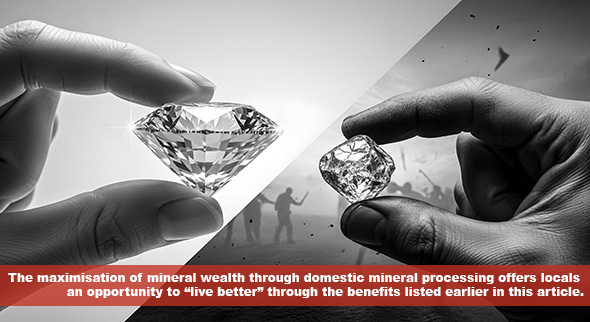
Mandatory mineral beneficiation requirements are therefore a necessary and legitimate tool to drive positive economic outcomes. The maximisation of mineral wealth through domestic mineral processing offers locals an opportunity to “live better” through the benefits listed earlier in this article. Mineral beneficiation programmes will allow the domestic population to capture greater value from their resources which will eventually lead to economic development contingent on trained human capital and adequate linkages to the domestic economy. This was demonstrated in Botswana, where diamond beneficiation programmes led to the creation of jobs, in addition to domestic diamond cutting and polishing industries.
Further, I argue that the absence of enforceable mineral beneficiation frameworks entrenches the present status quo where African countries supply raw minerals with minimal scope to integrate into more substantive activities in the mineral value chain. Consequently, Africa will continuously find itself unable to effectively capitalise on commodity super cycles.
However, the pursuit of the RtD does not offer a blank cheque for the violation of other rights, as is often the case in the extractives sector. The pivotal SERAC matter demonstrated that profits should not be pursued at the expense of human lives and the right to a clean and healthy environment.[11] In Centre for Minority Rights Development & Others v Kenya, the African Commission outlined the following as criteria for the effective fulfilment of the RtD: It must be equitable, non-discriminatory, participatory, accountable and transparent.[12] The African Commission found that the government of Kenya had violated the Endrois people’s RtD because the government failed to engage the people in effective consultation.[13] The African Commission referred to Article 2(3) of the Declaration on the RtD and emphasised the need for “active, free and meaningful participation in the development”.[14] Further, the Commission highlighted that the Endrois ought to have been empowered by the economic development, not disenfranchised from their rights to land.[15] The Commission found that the exercise of the RtD ought to have improved the choices and capabilities of the Endrois people.[16]
A rights-based approach to mineral beneficiation
A rights-based approach to mineral beneficiation should include the development of people-centred legislation and policy frameworks. The aforesaid frameworks should be developed after effective, meaningful consultation with all relevant stakeholders; inclusive of the private sector, workers unions, local communities and civil society. This will foster sustainable mineral beneficiation which is cognisant of right-holders.
The legislation and policy frameworks should prioritise access for duly qualified nationals to work in mineral processing facilities, incorporate knowledge and technology transfer, and enforce mandatory local content policies to facilitate linkages between the mineral processing activities s and other sectors of the economy. This will lead to an improvement in the choices and capabilities of the African people resulting in the realisation of the RTD.
Further, African states should ensure that investors and private actors engaging in mineral beneficiation are not subject to arbitrary discrimination in administrative and judicial matters related to mineral beneficiation in keeping with Article 17 of the African Continental Free Trade Area (AfCFTA) Protocol on Investment.
Conclusion
Mineral beneficiation is an essential tool for achieving the RTD and ensuring that Africa’s mineral resources are exploited for the benefit of the African peoples’ in line with the Articles 21 and 22 of the African Charter. However, Africa should not pursue an unrestrained approach in striving for economic development as this has led to the violation of other rights since time immemorial. African states should pursue a rights-based approach to mineral beneficiation ensuring inclusive consultation with stakeholders in the development of legislation and policy. This will ensure that mineral beneficiation activities are translated into sustainable economic transformation. Without deliberate enforcement of beneficiation policies, Africa’s mineral resources will continue to be exploited for the benefit of transnational corporations to the detriment of the RtD of Africans.
[1] International Monetary Fund ‘Regional Economic Outlook Analytical Note: Sub-Saharan Africa’ April 2024
[2] R Denhere ‘Evaluation of beneficiation constraints for identified critical minerals in Zimbabwe ‘ Masters thesis, University of the Witwatersrand, 2021 16 and 12.
[3] PM Mukonki ‘Development of a Downstream Beneficiation Strategy in an underdeveloped Country: Case Study of the Lualaba Province in the Democratic Republic of Congo’ PhD thesis, University of the Witswatersand, 2022 17
[4] African Mining Vision (2009) 3
[5] AMV 14
[6] AMV 18
[7] P Oyugi “The Right to Development In Africa: Lessons from China” in CC Ngang, SD Kamga and V Gumede (eds) Perspective on the Right to Development (2018) 275
[8] P Oyugi ‘The Right to Development In Africa: Lessons from China’ in CC Ngang, SD Kamga and V Gumede (n 4) 273.
[9] Y Li and D Uribe ‘Challenges and Potential to Revamp the Normative Framework on the Right to Development’ (2022) 65 Society for International Development 136 137
[10] Li and Uribe (n 6)137
[11] Social and Economic Rights Action Centre (SERAC) and Another V Nigeria (2001) AHRLR Communication 155/96 (ACHPR 2001) paras 53-54
[12] 2009 AHRLR 75 (ACHPR 2009) para 277
[13] Centre for Minority Rights Development & Others v Kenya para 281
[14] Centre for Minority Rights Development & Others v Kenya para 283.
[15] Centre for Minority Rights Development & Others v Kenya para 283-284
[16] Centre for Minority Rights Development & Others v Kenya para 283.
About the Author:
Nasubila Ng’ambi
recently obtained her LLM in International Trade and Investment Law (cum laude) from the University of Pretoria. She was part of the inaugural cohort of the World Trade Organization Young Trade Leaders Programme. Her research interests include international trade and investment law, trade and investment facilitation, economic development in African countries, and, more recently, mining law.
