

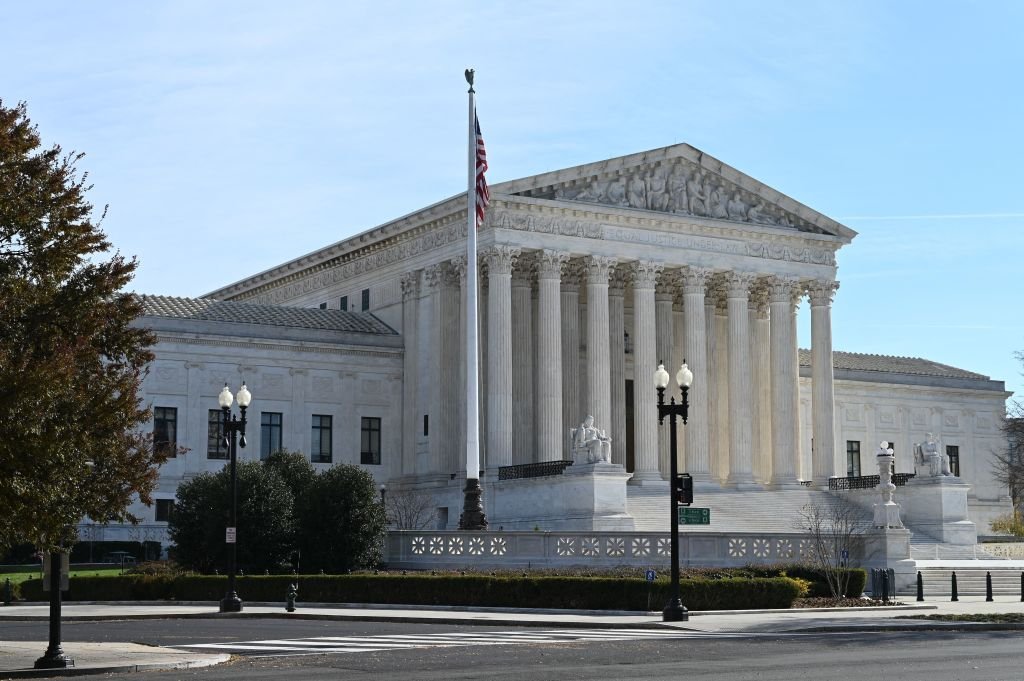
The Supreme Court will hear oral arguments on Monday in United States v. Hemani, the second gun-rights case of the 2025-26 term. In January, the Trump administration supported Hawaii gun owners in their challenge to that state’s law requiring them to obtain express permission from the owners of private property before bringing their guns onto that property. But on Monday, the Trump administration will be asking the justices to allow it to prosecute a Texas man on charges that he violated a federal law that prohibits users of illegal drugs from having a gun.
The case began after the FBI searched the home of Ali Danial Hemani, the defendant in the case. FBI agents found a Glock 19 9mm pistol, 60 grams of marijuana, and 4.7 grams of cocaine. Hemani told the FBI agents that he used marijuana roughly every other day.
Based on his admission that he used marijuana, Hemani was indicted on charges that he had violated a federal law that makes it a crime for anyone who is “an unlawful user of or addicted to any controlled substance” to have a gun. A knowing violation of the law is a felony, which can carry a sentence of up to 15 years in prison.
Hemani asked the federal trial judge to throw out the charge against him. He contended that at least as applied to him, the law violated the Second Amendment, which protects “the right of the people to keep and bear Arms.”
U.S. District Judge Amos Mazzant dismissed the indictment. He relied on a recent decision by the U.S. Court of Appeals for the 5th Circuit holding that the law is unconstitutional when it is used to charge someone who may have been a habitual drug user but was not shown to be under the influence of drugs when he had the gun.
The government appealed, but agreed with Hemani that – based on 5th Circuit precedent – that court should uphold Mazzant’s dismissal of the charge. In a brief, unsigned opinion, the court of appeals did just that.
The federal government came to the Supreme Court in June, asking the justices to grant review, which they did in October.
In its brief on the merits, the Trump administration recognized that the Second Amendment has a “central role in our constitutional scheme,” so that “the government bears a significant burden in justifying restrictions on” the right to have a gun. But Hemani’s case, U.S. Solicitor General D. John Sauer wrote, “presents narrow circumstances where the government can satisfy that rigorous burden.”
The government emphasized that the question before the court is “a narrow one”: whether, as the court of appeals held and Hemani argues, federal law only bars the possession of a gun by someone who is actually under the influence of drugs, or whether, as the government argues, it also prohibits possession by someone who habitually uses drugs.
Under the Supreme Court’s 2022 decision in New York State Rifle and Pistol Association v. Bruen, the government contended, the law can survive only if there is a historical tradition that justifies its “temporary disarmament of habitual drug users.” In early U.S. history, the government wrote, there was a tradition of barring people from having a gun when they were intoxicated. But there was also, the government continued, a “highly robust body of much harsher founding-era restrictions on the rights of” a group of people who were analogous to “habitual drug users” – laws involving “habitual drunkards,” which were based on the idea that those people were more likely to be criminals or violent. Indeed, the government suggested, early American legislatures punished “habitual drunkards” much more severely than people who were drunk in public on discrete occasions: the former could lead to jail time or a stint in a workhouse, while the latter “was punishable by a small fine or a few hours in the stocks.”
Moreover, the government continued, the practice of both the federal government and the states after the ratification of the Second Amendment further confirms that regular drug users can violate the law: “at least 43 States, the District of Columbia, and all five territories have enacted similar laws restricting the possession of firearms by drug users and drug addicts.”
And to the extent that there are potential concerns about the constitutionality of applying the law in particular “marginal cases,” the government concluded, those worries can be addressed by a separate federal law that allows anyone who would otherwise be prohibited from owning a gun to seek permission to do so from the U.S. attorney general.
In his brief on the merits, Hemani contended first that the question before the court is whether the law “is constitutional as applied to someone who admits to consuming marijuana a few times a week. It is not,” he concluded.
As an initial matter, Hemani told the justices, the law is so vague that it is unconstitutional, because it does not give defendants like him enough notice that they could be subject to it and face criminal penalties. The phrase “unlawful user” does not specify how often someone must use illegal drugs to be subject to the ban, or how recent or substantial the drug use must be. To try to fill in these gaps, Hemani said, the federal government adds the word “habitual” – which is not a word that appears in the statute. Indeed, Hemani suggested, even “the government does not say what it thinks ‘habitual user’ means, other than that it is broad enough to capture Mr. Hemani’s marijuana use.” The absence of an explanation from the government, he concluded, “is powerful evidence that the statute ‘fails to give ordinary people fair notice of the conduct it punishes.’”
But even if the law did provide clear notice to drug users, Hemani continued, there is no historical analogue that would support the ban that the law imposes. Everyone agrees, he wrote, that “the government may prohibit people from carrying firearms while intoxicated.” Moreover, he continued, if it does so clearly and with “appropriate safeguards,” it may also bar people addicted to drugs or alcohol from having guns. “But there has never been a tradition in this country of stripping anyone who uses an intoxicating substance with some degree of frequency of the right to keep a firearm in the home. To conclude otherwise would empower the government to deprive tens of millions of Americans who pose little if any risk of firearm misuse of a fundamental constitutional right,” Hemani said.
The historical analogues that the federal government suggests would justify imposing the law here – restrictions on “habitual drunkards” – “are far afield,” Hemani insisted. He contended that any historical restrictions on the gun rights of “habitual drunkards” did not apply to people who simply used alcohol on a regular basis. “Indeed,” he suggested, “to deem anyone who regularly drank alcohol a ‘drunkard’ not only would have been anomalous to early Americans, but would have labeled a significant portion of the populace ‘drunkards.’”
When states later began to impose restrictions on access to guns by people who use illegal drugs, Hemani continued, those restrictions largely focused on people who were addicted to illegal drugs. But those states did not, Hemani said, generally strip anyone who used illegal drugs, “regardless of the frequency or quantity of use, of the right to keep arms and bear them while sober.“ The federal government’s approach, Hemani suggested, could mean that “anyone who regularly takes a sleep gummy” or “regularly has a beer with dinner” could lose his right to have a gun in the house.
Hemani also pushed back against the government’s assurance that, in close cases, someone who otherwise would be prohibited from owing a gun could ask the attorney general to have his rights restored. “To state the obvious,” Hemani told the justices, “the prospect that rights may be restored has no bearing on whether the government may take them away in the first place.” But in any event, Hemani added, the rights-restoration process “has been on ice for over 30 years. And while the government claims to have ‘recently revitalized’” the process, right now the Department of Justice website indicates only that applications to restore gun rights “‘will be available online soon,’ pending the release of a ‘final rule.’”
Posted in Court News, Merits Cases
Cases: United States v. Hemani
Recommended Citation:
Amy Howe,
Court to hear argument on whether and when drug users may possess firearms,
SCOTUSblog (Feb. 26, 2026, 11:24 AM),
https://www.scotusblog.com/2026/02/court-to-hear-argument-on-whether-and-when-drug-users-may-possess-firearms/
