

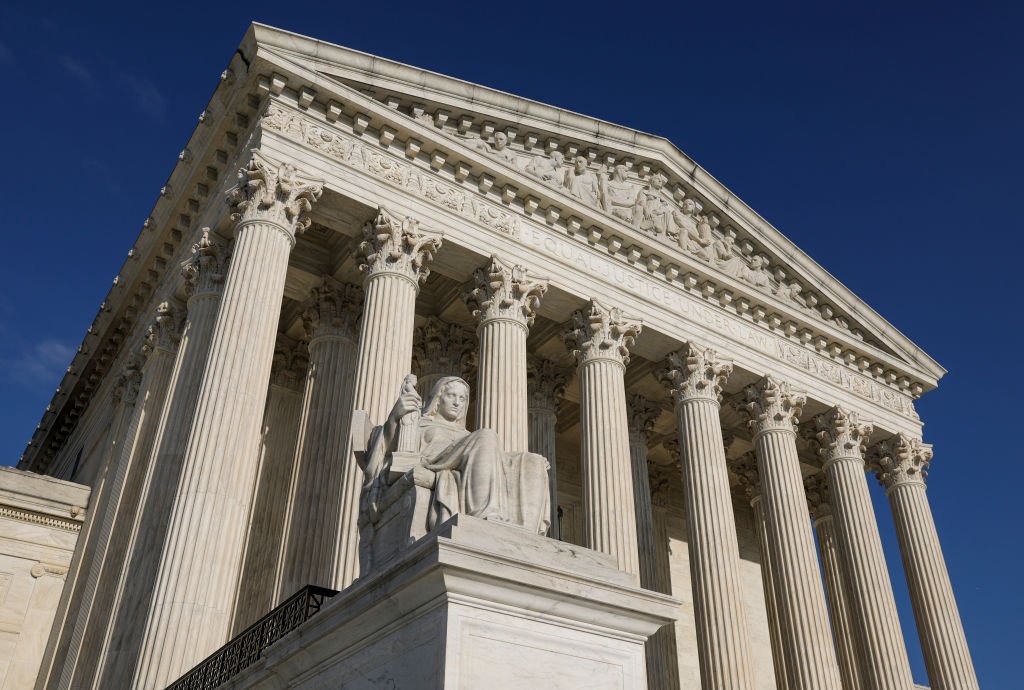
Controlling Opinions is a recurring series by Richard Re that explores the interaction of law, ideology, and discretion at the Supreme Court.
The Supreme Court is creating a formidable presidential power to remove subordinate executive officials, even from many once-independent agencies. Yet the court is not simply tearing down the principle of agency independence associated with Humphrey’s Executor v. United States, the court’s 1935 decision approving statutory limits on the president’s power to fire commissioners of the FTC. To fully understand the court’s removal jurisprudence – how and why it is changing – executive officials’ for-cause tenure protection must be understood in at least three dimensions.
In general, legal principles exhibit three distinct qualities. First is scope, or the range of cases to which the principle applies. Next is perforation, or the degree to which a principle is subject to exceptions or being overriden. And last is strength, or the legal ramifications of transgressing the principle.
The principle of for-cause tenure protection for executive officials is moving away from broad–perforated–weak and toward narrow–unperforated–strong. In other words, tenure is becoming far less widely available, but, where it exists, it will be both harder for the president to override and more vigorously enforced by the courts. That complex diagnosis helps explain how doctrine is changing, the reasons for the court’s pivot, and the likely fate of the Federal Reserve Board.
***
For many decades, Humphrey’s Executor was understood to create a principle that was broad (applicable to a large range of cases) but also perforated (subject to override) and weak (without great legal ramifications).
The principle’s scope was so broad that it applied not only where Congress had legislated an explicit for-cause provision to remove an executive officer, but also in many instances where it had not. In other words, the courts sometimes read in or inferred for-cause protection based on legislative silence. True, some agencies, like the Department of Defense, were thought to be too closely tied to executive power to have their officers subject to for-cause protection. But a host of agencies – with acronyms like FTC, SEC, and NLRB – were regarded as lawfully tenure-protected. Today, many commentators emphasize Humphrey’s Executor’s broad scope when celebrating the ruling’s importance and fundamentality.
But that breadth was balanced against significant degrees of perforation and weakness. For-cause protections were perforated because the meaning of “cause” was unclear. Humphrey’s Executor established only that simple disagreement between a president and an official did not amount to cause. But what if an official failed to meet the president’s performance goals, or allegedly met those goals while exhibiting “inefficiency” (a term that appears in many for-cause statutes)? No clear authority answered these questions. And if cause can easily be shown, then for-cause protection is not so consequential.
For-cause protections were also weak, in that it was unclear whether or when federal courts would issue injunctive relief to reinstate removed officials. Humphrey’s Executor involved only a backpay remedy, because Humphrey had died. Back in 2017, during the first Trump administration, I wrote a post about an oral argument before the U.S. Court of Appeals for the D.C. Circuit in which Judge Robert Wilkins expressed doubt about a reinstatement remedy and alluded to scholarship that did the same. For example, in 2013 law professor Aziz Huq wrote an article entitled “Removal as a Political Question.” The piece noted in part that “injunctive relief against an executive branch official in the form of a reinstatement order would raise substantial constitutional issues” and that “courts seem very unlikely to grant such relief.”
So while the Humphrey’s Executor principle was clearly broad, its degree of perforation and strength were at best unclear. Perhaps courts would construe cause narrowly while vigorously remedying violations by reinstating officials – yielding a potent principle. But for-cause tenure would matter much less if cause were construed loosely or if violations did not trigger reinstatement.
This legal uncertainty left room for non-legal practices to shape agency independence. Confirming as much, the conventional wisdom in many quarters was that statutory tenure was only mildly relevant to agency independence. A host of factors, from legal principles to political contingencies, influenced the relationship between agencies and presidents, with formal tenure protections being just one among many. An agency that seemed independent on paper might in practice be influenced by presidential buttonholing, dependent on executive-branch lobbying for appropriations, or sensitive to public criticism from the White House. Conversely, an agency that was formally under presidential control might be protected by informal norms as well as bipartisan support among legislators.
Justice Breyer took this view in his Free Enterprise Fund v. PCAOB dissent. Quoting law professor Peter Strauss, Breyer argued that “the President ‘is neither dominant nor powerless’ in his relationships with many Government entities, ‘whether denominated executive or independent.’”
That complex understanding of agency independence harmonized with the legal left’s general association with functionalism (roughly, emphasizing practical realities over formal laws). Conservatives, meanwhile, tended to treat formal tenure protections in statutes as the touchstone of agency independence. That contrast comported with the then-dominant pattern of liberals being functionalist and conservatives being formalist.
During the last decade or so, however, the court cast doubt on Humphrey’s Executor, and partisan polarization began to erode norms of agency independence. President Donald Trump dramatically accelerated that trend by firing tenure-protected officials en masse. In this new environment, defenders of agency independence, including liberals, increasingly cling to formal for-cause protections. Moreover, these commentators tend to emphasize the scope of Humphrey’s Executor, rather than its perforation and weakness. This new liberal tendency toward formalism is one of many recent legal realignments. The stage is now set for conservatives to undergo a reciprocal realignment toward functionalism, particularly with respect to the Federal Reserve’s independence.
***
Against that backdrop, the court’s recent jurisprudence on removal is not fully captured by the simple idea of eradicating the principle of agency independence associated with Humphrey’s Executor. So far, at least, the court appears to be narrowing the scope of for-cause protection while simultaneously reducing its perforation and increasing its strength. Where for-cause tenure applies, in other words, it may be a more potent principle. This claim is necessarily somewhat speculative at present, but much evidence supports it.
The diminishment in scope stems from the current court’s evident belief that “independent” agencies like the FTC and NLRB are not covered by a principle of for-cause tenure protection. In the court’s view, the statutes that appear to afford those agencies independence are unconstitutional. Humphrey’s Executor is therefore wrong, or else applicable to far fewer agencies than had been commonly believed. The court appears bound to so rule in Trump v. Slaughter, which concerns Trump’s firing of an FTC commissioner and was argued in December.
However, some agencies will still be covered. The Federal Reserve is by far the most salient and important example. The court has signaled that the Federal Reserve is special, going out of its way to say as much in Trump v. Wilcox, an interim docket case from last May. Wilcox may be the court’s most supportive statement on agency independence in decades. The U.S. Copyright Office, seemingly a legislative agency, affords another example: the justices have postponed consideration of the president’s removal authority in that context.
The recently argued Trump v. Cook case is also revealing – especially with respect to the dimension of perforation. The case involves Federal Reserve Governor Lisa Cook’s purported termination from the Federal Reserve Board for mortgage fraud and tees up the issue of what “cause” means, both conceptually and in practice. The case may therefore lead the justices to clarify the idea of for-cause termination, where that principle still applies. And notably, the justices scheduled argument on this issue months ago, rather than granting the administration interim relief. Here and elsewhere, a stay delayed is a stay denied.
Finally, the court appears to be strengthening the for-cause tenure principle by establishing the availability of a reinstatement remedy. As explained above, that issue has been clouded for decades, with noted scholars and judges expressing uncertainty or skepticism. The justices displayed awareness of that cloudiness by specifically requesting briefing on the point. Subsequent filings, buttressed by a new paper on the history of equity by professor Sam Bray, made a powerful case that reinstatement relief ought to be available. And the back and forth during last week’s Cook argument suggested that most justices agree.
***
The different dimensions of the for-cause tenure principle shed light on how and why the court is changing case law in this area.
Near the start of the current presidential administration, Trump fired many seemingly tenure-protected officials. Lower courts purported to block many of these terminations. Because Humphrey’s Executor had been only narrowed and not yet overruled, many commentators believed that the court should have denied expedited review and kept the lower-court orders in place. After all, these critics argued, the administration was defying on-point precedent that seemingly prevented it from firing executive officials without case. Yet the court intervened on the interim docket to greenlight most of the firings. Moreover, these interim decisions were at best thinly explained.
How could the justices grant such extraordinary relief in outright defiance of still-valid case law?
The multi-dimensional nature of the removal doctrine points toward an answer. From the standpoint of then-extant doctrine, the weakness in the lower courts’ rulings pertained to the reinstatement remedy. As explained, no clear modern authority supported a reinstatement remedy, as opposed to backpay. Doctrinally, then, the lower courts were on shaky ground whenever they issued reinstatement relief against the executive, and that circumstance supported the court’s decision to intervene on the interim docket.
So while the lower courts had doctrine on their side when it came to scope (whether the FTC and other agencies were protected by tenure at all), the justices wanted to change that case law. And though the justices planned to clarify that reinstatement relief would be available, the lower courts lacked clear doctrinal support on that critical issue of remedy. The cases thus featured cross-cutting areas of precedent, and the court wanted to reconsider them both.
In that convoluted situation, the justices implemented their own legal views summarily, rather than rushing to elaborate complex holdings or allowing what they regarded as erroneous decisions to stand.
***
Why has the apparent shift toward a narrow–unperforated–strong principle taken place? In other words, why are the justices rejecting the independence of agencies like the FTC while moving toward greater or clearer legal protections for the Federal Reserve Board?
A big part of the answer is that conservative legal thought has championed presidential power, including removal power, since the Reagan era. That backdrop helps explain why the court began to curtail the scope of agency independence, particularly from the 2020 ruling in Seila Law v. CFPB through Kennedy v. Braidwood Management in 2025. In different ways, these rulings excluded certain agencies from for-cause protection.
But why the apparent reduction in perforation and increase in strength? To some degree, these shifts work counter to the principle’s reduction in scope by diminishing the president’s overall removal power.
Perhaps conservative thinkers simply believe that some agencies are different in nature or importance, making greater independence more appropriate in those unusual contexts – such as for the Federal Reserve or legislative agencies. That perspective is hardly new. Justice Brett Kavanaugh, for example, wrote about the distinctive nature of the Federal Reserve’s independence back in 2009. And Kavanaugh, along with other justices, expressed appreciation of the Federal Reserve’s independence during the Cook oral argument. On this view, the removal doctrine’s shift away from broad–perforated–weak and toward narrow–unperforated–strong is a straightforward shift from what is legally wrong to what is legally right, allowing for removal only where appropriate.
Another possibility is that the court is reacting to the Trump administration. Faced with an astonishingly aggressive executive branch, the justices may be making a strategic retreat. But, even as the court does so, it has also signaled that the retreat will end, and that the Federal Reserve will likely remain protected. Partly for that reason, even the president has so far declined to argue that members of the Federal Reserve Board are removable at will. So the Trump administration itself has recognized that the Federal Reserve is special.
Whether the court is being legalistic or strategic (or both), another question looms: is the court actually prepared to enforce a narrow, unperforated, and strong principle of for-cause tenure? Or, instead, is the court’s effort at repositioning more like a bluff – a jurisprudential bark designed to deter the executive from shattering the Federal Reserve’s independence, without any actual bite?
It is true that, in general, the least dangerous branch is wary of direct confrontations with the president. And we have already seen that similar doubts about judicial power explain why Humphrey’s Executor was always perforated and weak.
Yet Federal Reserve independence is an auspicious place for the court to draw a line in the sand. At least as a policy matter, the reasons for Federal Reserve independence are distinctive, given the widely recognized importance of politically neutral monetary policy. Moreover, there is a strong political and business-oriented constituency protective of the Federal Reserve that simply does not exist for the FTC, NLRB, or most other DC acronyms. Finally, the Federal Reserve’s key function involves relatively discrete decisions regarding interest rates, not the sort of political leadership or discretionary policymaking that courts have trouble supervising through equitable relief. These largely functional points render the Federal Reserve distinguishable from agencies whose mission is to generate regulations and pursue their enforcement.
That said, the justices as well as the president would likely prefer to avoid a grand interbranch confrontation. The judiciary can facilitate such a détente by moving toward, and credibly standing ready to enforce, the narrow–unperforated–strong version of for-cause tenure. In other words, the court should use cases like Cook to continue signaling preparedness to defend the Federal Reserve Board’s independence. The president will soon be able to appoint new personnel to the Board, after all. And while the president’s choice of Board members will itself be somewhat constrained by law and politics, the power to appoint new members may eventually enhance the president’s effective control. That circumstance lessens the chances of escalation, causing the president’s cost-benefit calculus to tilt away from a confrontation with the courts.
At the same time, the prospect of new Federal Reserve Board members also reveals, or reminds us, that tenure protections can only do so much to curb presidential power. Here and elsewhere, the judiciary’s power to check the executive is substantial, but not unlimited.
Cases: Free Enterprise Fund and Beckstead and Watts, LLP v. Public Company Accounting Oversight Board, Seila Law LLC v. Consumer Financial Protection Bureau, Kennedy v. Braidwood Management, Inc., Trump v. Wilcox, Trump v. Slaughter, Trump v. Cook (Independent Agencies), Trump v. Cook
Recommended Citation:
Richard Re,
Defending the Fed: agency independence in three dimensions,
SCOTUSblog (Jan. 27, 2026, 10:00 AM),
https://www.scotusblog.com/2026/01/defending-the-fed-agency-independence-in-three-dimensions/
