

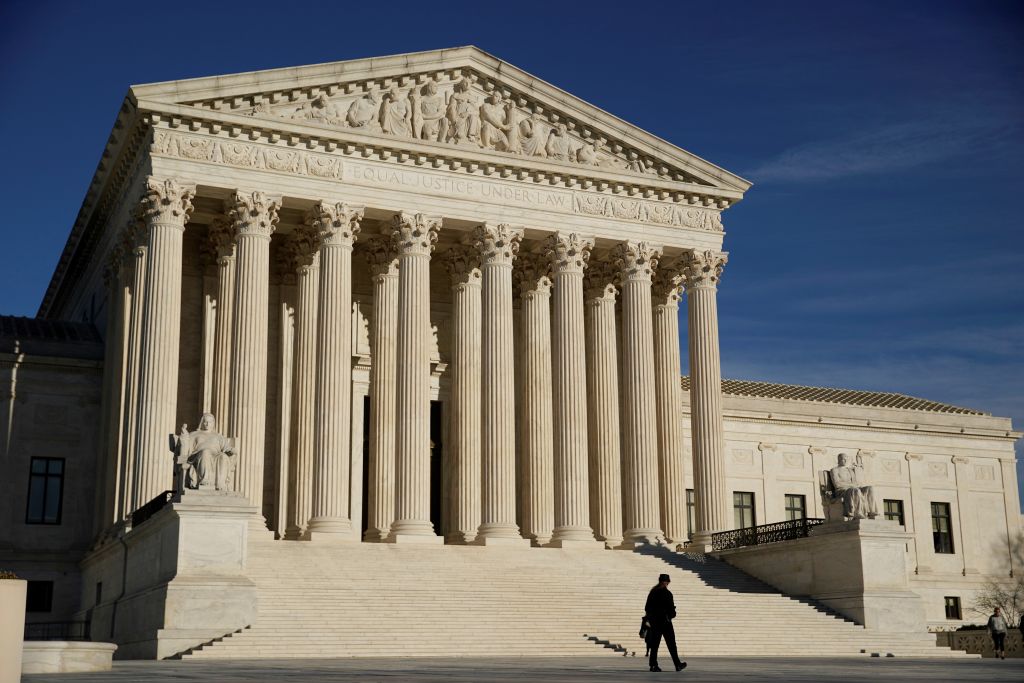
Two separate groups of New York voters and elected officials on Thursday afternoon urged the Supreme Court to leave in place a ruling by a state trial judge in Manhattan that would bar the state from using its existing congressional map in the 2026 elections. Instead, the ruling by Justice Jeffrey Pearlman of the New York Supreme Court – which is a trial court in that state – would require New York to redraw the map on the ground that it diluted the votes of Blacks and Latinos in the only New York City congressional district represented by a Republican. The voters called the request to intervene a “brazen defiance of” the Supreme Court’s rules, while a group of state officials added that granting the request would require the court to improperly intrude on state interests.
The dispute began last fall, when a group of voters went to state court to challenge the boundaries of New York’s 11th Congressional District, which includes all of Staten Island and parts of southern Brooklyn. The challengers contended that the boundaries violated the state’s constitution because they diluted the votes of Black and Latino voters, who make up roughly 30% of Staten Island’s population, and failed to give those voters an equal opportunity to elect a representative of their choice.
In a ruling on Jan. 21, 2026, Pearlman agreed and barred New York from using the map in upcoming elections. He also ordered the state’s independent redistricting commission to propose a new map by Feb. 6.
Rep. Nicole Malliotakis, a Republican who represents that district, and several individual voters joined the lawsuit to defend the existing map, along with several New York election officials. They asked two state appeals courts to put Pearlman’s ruling on hold, but the state’s highest court – the New York Court of Appeals – ruled that it did not have the authority to hear the case. The state’s intermediate appellate court finally turned the request down on Thursday, Feb. 19.
The map’s defenders came to the Supreme Court last week, asking the justices to step in and block Pearlman’s ruling. Malliotakis told the court that Pearlman’s “decision clearly violates this Court’s Equal Protection Clause case law by prohibiting New York from running any congressional elections until it racially gerrymanders CD11 by ‘adding [enough] Black and Latino voters from elsewhere,’ until the Black and Latino voters in CD11 control contested primaries and won most general elections.” The Trump administration, which filed a “friend of the court” brief, argued that the case presents “an open and unabashed racial gerrymander.”
The voters challenging the old map argued on Thursday that the dispute “falls miles” outside the Supreme Court’s power to intervene in state-court proceedings. Federal law, they contended, only allows the court to pause final rulings that it could review on the merits. But the only state court judgments that the Supreme Court can review on the merits, they said, are final judgments issued by a state’s highest court. “No New York appellate court—let alone the State’s highest court—has finally resolved the federal issue” raised by the map’s defenders.
And it doesn’t matter, the voters wrote, that the state’s intermediate appellate court denied the stay request of the map’s defenders. “[I]f relief is granted in this posture, future stay applicants will see little purpose in waiting for state court rulings before coming to this Court.”
A group of election officials led by New York Gov. Kathy Hochul added that putting Pearlman’s order on hold would infringe on the state’s prerogative to carry out its elections. Although the map’s defenders have asked the justices to act quickly, telling them that otherwise “New York’s congressional elections will be thrown into chaos and uncertainty,” Hochul and the other elected officials countered that “there is sufficient time for New York’s appellate courts to resolve” the pending appeals “on the merits while addressing any such upcoming state-law election calendar dates.” Indeed, they noted, in 2022, the state courts “quickly adjudicated” a redistricting challenge that was filed in February, leading the New York Court of Appeals to order a new congressional map in April and “adjustments to the State’s election-calendar dates to accommodate that process.”
Cases: Malliotakis v. Williams, Kosinski v. Williams
Recommended Citation:
Amy Howe,
Democrats ask Supreme Court not to disrupt New York redistricting dispute,
SCOTUSblog (Feb. 19, 2026, 7:30 PM),
https://www.scotusblog.com/2026/02/democrats-ask-supreme-court-not-to-disrupt-new-york-redistricting-dispute/
