



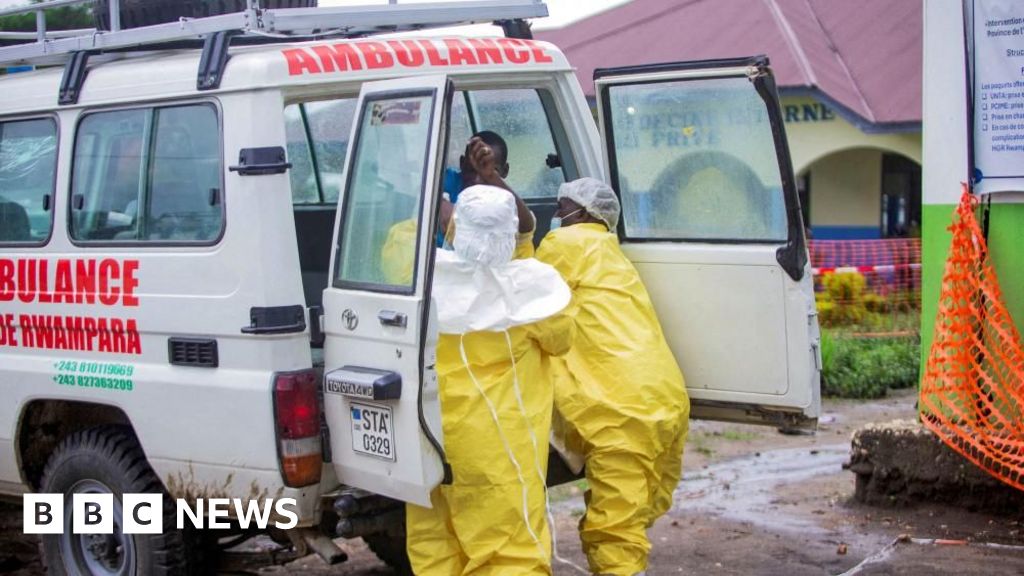
Ebola treatments trial begins in DR Congo
11 hours ago


Reuters
A trial of potential treatments for the species of virus behind the current deadly Ebola outbreak in the Democratic Republic of Congo has begun, the World Health Organization (WHO) has announced
The first patient has been enrolled in DR Congo, WHO chief Tedros Adhanom Ghebreyesus said on Thursday
More than 1,400 cases and 438 deaths have been confirmed in the country, according to the WHO
There are currently no approved vaccines or treatments for the Bundibugyo virus species of the disease, which is highly infectious
The current trial is sponsored by the WHO, and is being co-ordinated by scientists at the Institut National de Recherche Biomédicale in DR Congo, the Institute of Tropical Medicine in Belgium, and the University of Oxford in the UK
Patients will be tested on two antiviral drugs
Speaking to reporters from the WHO headquarters in Geneva on Thursday, Tedros said: “Even without approved therapeutics, people are recovering from this disease, but of course, we could save many more lives with safe and effective therapeutics in our toolkit.”
DR Congo’s Health Minister Dr Samuel Roger Kamba said the launch “represents a significant step forward, offering renewed hope to patients, their families, and affected communities”
What is Ebola and why is stopping the latest outbreak so difficult?
Recovery of Ebola patients offers rare moments of joy at epicentre of outbreak
The current outbreak of Ebola in DR Congo began in May, though transmission had been going undetected for some time
The situation has been declared a public health emergency by the WHO, which says there have been 1,460 confirmed cases in DR Congo, with 150 suspected cases and 452 deaths, as of 1July. According to the WHO, 213 people have recovered
There have also been 20 confirmed cases in Uganda, leading to two deaths, and one confirmed case in France, as of 1 July
Ebola is caused by a virus which attacks the body’s immune system and organs
It normally infects animals, typically fruit bats, but outbreaks among humans can sometimes start when people handle infected animals. It is spread through bodily fluids like blood
Congolese health authorities have said the outbreak is currently restricted to three eastern provinces – South Kivu, North Kivu and Ituri
However, the Reuters and AFP news agencies report that the body of a pregnant woman tested positive for Ebola in the neighbouring Tshopo province. The woman reportedly died in Ituri, before her body was transported by motorbike to Tshopo’s main city, Kisangani, which has a population of about 1.5 million people
Additionally, an individual suspected of having Ebola reportedly fled from an isolation unit in Ituri and later tested positive in the nearby Haut-Uele province
Authorities are said to have launched contact-tracing efforts across Tshopo and Haut-Uele. Earlier this week, public gatherings were banned in both these provinces, along with neighbouring Bas-Uele and the capital, Kinshsasa, in order to prevent the spread of Ebola
People with Ebola usually only become contagious after developing symptoms, and it takes two to 21 days for symptoms to appear
They come on suddenly and start like flu or malaria with fever, headache and tiredness
DR Congo’s health ministry said it has improved diagnosis across the affected region. Previously, four laboratories were testing for Ebola, but that number has now increased to 10
According to both Africa CDC and US public health authorities, the current outbreak has the potential to be one of the largest ever, because it was spreading for weeks before it was confirmed to be Ebola
International organisations also warn that conflict in eastern DR Congo is making it more difficult to tackle the outbreak. The M23 rebel group is in control of large parts of both North and South Kivu
Vaccines must be developed for each individual species of Ebola, of which there are six, but only three are known to cause outbreaks
Three Ebola vaccines in development amid growing outbreak fears
‘I buried my parents one day after the other’ – Ebola mourners learn how to grieve safely
Ebola virus
World Health Organization (WHO)
Africa





