

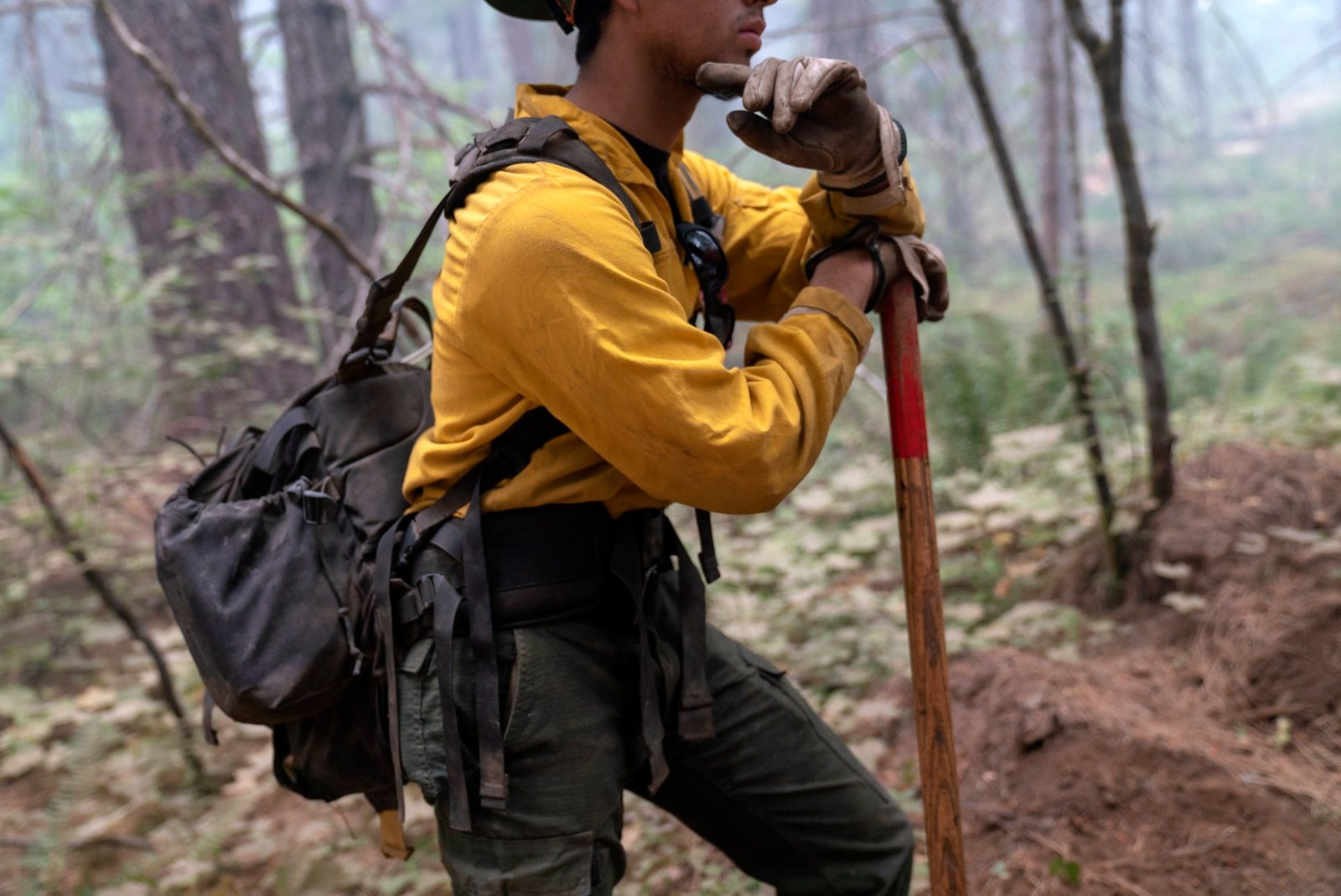
Officials at the U.S. Forest Service knew gear worn by wildland firefighters contained potentially dangerous “forever chemicals” years before the agency publicly acknowledged the issue, according to internal correspondence obtained by ProPublica.
Per- and polyfluoroalkyl substances, also known as PFAS, have been linked to negative health impacts, including certain cancers and delayed development in children. For years, PFAS chemicals were commonly used to treat the heavy gear worn by municipal firefighters to help it repel water and oil.
Federal agencies have said little about whether the compounds were also found in the lighter heat-resistant clothing worn by wildland firefighters. In February 2024, when ProPublica was reporting on the dangers of wildland firefighting — including the risk of cancer — the news organization asked both the Forest Service and the Department of the Interior if federal wildland firefighting gear contained PFAS. Both agencies gave nearly identical answers, writing that they did not have “specific measured concentration data showing that PFAS is contained in protective clothing and gear.”
But email correspondence obtained by ProPublica shows that government officials were alerted to the presence of PFAS in pants used by wildland firefighters as early as 2021. In April 2022, a senior Forest Service official asked colleagues if they had an obligation to tell firefighters that PFAS had been found in their gear.
According to the emails, the agency decided not to immediately share the information, instead waiting for the results of a study into whether PFAS can be absorbed through the skin.
The emails were released last week in response to a Freedom of Information Act request filed in 2022 by George Broyles, a former Forest Service employee who for years studied smoke exposure among firefighters, and who has repeatedly raised concerns about the agency’s reluctance to acknowledge cancer among its workforce. “They just obfuscate,” said Broyles. “It’s just a continuation of the same thing: ‘We’re going to stick our heads in the sand and hope that nobody notices.’”
The Forest Service declined to answer questions about the records, PFAS chemicals in its gear, and firefighter health. In 2024, the agency said in a statement to ProPublica, “The Forest Service is deeply committed to not only understanding occupational risks to employees but mitigating these risks.”
The Department of the Interior did not answer questions about PFAS.
By 2021, public awareness of the ubiquity and risks of PFAS was rising. At the beginning of that year, Congress ordered the National Institute of Standards and Technology, a subagency of the Department of Commerce, to find out if firefighting gear contained PFAS. Researchers from the agency began collecting hoods and gloves worn by municipal firefighters — who tackle building fires — as well as various samples of wildland firefighting gear.
In April, according to the documents, a Forest Service equipment specialist emailed one of its suppliers, TenCate, which produces fabric used in wildland firefighting gear. At the time, the company’s “Advance” fabric, a Kevlar blend used in some pants, was treated with a finishing product called Shelltite. “Question,” asked the Forest Service specialist. “Does the Shelltite finish on the Advance fabric have any PFAS presence?”
A TenCate manager quickly responded by attaching a document confirming that one of its finishes contained a form of PFAS that had been applied to repel hydrocarbons and gasoline. The manager also said that TenCate was “in the final stages of developing” a finish without the compound.
TenCate did not respond to repeated requests for comment from ProPublica.
PFAS is a broad class of chemicals. According to emails sent from TenCate to the Forest Service, the company’s finish used a form of PFAS with six or fewer fluorinated carbon atoms. According to experts, these “short-chain” PFAS chemicals are less harmful than other ones, but some can linger in the environment for years and in the human body for months. Their full impact on human health is not known.
All firefighters have significantly higher cancer risks than the general population, but less is understood about the health of wildland firefighters than of their counterparts who battle blazes in buildings and other structures. This is largely the fault of the government: As ProPublica has reported, the Forest Service has known of carcinogenic elements in wildfire smoke for decades but the government dragged its heels in studying the impacts on wildland firefighters. Researchers have found elevated levels of some PFAS in the blood of structural firefighters, but less is known about these chemicals in their wildland peers.
While structural firefighting departments often require garments that repel oil and water, experts say it is not always necessary for wildland firefighters, who often wear the same gear for weeks in remote locations.
“From the wildland firefighting perspective, I don’t see any reason to have the PFAS treatments in their gear. They don’t really need the oil repellency,” said Bryan Ormond, an associate professor of textile engineering, chemistry and science at North Carolina State University, in an email. “It would be a safer option to not have the PFAS treatment.”
According to a former fire service official with direct knowledge of the dynamic, the presence of PFAS in pants was a topic of discussion around 2021 by a risk management committee made up of senior officials from multiple agencies, including the Forest Service and the Department of the Interior. The official said that committee members wanted to know: “Is it a big deal, little deal, or no deal?”
In April 2022, a full year after TenCate told the Forest Service about the PFAS treatment used on its fabric, a senior agency official named David Haston raised the issue again. An assistant director of operations at the Forest Service at the time, Haston emailed colleagues asking whether TenCate’s fabric was “still coming with PFAS in the finish? Can Tencate tell us whether or not this is hazardous to people that wear these garments? Do we have a duty to notify employees?”
The email was forwarded to a Forest Service equipment specialist named David Maclay-Schulte who said he’d asked the company if its PFAS-free fabric was ready. “They said they will look into it and get back to me,” wrote the specialist. “I am hopeful it’s sooner rather than later.”
Five months later, in September, Maclay-Schulte wrote to Forest Service officials that he still hadn’t heard back from TenCate. In the email, Maclay-Schulte said he would contact the company again, but added that the Forest Service had decided to wait until the National Institute for Occupational Safety and Health had completed studies, including one about whether PFAS can be absorbed through skin, “before any decisions would be made.” In the same email, he asked colleagues whether he should respond to questions about PFAS that Broyles had asked on behalf of a labor advocacy group called Grassroots Wildland Firefighters. The other officials all agreed that they would not immediately tell Grassroots about the PFAS. “They need to send the FS an official request asking for this information,” wrote a physiologist for the agency.
According to multiple wildland firefighters and government officials familiar with contracting and purchasing, the Forest Service never told rank-and-file wildland firefighters that their pants might contain PFAS.
“To me it demonstrates that managers high up in the agency over several years have never really prioritized the health and well-being of the actual firefighters,” said Riva Duncan, the president of Grassroots and a former Forest Service fire chief. Duncan noted that many wildland firefighters wear their pants even in the offseason. “They’ve known about this. They’ve known about other threats to health and well-being yet they have chosen to not be proactive and share the information with employees. It seems it’s only when they’re forced to provide information that we find out about it.”
In the past few years, under pressure from labor groups and lawmakers, the federal government has begun to acknowledge cancer in the workforce, and the Forest Service last year made masks available to wildland firefighters in response to reporting from The New York Times. But a full accounting of the risks is still not available; the government’s preparedness guide for incoming wildland firefighters, produced in 2022, makes no mention of cancer. When ProPublica asked the Department of the Interior if it planned to update the guide, a spokesperson directed the news organization to a blog post about research into workplace hazards that does not mention cancer.
In January 2023, almost two years after the Forest Service learned of the PFAS treatments, TenCate finally responded to Maclay-Schulte. “To the best of our knowledge wearing ADVANCE with Shelltite or Supershelltite has not caused deleterious health impacts,” wrote a senior director at the company. But the company also informed the agency that it was now producing its PFAS-free finish for the pant fabric.
It is unclear if the government began purchasing pants with the new finish or if it continued to purchase the pants with PFAS.
In 2024, NIST released the study of PFAS in firefighting gear that Congress had mandated in 2021. The study found that some wildland firefighting gear contained PFAS. Most of it had modest amounts of the chemicals. But, NIST wrote, in a summary of the study, “there were some cases that had notably high levels.” According to Heather Stapleton, an exposure scientist and professor at Duke University, the study showed levels in certain samples “similar to what has been reported in structural firefighting gear.”
The study did not specify the companies it had sourced its gear from, and NIST did not respond to questions from ProPublica. The NIOSH study that the Forest Service officials had been waiting on when deciding how to act, however, is still ongoing.
