


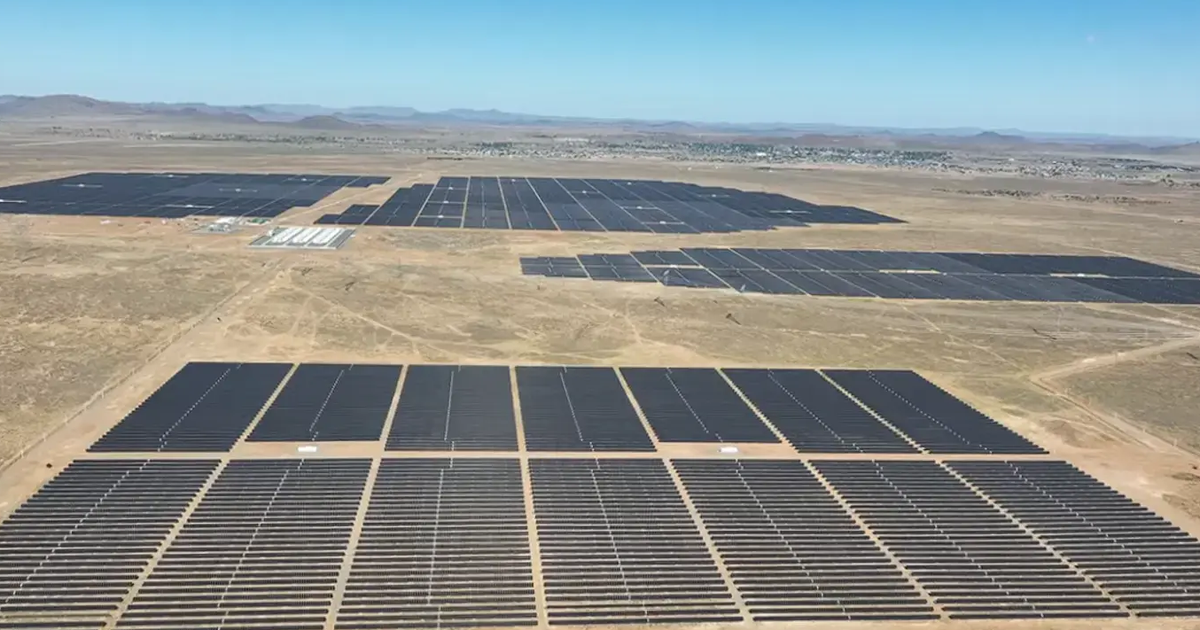
French energy giant TotalEnergies has inaugurated Africa’s largest hybrid renewable energy project in <a href="https://absafricatv.com/south-africa-namibia-strengthen-gender-equality-cooperation/" title="South Africa, Namibia strengthen gender equality cooperation”>South Africa, marking a major milestone in the continent’s shift towards cleaner electricity while helping strengthen one of Africa’s most strained power systems.
The Hydra hybrid renewable energy project in South Africa’s Northern Cape combines a 216 MW solar plant with a 500 MWh battery storage system.
- TotalEnergies has inaugurated the Hydra project, Africa’s largest hybrid renewable energy facility, in South Africa’s Northern Cape.
- The project combines a 216 MW solar plant with a 500 MWh battery storage system to provide reliable electricity beyond daylight hours.
- It will deliver more than 400 GWh of electricity annually, enough to power around 200,000 households, under a 20-year agreement with Eskom.
- The development highlights the growing role of large-scale battery storage in tackling Africa’s power shortages while accelerating the continent’s clean energy transition.
Known as the Hydra project, the facility is located in South Africa’s Northern Cape province and combines a 216-megawatt (MW) solar photovoltaic plant with a 500-megawatt-hour (MWh) battery energy storage system.
The project has been developed by a consortium comprising TotalEnergies (35%), Hydra Storage Holding (35%) and Reatile Renewables (30%).
Unlike conventional solar farms that generate electricity only when the sun shines, Hydra stores excess solar power in batteries, allowing electricity to be supplied for extended hours after sunset.
DON’T MISS THIS:TotalEnergies to end South African offshore gas exploration, shifts focus near Namibia
The facility will provide 75 MW of dispatchable renewable electricity to South Africa’s national grid continuously between 5:00 a.m. and 9:30 p.m. under a 20-year power purchase agreement with Eskom.
According to TotalEnergies, the project will generate more than 400 gigawatt-hours (GWh) of electricity annually, enough to meet the electricity needs of about 200,000 South African households.
“This project reinforces our renewable production capacity in South Africa, the continent’s largest power market in terms of electricity consumption,” said Magali Pailhé, Managing Director of TotalEnergies Southern Africa.
She added that the project would strengthen South Africa’s energy security while supporting efforts to decarbonise electricity generation.
The Hydra project goes beyond adding new renewable capacity. One of the biggest criticisms of solar energy is its intermittency electricity production falls sharply after sunset, when demand often remains high.
DON’T MISS THIS: TotalEnergies plans to exit Nigerian onshore oil


TotalEnergies says the Hydra project will supply more than 400 GWh of electricity annually under a 20-year agreement with Eskom.BI Africa
The project is also among the largest battery-backed renewable facilities on the African continent, reflecting a broader shift in electricity investment from simply adding renewable generation to building systems capable of supplying power more consistently.
DON’T MISS THIS:South Africa’s Eskom records 100 days without a power cut since 2020
A boost for South Africa’s energy transition
Hydra forms part of South Africa’s Risk Mitigation Independent Power Producer Procurement Programme (RMIPPPP), introduced to attract private investment into electricity generation following years of power shortages and load shedding.
Although electricity supply has improved over the past year, South Africa continues to diversify its generation mix by adding renewable energy and storage to reduce dependence on its ageing coal-fired power stations while improving grid resilience.
For TotalEnergies, the project also strengthens its growing electricity business as the company expands beyond oil and gas into renewable energy and battery storage.
The company said it now has nearly 36 gigawatts of gross renewable power generation capacity globally and is targeting more than 100 terawatt-hours of net electricity production by 2030.
DON’T MISS THIS:Africa’s electricity giant records first profit in 8 years
The launch comes as countries across Africa race to expand electricity access while reducing carbon emissions.
Battery-backed renewable projects such as Hydra could become increasingly important across the continent because they offer a way to improve electricity reliability without relying entirely on fossil-fuel generation.
As more African governments seek private investment in clean energy, the project may serve as a model for future large-scale solar-and-storage developments.

