


Future compass – Opinion – Chinadaily.com.cn
Future compass


APEC ‘China Year’ marks a defining moment for the destiny of regional joint efforts
For more than 30 years, the Asia-Pacific Economic Cooperation mechanism has been one of the world’s most successful platforms for economic dialogue. Since its foundation in 1989, it has promoted trade, investment and practical cooperation among 21 member economies that together represent nearly 40 percent of the world’s population, close to half of global trade and around 60 percent of global GDP.
Unlike many international organizations, APEC does not rely on legally binding agreements. Instead, it works through consensus, trust and voluntary cooperation. That flexibility has often been underestimated, yet it is precisely what has allowed economies with very different political systems, levels of development and strategic interests to continue working together, even during periods of international tension.
Today, that role has become more valuable than ever.
The world economy is entering a new phase — one driven less by inexpensive labor or abundant natural rethe ability to adapt. Artificial intelligence, advanced manufacturing, biotechnology, clean energy, quantum computing and digital services are rapidly redefining competitiveness
Success in this new era will depend not only on what countries produce but also on how effectively they collaborate. Innovation no longer happens in isolation. It grows within ecosystems where governments, universities, businesses, researchers, investors and entrepreneurs work together to create ideas, commercialize technologies and respond quickly to changing global conditions.
China has experienced this transformation firsthand.
Over the past two decades, the country has evolved from primarily the world’s manufacturing powerhouse to one of the world’s leading innovation economies. Cities such as Shenzhen, Guangzhou, Hangzhou and Shanghai have become global centers for AI, robotics, biotechnology, digital finance, electric vehicles and advanced manufacturing. This progress did not happen overnight. It reflects long-term investments in education, research, infrastructure, entrepreneurship and increasingly sophisticated public policy.
Perhaps nowhere is this evolution more visible than in the Guangdong-Hong Kong-Macao Greater Bay Area. Rather than functioning as separate cities competing with one another, the area is steadily becoming an integrated innovation ecosystem where universities, multinational companies, startups, financial institutions, research laboratories and manufacturing clusters reinforce one another.
Its experience offers an important lesson for the broader Asia-Pacific. The economies that will thrive over the coming decades are unlikely to be those that innovate alone. They will be those that build strong regional partnerships, share knowledge, attract global talent and create environments where ideas can move as freely as goods and capital.
China’s chairmanship of APEC this year also arrives at an important moment for regional economic integration. The implementation of the Regional Comprehensive Economic Partnership, now the world’s largest free trade agreement, is strengthening regional supply chains and reducing barriers to trade and investment. Yet much more remains to be done.
Future competitiveness will increasingly depend on areas that traditional trade agreements barely address: digital commerce, cross-border data flows, AI governance, cybersecurity, green finance, intellectual property and regulatory cooperation. These are precisely the kinds of issues where APEC’s flexible and consensus-based approach can make a meaningful difference.
Another priority should be the continued pursuit of the vision first outlined in the Bogor Goals more than three decades ago. While remarkable progress has been made in opening markets, today’s barriers are often less visible than tariffs. They appear in fragmented digital regulations, incompatible technical standards, restrictions on services and different approaches to emerging technologies.
One area that deserves particular attention is services.
Although services now generate the majority of economic value in many advanced economies, cross-border services remain far less integrated than the trade in manufactured goods. Digital consulting, healthcare, education, engineering, financial services, creative industries and research collaboration are becoming central drivers of economic growth. Helping professionals move more easily across borders, encouraging mutual recognition of qualifications, improving digital connectivity and harmonizing regulations could unlock significant opportunities for businesses throughout the Asia-Pacific.
Climate cooperation must also remain high on the agenda.
The Asia-Pacific is both one of the regions most exposed to climate change and one of the world’s leadingbusinesses are investing heavily in renewable energy, battery technologies, smart infrastructure, sustainable manufacturing and green finance
China has become one of the major contributors to this transition. Its rapid expansion of renewable energy, EVs and clean technologies demonstrates that environmental sustainability and economic growth can reinforce rather than contradict one another. This year offers an opportunity to strengthen regional cooperation in these fields through technology sharing, joint investment and collaborative innovation.
AI will undoubtedly be another defining topic.
AI is already transforming healthcare, manufacturing, logistics, finance, education and public services. But alongside its enormous promise come equally important questions about ethics, cybersecurity, workforce transitions, data governance and public trust.
Rather than allowing different regulatory approaches to create new economic barriers, APEC could encourage greater dialogue on common principles that support both innovation and responsible governance. Such cooperation will be essential if the region hopes to fully realize AI’s benefits while minimizing its risks.
Beyond specific policy areas, perhaps the greatest contribution China can make during its chairmanship is to reinforce confidence in multilateral cooperation itself.
The international environment is becoming increasingly fragmented. Strategic competition often dominates headlines, and protectionist measures continue to reshape global trade. Yet the Asia-Pacific has repeatedly demonstrated that practical economic cooperation remains possible even when political differences persist.
Ultimately, the success of APEC in 2026 will not be measured simply by the number of ministerial meetings held or declarations issued. Its real legacy will depend on whether it strengthens confidence among businesses, investors, researchers, entrepreneurs and citizens that regional cooperation continues to offer practical solutions in an increasingly uncertain world.
The “China Year” is therefore about much more than China’s leadership. It is about the future direction of the entire Asia-Pacific.
If APEC economies work together to build consensus around innovation, sustainable development, digital cooperation and open regionalism, this year could become one of those moments that historians look back on as a turning point — not because it solved every challenge, but because it renewed confidence that the region could face them together.
At a time when the world often appears divided, that may prove to be the greatest achievement of APEC “China Year”.


The author is the executive vice-president of the French Chamber of Commerce and Industry in China, and an arbitrator at the Hainan International Arbitration Court.
The author contributed this article to China Watch, a think tank powered by China Daily. The views do not necessarily reflect those of China Daily.
Contact the editor at editor@chinawatch.cn.
Media tour for 2026 WIC forum spotlights Xi’an’s logistics


Media tour Xi’an ahead of 2026 WIC forum
Xi asks whether we’re satisfied with new apartments


Search dog sniffs out signs of life at landslide site


An ‘old neighborhood’ in Fuzhou

Key takeaways from Xi’s speech on AI
Most Viewed in 24 HoursGlobal Lens


China, ASEAN partners in prosperity


Chamber chief’s insights on China’s business environment
Columnists+

How I keep my date with strolls even on hot and sunny afternoons

Endurance and determination on Highway 318
Chinese Perspectives


Winning audiences with shared memories
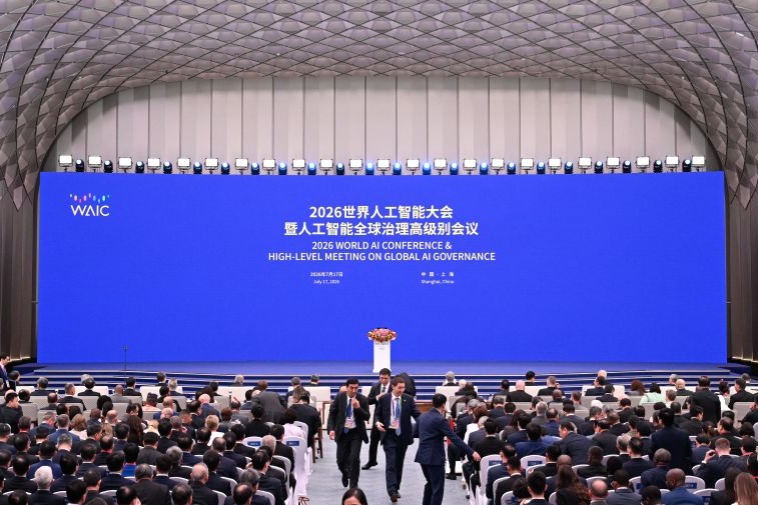

A shared future for AI begins with shared governance
China and the World Roundtable+
CPC’s governing philosophy underpins China’s success


South Asia, China to build a shared future
BACK TO THE TOP
English
中文




Copyright 1994 – . All rights reserved. The content (including but not limited to text, photo, multimedia information, etc) published in this site belongs to China Daily Information Co (CDIC). Without written authorization from CDIC, such content shall not be republished or used in any form. Note: Browsers with 1024*768 or higher resolution are suggested for this site.
License for publishing multimedia online 0108263


About China Daily
Advertise on Site
Contact Us
Job Offer
Expat Employment
FOLLOW US


