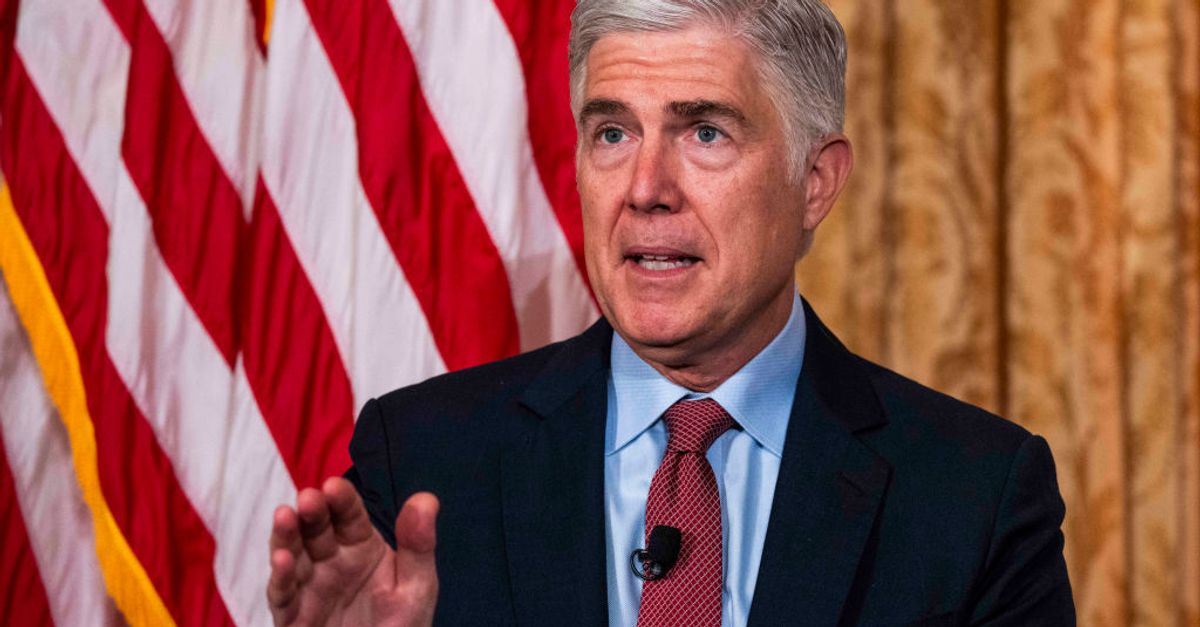


Supreme Court Justice Neil Gorsuch on Tuesday called American democracy “very fragile” and said no person or group “should have too much power,” while observing that young people need to study an unvarnished version of the nation’s history.
“I just don’t think you’re ever going to fix” the decline of civics education and related issues “unless people understand our history and learn our history, warts, glories, and all,” Gorsuch said.
Gorsuch spoke virtually to a forum organized by the Ronald Reagan Center on Civility and Democracy, which brought together an audience of some 120 mostly college-age people at the center’s offices just a block from the White House.
The justice spoke from Prague, Czechia, where he is lecturing in the national security and separation of powers summer program of George Mason University’s Antonin Scalia Law School. Gorsuch said he had visited a segment of the Berlin Wall over the weekend “and it brought back a lot of gratitude for the work President [Ronald] Reagan did to bring freedom to so many people across the world.”
Gorsuch was interviewed by Frederick Ryan, Jr., the chairman of the Ronald Reagan Presidential Foundation and Institute, who highlighted the justice’s new children’s book, Heroes of 1776: The Story of the Declaration of Independence (co-written by his former law clerk, Janie Nitze).
Neither Gorsuch nor Ryan referenced any recent controversies over presentation of U.S. history in schools or in museums such as the Smithsonian Institution, where President Donald Trump recently ordered signs be posted at the National Museum of American History that warn visitors of “inaccurate information.”
Gorsuch also did not directly address the Supreme Court’s latest term, which included many high-profile cases and sometimes tense relations among the justices. He said that Americans need to “assume the person with whom you disagree loves this country every bit as much as you do,” adding that he will never convince his more liberal colleague Justice Sonia Sotomayor to become an originalist or a textualist, nor will she convince him to abandon those analytical approaches.
“I know she loves this country,” Gorsuch said. “She knows I love this country. We know we’re coming at it from the right place internally. And then we sit down” and talk.
Gorsuch appeared most comfortable discussing history. He said many of the delegates to the Continental Congress in Philadelphia’s Independence Hall “knew that they were forfeiting their lives and potentially their freedom.”
“A third of them had their homes burned,” he said. “Many of them lost their fortunes or gave it away to the cause of freedom, dying impoverished, and even didn’t live to see the success of that revolution. And all of those kinds of virtues are virtues that were absolutely right. If we’re going to sustain our democracy, we renew our commitment to them.”
He said a little later that “most Americans sat on the sidelines in the revolution,” while some 20 to 30% remained loyal to the British crown.
“I ask young people, ‘What would you have done against those great odds? Would you have been one of the 40% that actually stood up and supported the patriot cause and risked your life, your liberty, your fortune, your sacred honor?’” the justice said. “I just ask you to choose and choose again to participate in the American experiment. Before you do, learn. Learn your history, because otherwise you’re bound to make the same mistakes.”
Asked by Ryan what gives him confidence that America will have another milestone birthday in 250 years, Gorsuch said, “Well, I am an optimist.”
“Part of what gives me enormous hope and optimism are the young people who I encounter … who really care, who have learned or are learning American history, who do recognize that people with whom they disagree are persons, too, and entitled to the same rights and decency that they afford themselves,” the justice said.
The nation has “a perfect mission statement” in the Declaration of Independence and its three central ideas, that “we’re all created equal. That we have God-given rights that don’t come from government, each of us. And that we have the capacity and the right to rule ourselves,” Gorsuch added.
“We have to choose and choose and choose again to make these our goals, our ideals, those three big ideas in the Declaration,” he said, “and recognize that the Constitution that was developed to realize them may not be perfect, but boy, it’s better than a whole lot of things around the world today or through history.”
He mentioned the Roman Republic, where “all it took was people choosing something different, and you wind up with tyranny pretty quickly.”
“We are all in it together,” Gorsuch said, “and if we don’t stay all in it together, it will crumble.”