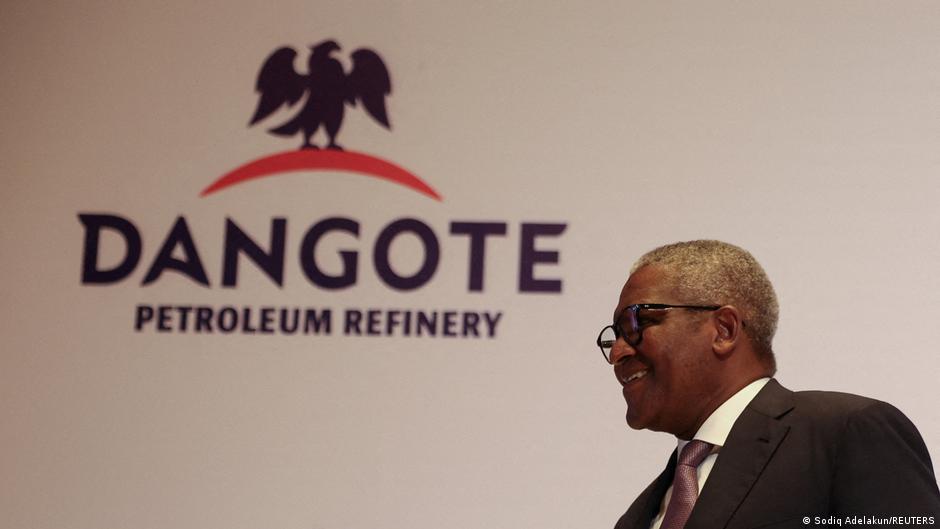
From cement plants in Ethiopia and Tanzania to refineries in Nigeria and Kenya, Nigerian billionaire Aliko Dangote has spent the last two decades building one of the most ambitious business empires that Africa has ever seen.
His companies now operate in at least 17 African countries and span across several industries, including cement, fertilizer, petrochemicals, logistics, ports, energy and infrastructure.
Dangote has a vision for the continent, an African dream. “We want to see more ships leaving the African shores, carrying products made in Africa by Africans, consumed by the world,” he told the audience at the opening of his Lamu refinery in Kenya this week.
“We want to make sure we are not the dumping grounds for the world; we also want to go and dump our products elsewhere,” he added, speaking in no uncertain terms about his ambitions.
Cement: A solid foundation for Dangote
Dangote began importing cement and other commodities to Nigeria in the early 1980s, but his breakthrough only came in 2002, when he began investing heavily in local cement production.
Afew years later, the opening of the Obajana plant in 2007 became the blueprint for his strategy: Produce locally, build at enormous scale, control the supply chain and expand business across African borders.
Ayodele Oni, an energy analyst and consultant to Dangote in Abuja, says the Nigerian billionaire’s recipe is to target sectors where the state has failed to provide goods or infrastructure, especially in his home country — like Nigeria’s dysfunctional refineries.
Dangote, he explains, engages directly with policymakers to address obstacles that could undermine his investments, including subsidies and other regulatory barriers; this strategy, Oni says, combines patient capital with close engagement with government: “He understands the terrain.”
Oni tells DW that Dangote furthermore turns gaps in the system into “a barrier to entry” by building the infrastructure around his factories. “He just looks for where a state has failed, finds out what the barriers are, and has conversations with the relevant people to take out those barriers.”
Today, Dangote Cement alone operates businesses in Nigeria, Ethiopia, Tanzania, South Africa, Senegal, Zambia, Cameroon, Ghana, Sierra Leone, the Republic of Congo and Ivory Coast, with a capacity of producing over 55 million tons a year.
Risking everything to refine black gold
The Dangote Petroleum Refinery in Lagos, commissioned in 2022, became one of the largest industrial projects ever undertaken in Africa, estimated at around $2.5 billion (€2.4 billion).
In 2026, the group announced a further $7 billion expansion program, aiming to triple Nigerian production while at the same time constructing a major new fertilizer complex in Ethiopia.
However, construction costs climbed to around $20 billion, financed through a mix of Dangote equity, commercial lending and development-finance support, including financing linked to the African Development Bank.
For years, analysts doubted the project would ever become operational; according to the Dangote Refinery’s 2026 IPO prospectus, the refinery meanwhile generated more than $13 billion in revenue in the first half of 2026 alone, redefining the concept of commercial success in Africa.
Africa’s fuel crisis: Is Dangote the answer?


From West Africa to East Africa — and beyond
This week, Dangote broke ground on his first refinery in Kenya. Upon completion, the planned Lamu refinery could process up to 700,000 barrels of oil a day, potentially making it Africa’s second-largest refinery.
Meanwhile, Dangote is also pushing ahead with major pipeline projects linking Djibouti and Ethiopia, as well as Namibia, Botswana and South Africa.
He has also built ports, trucking fleets and storage facilities that help control his supply chains from production to delivery.
And he’s not stopping there. In Lamu, he announced $50 billion in planned investments through 2030 across infrastructure, minerals, ports, power and petrochemicals.
Mma Ekeruche, a senior research fellow at the Centre for the Study of the Economies of Africa, tells DW that Dangote’s projects “have the potential to make Africa less dependent on foreign investment and imported energy products, which could ultimately reduce the continent’s vulnerability to global energy shocks.”
However, there is also the danger of huge conglomerates like Dangote’s becoming monopolies, dictating their rules onto markets across the continent and beyond.
“When a single player comes to dominate a sector, that player can exert significant influence over pricing,” she cautioned.
Opportunity in adversity
Dangote’s motto is growth. He finances his expansions by reinvesting profits, leveraging industrial assets for loans, and tapping external financing, including development banks, bonds and planned public offerings.
This model has helped turn his cement business into a continental industrial platform, with Dangote Cement reporting about $3 billion in revenue and $700 million in profit in 2025 — after tax.
Businesses looking to emulate Dangote’s approach have to identify products that could be produced locally instead of imported, says Oni, adding however that in addition to massive funds, what’s needed is political capital, meaning relationships and access to government decision-makers.
And perhaps there also something to be said for Dangote’s attitude: Where others in Africa see uncertainty and risk, Dangote sees opportunity, spending decades building an empires that is set to reach every corner of the continent.