



Artificial intelligenceis rapidly changing the way air forces think about future combat
Around the world, military planners are investing in aircraft that can fly alongside crewed fighters, carry out reconnaissance missions, strike targets and process battlefield information at machine speed with limited human input
The United States is developing Collaborative Combat Aircraft to accompany its future fighter force. Europe is pursuing similar concepts through the Global Combat Air Programme (GCAP) and Future Combat Air System (FCAS), while countries including India, Turkey and China are advancing their own autonomous combat aircraft projects
India’s private aerospace industry now wants to be part of that race
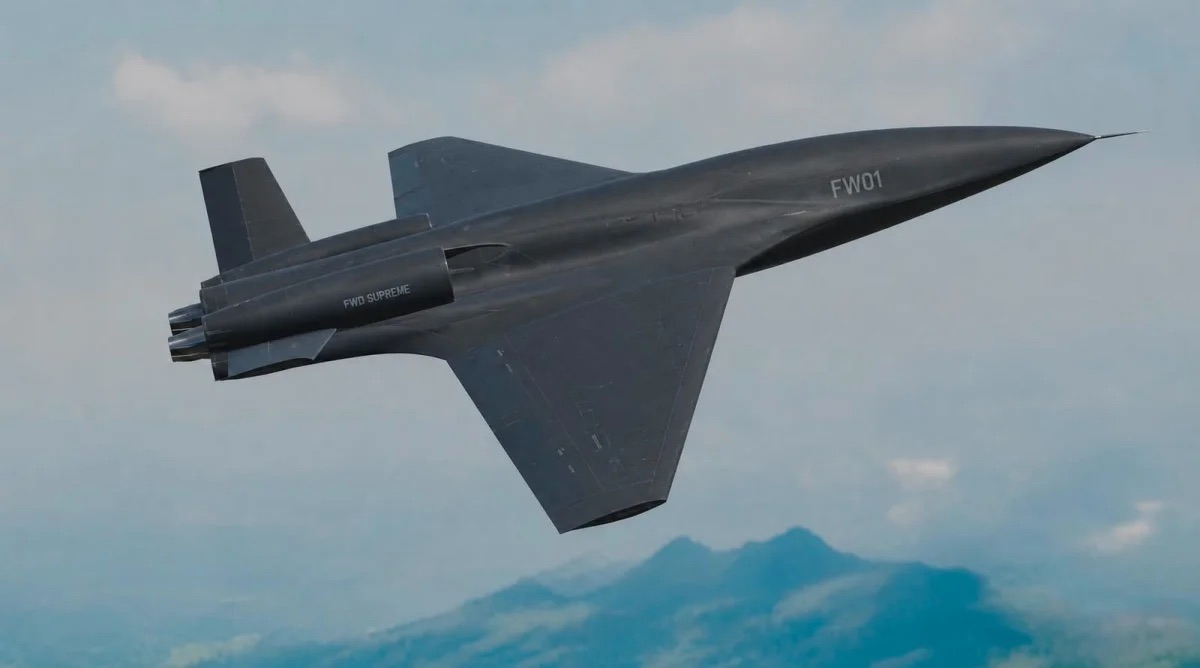
Bengaluru-based Flying Wedge Defence & Aerospace (FWDA) has unveiled FWD Supreme, an artificial intelligence-powered autonomous combat aircraft concept that the company says is designed to operate independently or as part of coordinated swarms
The programme was outlined in company statements
While the aircraft remains at the concept stage, its announcement reflects a broader shift within India’s defence ecosystem, where private companies are increasingly moving beyond conventional drones and into more sophisticated autonomous combat systems


Unlike remotely piloted uncrewed aircraft, FWD Supreme is being designed to fly with minimal human intervention
According to the company, its autonomous mission software will enable the aircraft to navigate, identify threats and cooperate with other uncrewed platforms during combat operations
The concept is built around what Flying Wedge calls its “Mobbing Doctrine”, in which multiple AI-enabled aircraft work together to overwhelm high-value targets through coordinated attacks rather than relying on a single platform
“The future of air superiority will not be achieved by a single fighter aircraft,” the company said while unveiling the programme. “It will be defined by intelligent and adaptive combat systems working together at machine speed.”
Rather than attempting to build a full-scale autonomous fighter from the outset, Flying Wedge plans to develop the programme in stages
The first demonstrator, known as FWD Supreme Lite, is a 250kg-class aircraft intended primarily to validate the company’s autonomous flight technologies. Its maiden flight is targeted for the third quarter of 2026
The longer-term objective is FWD Supreme Heavy, a one-tonne-class autonomous aircraft intended for intelligence, surveillance and reconnaissance, precision strike and collaborative combat missions
During the programme’s initial phase, the company is targeting speeds of up to Mach 0.9 and an operational radius of between 700km and 1,000km
Those ambitions place the project within a rapidly expanding field of autonomous combat a
Defence manufacturers are increasingly moving away from treating uncrewed aircraft as remotely controlled platforms and towards systems capable of supporting tactical decision-making with varying degrees of autonomy
Future combat operations are expected to involve crewed fighters directing formations of autonomous aircraft carrying sensors, electronic warfare payloads or weapons, while taking on higher-risk missions
For India, that transition has become strategically important
The Indian Air Force is already examining concepts ranging from loyal wingman aircraft to AI-enabled decision support systems, while indigenous programmes continue to explore autonomous technologies for future combat a
Although Flying Wedge’s proposal remains at an early stage, it highlights how private industry is beginning to position itself alongside government-led efforts in one of military a
The company says the programme is intended to combine indigenous aircraft design with advances in artificial intelligence, secure communications and autonomous mission management
FWD Supreme is not the company’s only autonomous a
Last month, Flying Wedge announced that it had established its first international manufacturing node in Portugal through a partnership with technology company SKETCHPIXEL LDA, also known as KEYDEF, to support production of its Kaal Bhairava Medium Altitude Long Endurance autonomous combat aircraft
Under the agreement, the Portuguese partner will contribute simulation technologies, AI integration, communications systems and interoperability capabilities, while Flying Wedge will retain responsibility for the aircraft’s autonomous systems and airframe design
According to the company, Kaal Bhairava is being designed for missions requiring long endurance and extended range, with a claimed operational radius of 3,000km, endurance of more than 30 hours, AI-assisted target recognition and swarm coordination capabilities
Flying Wedge says the Portugal facility forms the first overseas manufacturing node under its long-term “Operation 777” strategy, which is aimed at establishing international production and integration partnerships for Indian-designed autonomous systems
Although Flying Wedge’s announcement is significant for India’s private aerospace sector, it enters an increasingly competitive international landscape
The United States is investing heavily in Collaborative Combat Aircraft programmes led by companies including General Atomics and Anduril,which are developing autonomous aircraft designed to operate alongside crewed fighters
Europe’s GCAP and FCAS programmes both envisage autonomous “loyal wingmen” and remote carriers working with sixth-generation combat aircraft, while Turkey’s Baykar has already flown the Kızılelma uncrewed combat aircraft. China is also believed to be pursuing several classified autonomous combat aircraft programmes
Against that backdrop, Flying Wedge’s proposal illustrates how autonomous air combat is no longer confined to the world’s largest defence manufacturers
Smaller companies are increasingly seeking to develop specialist capabilities in artificial intelligence, autonomy and mission software rather than competing directly in the traditional fighter aircraft market
Read all our coverage of autonomous and uncrewed systems in one place hereRead all our coverage of autonomous and uncrewed systems in one place here
News
DefenceDefence & SecurityInnovation & TechnologyUnmannedAIArtificial IntelligenceautonomousCCACollaborative Combat AircraftFlying Wedge Defence & Aerospace (FWDA)FWD SupremeIndia
Similar Reads
China-Russia bomber patrol triggers fighter jet scrambles from Japan and South Korea
June 29, 2026
Boeing T-7A Red Hawk investigation exposes data rights and sustainment concerns
June 29, 2026
Which fighter jet has the fastest top speed?
June 28, 2026
How Airbus is keeping the NH90 fit for the future
June 28, 2026
Related Topics





