



Jousting with Ghosts in South African Politics
– June 30, 2026
5 min read
Benji Shulman writes on how South African politics is being haunted.


It centred darkly that “foreign-aligned Zionist lobbying threatens South Africa’s sovereignty” and how South Africans “did not defeat apartheid only to become vulnerable to new forms of pressure dressed up as lobbying, philanthropy, diplomacy, religion, or ‘shared values’”. In particular, he launched an attack on the South African Israel Public Affairs Committee (SAIPAC), which he described as “a clear and present political danger to our constitutional sovereignty, democratic integrity, and historical memory”. Hectic stuff.
What was interesting, however, was not Jacobs’s article but SAIPAC’s response to it. Or rather, the lack of one. You see they said nothing, just ignored it entirely
Perhaps they were just uninterested but a closer inspection reveals that SAIPAC has not issued a public statement in nearly ten years. An even closer look shows why. You see, over the last ten years the people involved in the organisation have died. Mr Jacobs appears to be worried that South Africa’s sovereignty is being threatened by a group of ghosts. Not exactly the supernatural governance that we all hoped for
Paranoia
The ANC’s years in exile, its immersion in the paranoid political culture of Soviet-style communism, and its own history of corruption have created fertile ground for opaque policymaking and a suspicion of openness. The movement has always had a particular fondness for hidden foreign enemies and explanations. For the ANC, this politics by poltergeist is not merely a means of distraction. It is a category of political analysis
Take Oscar Mabuyane, the Premier of the Eastern Cape, for example. He recently suggested that the factional battles consuming his provincial ANC structures, problems the national leadership itself has been called in to resolve, were somehow the work of the Mossad, the Israeli intelligence service. It is reassuring to know that while Iran is battling cyberattacks, Hezbollah is ordering replacement pagers, and Hamas commanders continue to disappear under mysterious circumstances, Israeli intelligence apparently still has enough spare capacity to manipulate an ANC provincial conference.
The Minister of International Relations and Cooperation, Ronald Lamola, has been more subtle but no less conspiratorial. He has hinted that South Africa’s xenophobia crisis, and even the reactions of African countries such as Ghana, may somehow be connected to South Africa’s case against Israel at the International Court of Justice (ICJ)
As Lamola put it: “With the geopolitical environment and South Africa’s role in the international space, including our case at the ICJ, you cannot exclude state and non-state actors trying to erode the human rights standing of South Africa.”
Lamola carefully avoids naming who these “state and non-state actors” might be. But you do not need to be a dog to hear this particular whistle. Explaining away South Africa’s xenophobia problem through the lens of an antisemitic conspiracy is quite the flex
Media Fooled
Unfortunately, as with so much else in South African politics, the ANC has a habit of exporting its philosophy-by-phantom to the rest of us. Editors in parts of the mainstream media have adopted more polite versions of Lamola’s prognostications, while social media and alternative outlets have dispensed with the subtlety altogether
July Eccles, the Hanoi Jane of Islamist broadcasting channels, has explicitly linked anti-foreigner violence to Israeli interference and funding, while a number of prominent activist accounts have enthusiastically amplified similar claims
Like the paranormal in general, these explanations are more emotionally satisfying than they are plausible. The simpler explanation is also the more convincing, if difficult, one
Israel, like all states, seeks to advance its interests through diplomacy, relationships, and influence, not by encouraging chaos. Indeed, the last significant Israeli diplomatic initiative in South Africa, before it was halted by the government, involved providing water solutions to rural communities in the Eastern Cape as a means of building goodwill beyond the ANC. That is a very different proposition from the destabilisation campaign now being alleged. While Israel certainly has an interest in persuading South Africa to abandon its ICJ case, deliberately fuelling domestic unrest would hardly strengthen Israel’s position in the Hague nor persuade any other South African political actor to assist it.
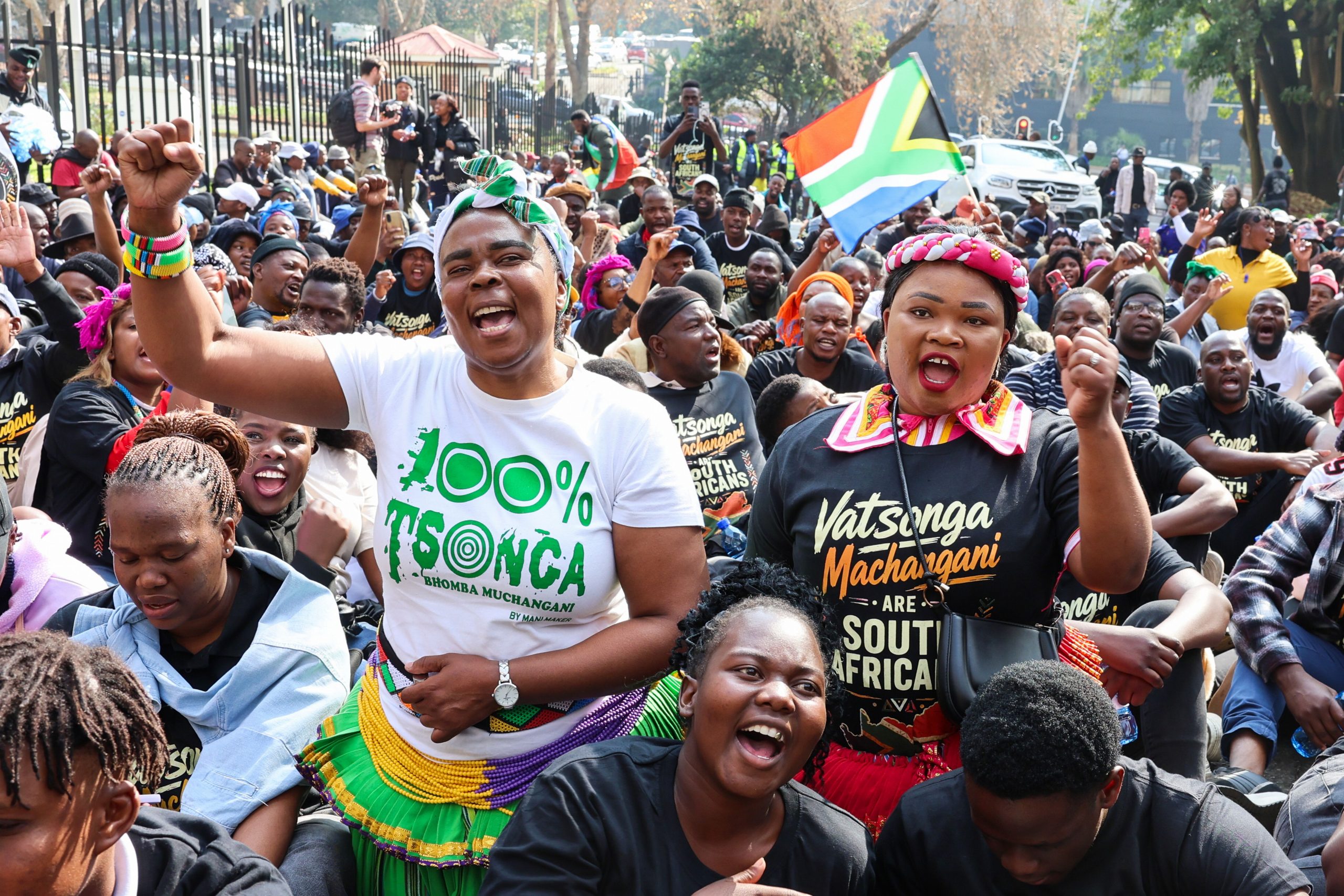
This particular conspiracy has become so widespread on social media that the leader of March and March, Jacinta Ngobese-Zuma, felt compelled to respond publicly. Clearly exasperated, she explained that she had never met an Israeli and had never visited the country. The issue of illegal immigration, she insisted, was a local South African issue. Why, she asked, would she concern herself with a distant Middle Eastern conflict and make that part of her problems?
She went further, accusing her critics of racism. Whenever black South Africans organise independently, she argued, someone immediately assumes they must be funded or directed by foreign actors
Uncontroversial
The suggestion that March and March, and the broader anti-immigration movement, is organised and has strong backing is hardly controversial. But one need not invoke shadowy forces, foreign or otherworldly, to explain why it exists. Failing service delivery, competition for scarce jobs, economic stagnation, strong migrant support networks, election-year politics, and the near-total absence of accountability for perpetrators of previous waves of xenophobic violence over the past twenty years provide more than enough explanation for today’s crisis. Certainly countries unable to resolve these problems domestically are rarely important enough to require elaborate foreign destabilisation campaigns.
Jews are the archetypal conspiracy but South Africa is blessed with whole host of others: the Illuminati, Masons, Zionists, globalists, neoconservatives, George Soros, Jeffrey Epstein, white monopoly capital, secret cabals, varying ethnic and religious minorities, and assorted occult forces have all enjoyed starring roles in South Africa’s political imagination over the years. Not to mention the more structural ghosts of the political past: apartheid, colonialism and imperialism, which continue to haunt our explanations for the present.
We should not confuse incompetence, corruption, and institutional decay with conspiracy and apparitions. The former are difficult enough to confront. The latter would need an exorcism and who knows how that might threaten South Africa’s sovereignty in new and scary planes of existence





