

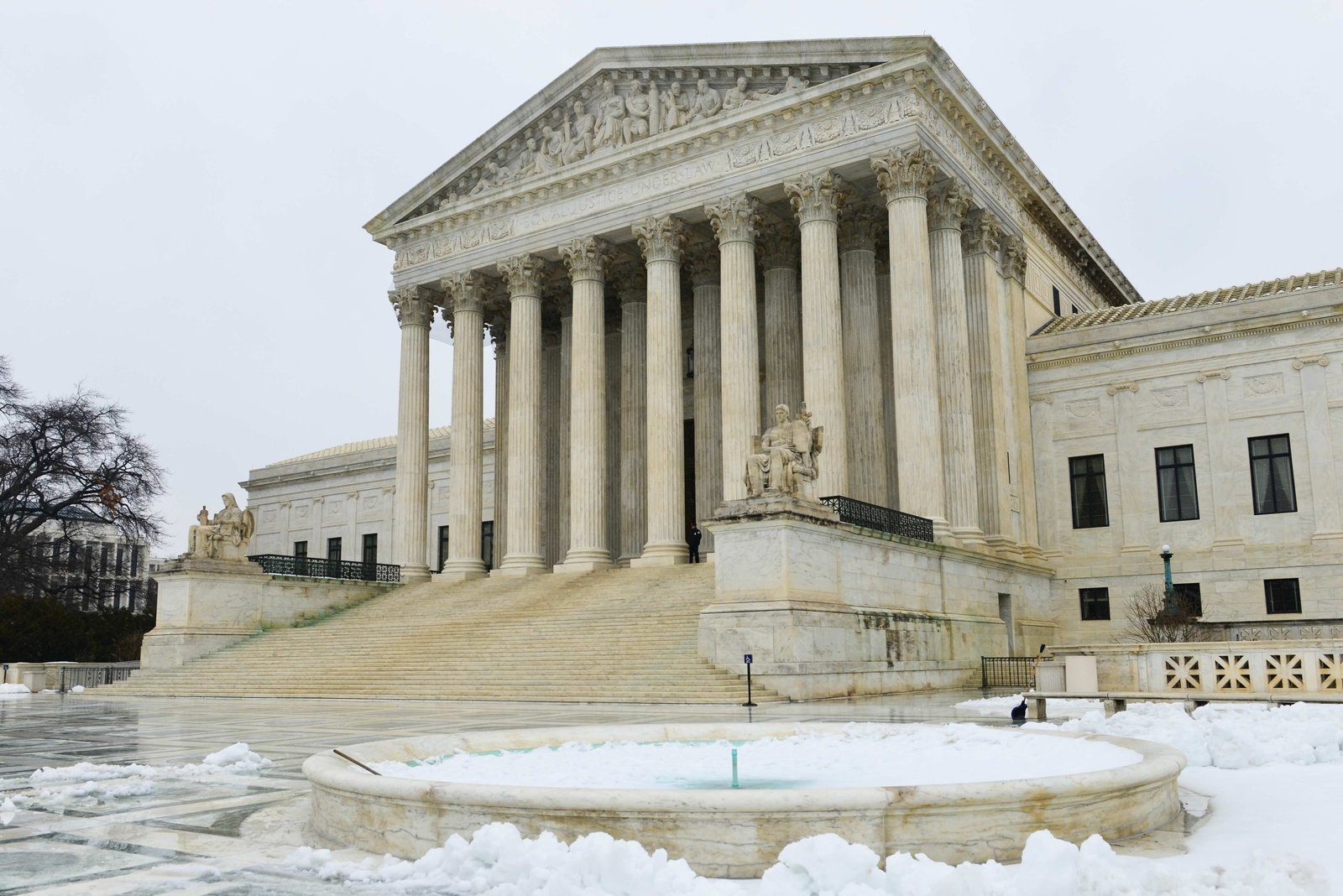
The Supreme Court on Wednesday debated whether New Jersey’s public transit agency can be sued in state courts in New York and Pennsylvania. The New Jersey Transit Corporation argues that it is an “arm” of the state and therefore is immune from lawsuits elsewhere, but after a little over an hour of arguments, it was not clear whether a majority of the justices agreed.
The lawsuits before the court on Wednesday were filed by men who were injured in accidents with NJ Transit vehicles. Jeffrey Colt went to state court in New York after he was struck by a bus in a crosswalk in Manhattan; Cedric Galette went to state court in Pennsylvania after the car in which he was a passenger was hit by a bus in Philadelphia.
New Jersey Transit, which was created by the New Jersey Legislature more than four decades ago, is one of the largest public transit providers in the United States. Its network of train, bus, and light rail services crisscrosses New Jersey but also extends into New York and Pennsylvania.
Under a doctrine known as interstate sovereign immunity, Colt and Galette would not be able to sue New Jersey itself in New York or Pennsylvania state courts. The Pennsylvania Supreme Court dismissed Galette’s case against NJ Transit, reasoning that the agency is an “arm” of the state and therefore was entitled to the same immunity. The New York Court of Appeals, the state’s highest court, allowed Colt’s lawsuit against New Jersey to go forward, concluding that NJ Transit is not an “arm” of the state.
New Jersey Deputy Solicitor General Michael Zuckerman framed the question before the justices as whether, based on a variety of factors, NJ Transit “is most like a private business, locality, or state agency.” The answer, he suggested, is an easy one: NJ Transit has the power to make rules that will be subject to state procedural laws and to enforce the state’s criminal laws. Moreover, he added, New Jersey’s governor exercises significant control over the board and has the right to veto the board’s actions. “And the state sharply limited NJ Transit’s ability to raise revenue, cut costs, or issue debt, effectively promising to cover its annual deficits as it always has.”
“In short,” Zuckerman concluded, “NJ Transit looks nothing like a city or town and little like a private company. It looks a lot like a New Jersey state agency. That means plaintiffs must sue it where the state has consented, in New Jersey.”
Arguing on behalf of the plaintiffs, lawyer Michael Kimberly urged the justices to focus on the legal status of the public entity seeking immunity as an “arm” of the state. He explained that states have two options when they want to create a new public entity: they can make it part of the state government itself, or they can make it a public corporation. “It is entirely the point of creating a public corporation,” Kimberly emphasized, “that it is a distinct legal person, separate and apart from the state that creates it.” And when a state makes that choice, he stressed, it comes with a downside – “and that’s that” the public corporation “does not share in the state’s sovereign immunity. That has been the consistent holding of this Court for the last 200 years.”
Zuckerman pushed back against any suggestion that New Jersey’s mere designation of NJ Transit as a corporation meant that it could not be an arm of the state. “[W]hen you look at NJ Transit, when you see … how closely tied it is to New Jersey, and you analyze its features, under state law, the word ‘corporation’ … couldn’t have meant that kind of separation because we’re giving it rulemaking power, we’re having it sued in our appellate division the same way you sue every other agency that engages in rulemaking. We have a statewide police department, all of these hallmarks of sovereignty.”
But despite Zuckerman’s efforts to have the court consider the big picture, some justices focused on individual factors, beginning with whether New Jersey can be held liable for NJ Transit’s debts. Chief Justice John Roberts told Zuckerman that “it’s kind of hard to say it’s part of the state if you’re not going to cover it when they get into trouble.” Roberts may have been playing devil’s advocate, however, as he later asked Kimberly whether it was “significant that New Jersey does, in fact, cover the liabilities of the Transit Corporation, regardless of whether it’s a formal commitment which carries with it consequences that I don’t think would be good for either side, but why isn’t that what’s really significant?”
In line with Roberts’ questioning, Zuckerman told the court that even if the state is not formally liable for NJ Transit’s debts, “[w]e fund NJ Transit’s deficits every single year, most years well over $200 million.”
Kimberly offered a different view. “[T]he question of who foots the bill, who ultimately picks up the cost isn’t the relevant question,” he said. “The question … is who bears actual legal responsibility for the judgment.”
Justice Sonia Sotomayor appeared skeptical of Zuckerman’s arguments. The Supreme Court has said, she told him, “that the corporate form itself is evidence that an entity is not the state, correct?” And it has also said, she continued, “that formal liability, not informal liability, not indemnity, but formal liability continues to remain centrally important.” “We’ve called it a critical factor,” she added.
Justice Ketanji Brown Jackson echoed Kimberly’s arguments, telling Zuckerman that “you’re sort of suggesting that this multifactor look at the function of the entity is … how this was always done and that’s the way it should be done. And I guess I’m questioning,” she said, “I thought originally the idea was is this a corporation? And if it is, it’s sort of presumptively not going to get sovereign immunity.”
Justice Amy Coney Barrett chimed in, also voicing skepticism of any such multifactor test. The Supreme Court, she said, had not “had any cases … in which we have found” that a corporation – like NJ Transit – with the power to bring lawsuits and to be sued “is immune from suit, correct?”
Justice Elena Kagan seemed most sympathetic to New Jersey’s arguments. She invoked the Supreme Court’s 2023 decision in Biden v. Nebraska, striking down the Biden administration’s student-loan debt relief program. In that case, Kagan noted, “the key question was” whether the Missouri Higher Education Loan Authority – one of the country’s largest servicers and holders of student loans – “was a part of Missouri.” MOHELA, Kagan emphasized, was “a sue-and-be-sued agency which had exactly the same kind of insulation from liability as” NJ Transit, and in holding that MOHELA did have standing, she noted, the Supreme Court considered “all the kinds of things that you want us to look at.”
Kimberly responded that the MOHELA issue was just about standing – that is, a legal right to sue at all. “And this Court’s cases,” he said, “recognize that the constitutional status of entities as state actors varies depending on the constitutional context.” In a 1979 Supreme Court case, for example, he said, the justices concluded that the Tahoe Regional Planning Agency – formed by California and Nevada – was a state actor for purposes of a federal civil rights lawsuit against it, but was “not a state entity for sovereign immunity purposes.”
Kagan was unconvinced. “The opinion says MOHELA is a part of Missouri. That’s what allowed the standing to proceed,” she insisted.
Kimberly argued that “the benefit of ruling in our favor … is state lawmakers would have a clear constitutional rule. They would understand … when their entities would be entitled to such immunity and when they wouldn’t.” By contrast, he continued, “[u]nder NJ Transit’s test, it’s sort of a mishmash: You know it when you see it.” “That kind of a rule … really is wholly unworkable and is far, I think, more troubling than anything that a ruling in our favor would implicate.”
In his rebuttal, Zuckerman told the court that in fact NJ Transit’s rule is “far, far simpler and not at all unworkable and I haven’t heard any serious argument [that it] is unworkable to do what this Court has always done, which [is to] say, look there are three buckets … is it a state agency? … is it a municipality or is it a private company? And New Jersey Transit doesn’t look anything like a municipality and it’s true it doesn’t look anything like a private company because no private company could ever have or be subject to the kinds of responsibilities that New Jersey Transit has.”
A decision in the case is expected by the summer.
