For decades, South Africa was the great success story of African industrialization. Last year, Morocco took the lead, emerging as the African Development Bank’s top-ranked industrial economy in Africa. In the Bank’s analysis, published in the latest edition of its industrialization index, Morocco’s growth has been “driven by sustained industrial upgrading, export diversification, and strong industrial policy.” Since the mid-2000s, it has leveraged its location and dominant phosphate reserves to get free trade agreements with the US, the EU, and fifty other countries: the Kingdom would like Morocco to be to France what Eastern Europe is to Germany, or what Mexico is to the US: an export-base “workbench.”
Having positioned itself to profit from the shift to clean energy supply, Morocco is nimbly pivoting its auto manufacturing sector to build EVs, working with incumbents like Renault and Stellantis, and is host to Africa’s first battery gigafactory. That single 70 gigawatt-hour battery factory in Casablanca is expected to supply a third of Europe’s current market. Last year, the government approved construction for a new green hydrogen industrial park, aiming to produce ammonia, steel, and industrial fuel worth a total of $32.5 billion. It has also been strategic in focusing its industrial strategy on aerospace manufacturing, with Airbus becoming a strategic partner, along with investments from Boeing, Thales, and Safran. Its aerospace exports more than tripled in the decade to 2024, to reach almost $3 billion.
For its part, South Africa’s once-successful car, steel, and chemical processing industries have, since 2019, gone into decline. Its industrial capacity is hampered by chronic electricity shortages, a hollowed-out twentieth-century industrial base, and the failures of its coal-heavy, state-owned public utility, Eskom. Encumbered by an outdated model of fossil fuel–based industrialization, it is now in danger of being left behind in the clean transition.
Despite improvements in some other countries, about a quarter of the fifty-four nations tracked in the African Development Bank’s index have gone backwards in their overall industrialization score over the course of the last fifteen years. The continent currently accounts for less than 2 percent of global manufacturing output and just 1.4 percent of manufacturing exports, and manufacturing value-add per capita is lower than it was in 2014.
With the US and China locked into their own asymmetric power struggles, and with middle powers trying to escape from networked interdependence, most African countries have been left to fend for themselves, reliant on a mixture of luck, resourcefulness, and bargaining ability. Negotiations over technology transfer, market access, and finance deals have become a feature of the new cold war of this decade. This is what, in 2024, we referred to as “strategic green industrial diplomacy.” In the case of sub-Saharan Africa, these efforts must now contend with extraordinary new obstacles for development created by the crumbling of the US-led world order.
Global environment
African development has come up against significant obstacles over the last few years. As the liberal vision of global development appears to be coming undone, both trade and aid—two main sources of African growth—have taken big blows. If the first Trump administration, eager to counter Chinese influence, maintained the status quo in terms of the US’s strategy in Africa, the second has changed course. “America First” policies have meant that the US has taken an axe to African trade, all but abandoning the African Growth and Opportunity Act, which had been introduced in 2000 to lift trade between the US and sub-Saharan Africa. Europe and China have traditionally been larger export markets for Africa, but have hardly proved themselves reliable friends, either. For its part, Europe is set to impose a carbon border tax, which will be particularly painful for a handful of African countries. Meanwhile, China continues to occupy a large share of low-value manufacturing, squeezing developing countries’ efforts to develop their own manufacturing sector. Though China has pledged to keep tariffs to zero for most African countries, this will have little impact on the steep asymmetry of their trade relationship.
The elimination of USAID last year hit African countries hardest. It has already caused hundreds of thousands of deaths, disrupted health systems across the continent, and meant that a new strain of Ebola in the DRC and Uganda has spread more quickly. In the wake of USAID, the Trump administration’s America First Global Health Strategy focuses on “prevent[ing] infectious diseases from reaching US shores,” and demands that African governments hand over the health data of their citizens in exchange for basic medical aid needed to address HIV, malaria, tuberculosis, and other illnesses.
It is not just the US that is repealing its allocations to sub-Saharan Africa. Traditional development finance has been diminishing for the last fifteen years, and while some newmirates—their scale is far from what’s needed
Solar-powered continent
Amid these constraints, African governments are attempting to find some room for manoeuvre. One major new development across the continent has been the purchase of enormous quantities of solar panels from China, which means radically improved access to electricity. The continent’s imports of solar panels rose by 60 percent last year; it was up thirty-three-fold in Algeria; six-fold in Zambia, Botswana, and Sudan, and three-fold in the DRC, Angola, and Ethiopia. This has been helped by China’s own industrial policy, which has been pushing the price of solar panels and batteries even lower. The rapid shift to solar has allowed many sub-Saharan countries still struggling with energy access to leapfrog the build-out of fossil fuel–intensive infrastructure, and go straight to distributed energy.
That said, the scale of Africa’s electricity access gap remains staggering. Sub-Saharan Africa accounted for 86 percent of the global electricity access gap in 2024. Some 563 million people in the region still live without power. This sudden access to electricity is an unalloyed good, not just for the tens of millions of people now receiving stable electricity, but also for the powering of growth-enhancing activities. Reliable electricity is the sine qua non for development, enabling cold storage for agriculture, power for small manufacturers, lighting for schools and clinics, and connectivity for the digital economy.
The boom in Chinese solar panel installations has prompted some African countries to try to move up the value chain in the manufacture—or at least in the assembly—of solar power gear. This turn from importing finished products to components for assembly has happened incredibly quickly; it was only a few months ago, in late 2025, that imports of cells and wafers, the primary components of solar panels, overtook imports of finished panels by capacity. South Africa, Morocco, Ethiopia, Kenya, Tanzania, and Nigeria each have their own assembly plants, and Angola has an MOU for a Chinese assembly plant to come. Without the fiscal latitude of richer countries to jumpstart local industries—typical tools are tax exemptions and special economic zones—African nations must use other bargaining chips to secure foreign investments.
In exchange for investments in manufacturing plants, African countries can offer access to their own markets as well as those of other countries—which is useful for Chinese manufacturing firms with spare capacity to burn, keen to maintain markets beyond the hothouse of domestic Chinese competition. Such access is also useful to Chinese manufacturers looking to avoid tariffs or restrictions on their exports. Ethiopia has a handful of foreign-backed solar manufacturing plants set up in part to reach the US market via an exemption to the solar tariffs introduced in 2018. With a few exceptions, the facilities are assembling rather than creating components. The majority of the supply chain remains almost entirely Chinese. (Production of high quality polysilicon is scarce outside of China.) It remains to be seen how much further up the value-adding chain African countries can get when it comes to solar production.
The Indonesian model
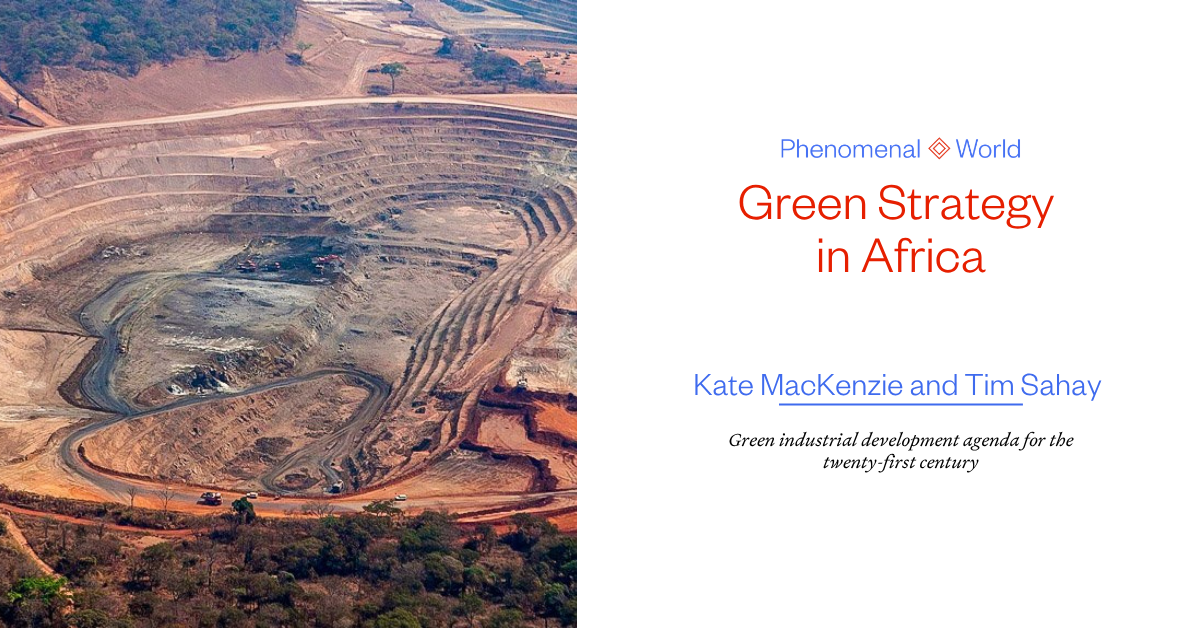
The scramble for cleaner energy, plus the trade wars and security tensions that have become a feature of today’s fragile world order, have helped to increase demand for transition minerals, many of which are produced by African countries. Historically, the bulk of these minerals have been exported raw, meaning that value-added processing is done abroad, and re
More recently, at least thirteen African countries have imposed raw mineral export controls, creating a pathway for downstream domestic industries to develop. The logic is straightforward: if the world needs African cobalt or lithium, it will need to refine it there, creating domestic jobs and building capabilities, rather than shipping raw ore to China where value will be added beyond the reach of Africans.
Indonesia, which began suspended raw nickel exports in 2014, and imposed a permanent ban in 2020, is the exemplar for many resource-rich African countries looking to develop their industries. After Indonesia introduced its raw nickel export ban, foreign investments in the country’s metal manufacturing industry soared, hitting over $12 billion by 2025. In 2014, before restrictions had been imposed, Indonesia was a net importer of processed nickel and stainless steel products; a decade later, it had become a thriving exporter.
The strategy has not been without some criticism, as plants have brought local pollution, driven coal-fired power demand, and led to the establishment of a Chinese–Indonesian smelting oligopsony. But the countries’ joint venture investments spanning smelting facilities, stainless steel production plants, and battery-and-EV industrial parks, have been part of a rapid transformation of Indonesia’s re
Resource-rich countries in Africa are taking note, and some are already beginning to successfully emulate the Indonesian model. Guinea, the world’s largest bauxite producer,restricted raw exports this year and is seeking to onshore its aluminium processing as well. In May, the Chinese aluminium company, Chalco, announced a $1.2 billion alumina plant in Guinea, with a 5 percent stake going to the government—with an option to raise it to 35 percent in the future. Several Chinese mining companies have begun building lithium processing facilities in Zimbabwe since the government there announced its own export ban in 2023. Elsewhere, the Democratic Republic of Congo has imposed export restrictions on its raw cobalt, not in a bid to move up the value chain per se, but to bolster the price of cobalt, the supply of which it dominates globally.
Future prospects
These reoordinated approach by the various mineral-rich nations would likely increase their leverage significantly. With the mining, processing, and ultimate use of most transition minerals linked to China, solidarity among smaller states is a powerful asset
The African Development Bank’s 2025 report was emphatic that regional integration is key to industrialization efforts. Importantly, stronger connections between countries could reduce the need to rely on more far-flung export markets. Moreover, sophisticated industrial development, especially if it’s to benefit smaller and poorer countries, will require collaboration to allow for specialization at scale. This has been the model of Southeast Asia, with its deep supply-chain links and free trade between ASEAN members. Intra-African trade is notoriously poor: the most commonly cited figure for trade within the continent is only about 15 percent—barely a quarter of the rate seen in Asia and Europe. Most “intermediate goods” produced in Africa are exported to Asia and Europe; only 13 percent go to other African countries.
Africa isn’t lacking integration initiatives. The African Union—comprising fifty-five states—was launched in 2002 in a bid to increase cooperation between members, and the African Continental Free Trade Area (AfCTFA) was established in 2019. But progress remains slow. The UN Commission on Trade and Development estimates that non-tariff barriers such as lengthy customs procedures, technical rules, and phytosanitary requirements restrict intra-African trade as much as three times more than import duties do. It also found that these barriers had eased only barely, if at all, between 2010 and 2021.
A shift in the public perception of foreign powers might yield potential for change. A recent survey of African youth found pragmatic support for Chinese investment, along with an appetite for holding their own governments accountable for economic hardship. Seizing opportunities from the chaotic global environment is a faint hope, but it’s not impossible that such chaos may spur political momentum to act opportunistically, or perhaps even to pursue more concrete regional solidarity.
Sub-Saharan Africa, Climate & Energy, Industrial Policy, Mining & Extraction
Further Reading
Sectoral Strategy
Free trade and the resurgence of industrial policy in Africa
Africa’s Century of Growth?
On Morten Jerven’s The Wealth and Poverty of African States
Economics, Bosses, and Interest
An interview with Stephen Marglin.
Further Reading


Sectoral Strategy
Industrial policy in Africa is back. Beginning last January, Nigeria moved forward with the second phase of its “Sugar Master Plan,” a flagship industrial policy…


On May 1, 2014, Nigeria’s then-president, Goodluck Jonathan, addressed a crowd of workers in the country’s capital Abuja. He declared that “the challenge of the…


Stephen Marglin is Walter S. Barker Professor Economics at Harvard University, where he has taught since he received tenure in 1968.
Maya Adereth, Shani Cohen, Jack Gross