As organisations navigate rapid technological change, evolving workforce expectations, and increasing business complexity, learning has become a strategic imperative rather than a standalone HR initiative. The challenge is no longer providing access to learning; it is creating environments where learning becomes part of how work gets done, leadership is developed continuously, and employees are empowered to grow throughout their careers.
At Quest Global, this philosophy has shaped the organisation’s approach to capability building. By combining technology-enabled learning with coaching, leadership involvement, and contextual development experiences, the company is creating a learning ecosystem designed to support business growth, leadership readiness, and long-term talent development.
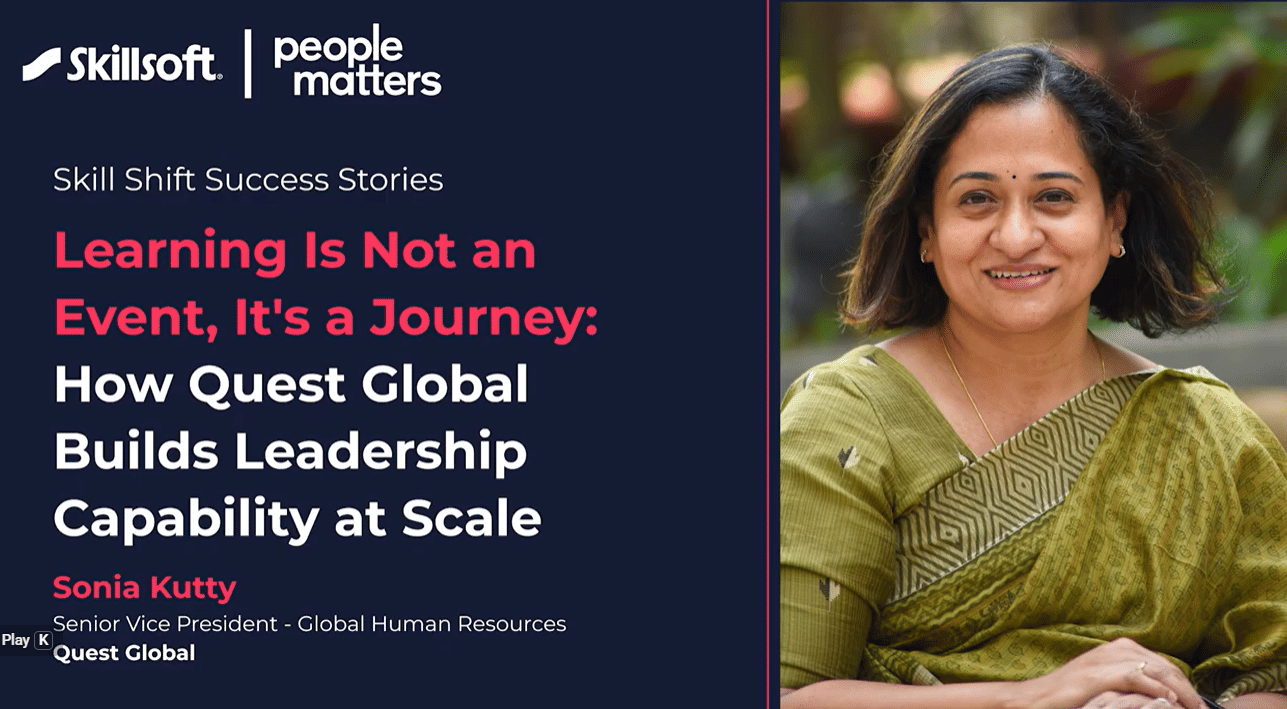
As part of the “Skill Shift Series”, a collection of transformative learning stories curated by Skillsoft and People Matters, Sonia Kutty, Senior Vice President – Global Human Relearning into the flow of work, strengthening leadership capability, and creating sustained engagement through a blended learning approach
For Quest Global, learning is closely linked to the organisation’s long-term growth ambitions. According to Sonia, the company’s learning strategy is guided by three critical priorities: building leadership capability, preserving organisational culture, and enabling continuous people development.
“If I take a step back and ponder over what we as an organisation are striving for, there are a couple of things that are top of mind. One is the need for leaders to come up to speed quickly and build a robust leadership pipeline. The second is nurturing and preserving what we treasure as the Quest Global culture. And third would be people development in all its true colours, in terms of where people are today and where they want to be.” Sonia said
These priorities have influenced how Quest Global designs its learning experiences, ensuring that development initiatives support both individual growth and organisational objectives. Within this framework, Skillsoft has emerged as a key partner, particularly in strengthening leadership development capabilities across the organisation.
“For us, Skillsoft has been an able partner in making this journey happen, particularly with leadership development as a core tenet. We’ve been able to draw on Skillsoft’s strengths to ensure our people are equipped for their personal growth journey,” she said.
One of the key lessons Quest Global identified early was that learning cannot be treated as a one-off event. Sustainable capability building requires embedding learning into everyday work and reinforcing it through multiple experiences over time.
“The whole learning ambit is not a once-in-a-while instance. It has to happen as a journey. It has to be more in the flow of work for it to become effective,” Sonia said.
To address this challenge, the organisation adopted a blended approach that combines digital learning with coaching, facilitated interventions, and experiential development opportunities. Rather than relying solely on online courses, Quest Global focuses on creating continuous learning experiences that reinforce knowledge and encourage application.
“What Skillsoft gives us is the ability for people to learn at their own pace. They can choose to watch, hear, or experience something to make the journey more impactful. But for us, the curation has been about amplifying that experience with trainers, coaches, and other interventions so that it becomes more blended and more continuous.”
This flexibility has enabled Quest Global to tailor learning journeys to different audiences while ensuring development remains relevant and accessible.
For many organisations, maintaining learner engagement beyond the initial launch of a program remains a persistent challenge. Quest Global has found that sustaining momentum requires a combination of approaches rather than reliance on a single platform or intervention.
“Learner engagement is one of the toughest things. While the journey starts with good intentions and enthusiasm, it’s very difficult to maintain that momentum. Just having one tool doesn’t really help,” she said.
Instead, Quest Global uses a mix of learning channels that complement each other. These include external subject-matter experts, executive coaches, internal leaders serving as teachers, and digital learning re
“Our way of working around this is to make sure that what we are trying to achieve is provided through various media and interventions. One stroke does not usually work in isolation. It has to be continued, interspersed over time, and that’s what gives us the benefit overall.”
A partnership built around flexibility and outcomes
For Quest Global, the partnership with Skillsoft is designed around enabling learning outcomes rather than simply providing access to content. According to Sonia, the collaboration has been characterised by a shared focus on business outcomes and a willingness to customise learning experiences to organisational needs.
“When we were designing our leadership development initiatives, we worked closely with Skillsoft on our intended outcomes. Their understanding of what is available on the platform helped us identify what would be most relevant for our people.”
She also highlighted Skillsoft’s collaborative approach as a key differentiator.
“Skillsoft’s openness and flexibility with respect to how you get to an intended goal using different reing ecosystem have been very useful,” Sonia said
Quest Global has also begun incorporating new capabilities, such as Skillsoft’s AI-powered simulations, into its learning architecture, providing learners with more interactive and practical development experiences.
While participation and engagement remain important indicators, Quest Global places equal emphasis on understanding whether learning translates into meaningful behavioural change and business impact.
“Engagement and adoption are the first things we look at. But equally important is understanding the benefit and ROI we are getting from the investment.”
To achieve this, the organisation gathers feedback from both participants and their managers and conducts follow-up assessments several months after learning interventions are completed.
“We check back after six months and ask: Has this actually stuck? Are the behavioural changes we intended to happen actually visible on the ground?” she said.
This focus on long-term application helps ensure learning investments contribute to measurable organisational outcomes rather than simply course completion metrics.
Perhaps the most important factor in Quest Global’s learning success has been leadership involvement. Sonia believes leaders play a pivotal role in shaping learning culture by demonstrating their own commitment to growth and development.
“Leadership behaviour and leadership espousing the value of learning and becoming a better version of oneself goes a long way in influencing what people actually do on the ground,” she said.
The organisation has found that learning initiatives gain significantly greater traction when leaders actively participate, share their own experiences, and reinforce the importance of continuous development.
“Our most effective learning interventions have been where a leader has spoken about the value of learning or shared a personal experience about overcoming a challenge or learning something new. We have consistently seen higher adoption in those situations.”
For Quest Global, leadership is not simply a sponsor of learning—it is an active participant in creating and sustaining a culture of growth.
The road ahead
As organisations continue to navigate an increasingly dynamic business environment, Quest Global’s experience highlights an important reality: learning cannot be treated as an activity that sits alongside work. It must become part of how organisations operate, develop talent, and prepare leaders for the future.
Reflecting on her biggest learning as a development leader, Sonia offered a simple but powerful reminder.
“Learning is a continuous journey, and it is a personal one at that. No two people learn the same way. As organisations, we have to continually innovate to make learning part of how we operate. The moment learning becomes something ancillary, we lose the case.”
For organisations looking to build resilient, future-ready workforces, that lesson may be more relevant than ever.
This is part of the Skill Shift Series, in which Skillsoft and People Matters explore how companies are redefining learning to bridge the skills gap and drive business impact.
Learn how Skillsoft Percipio can transform your organisation’s learning journey today!